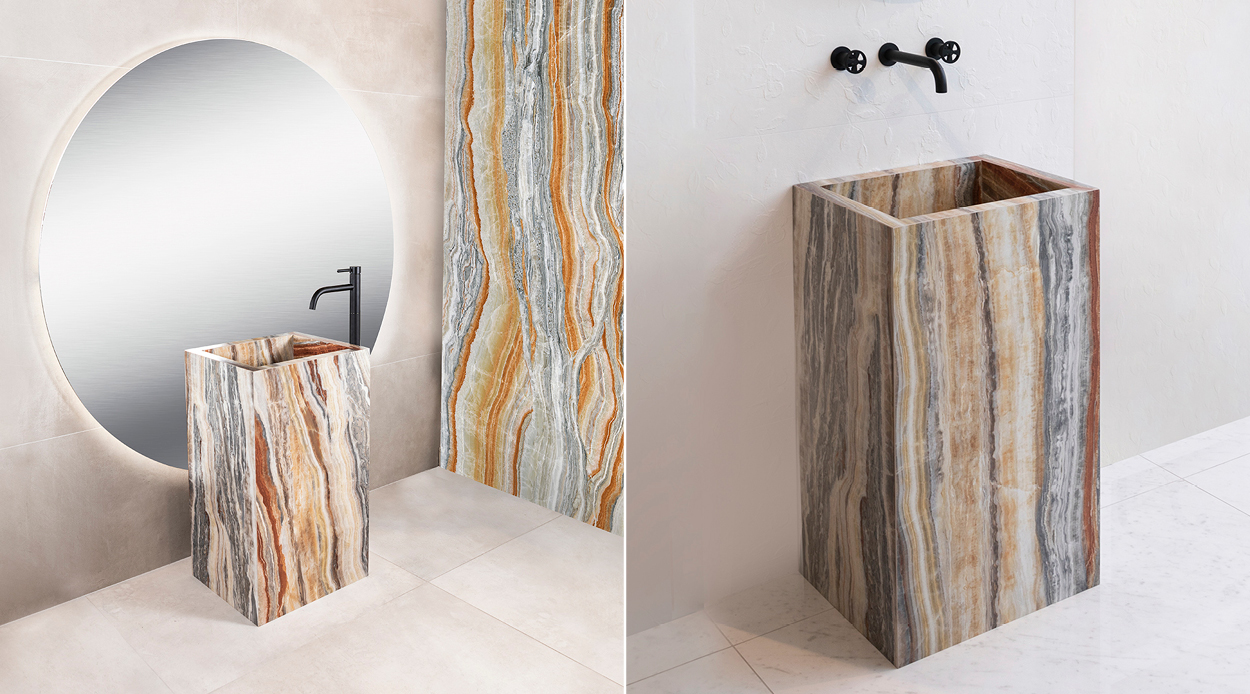
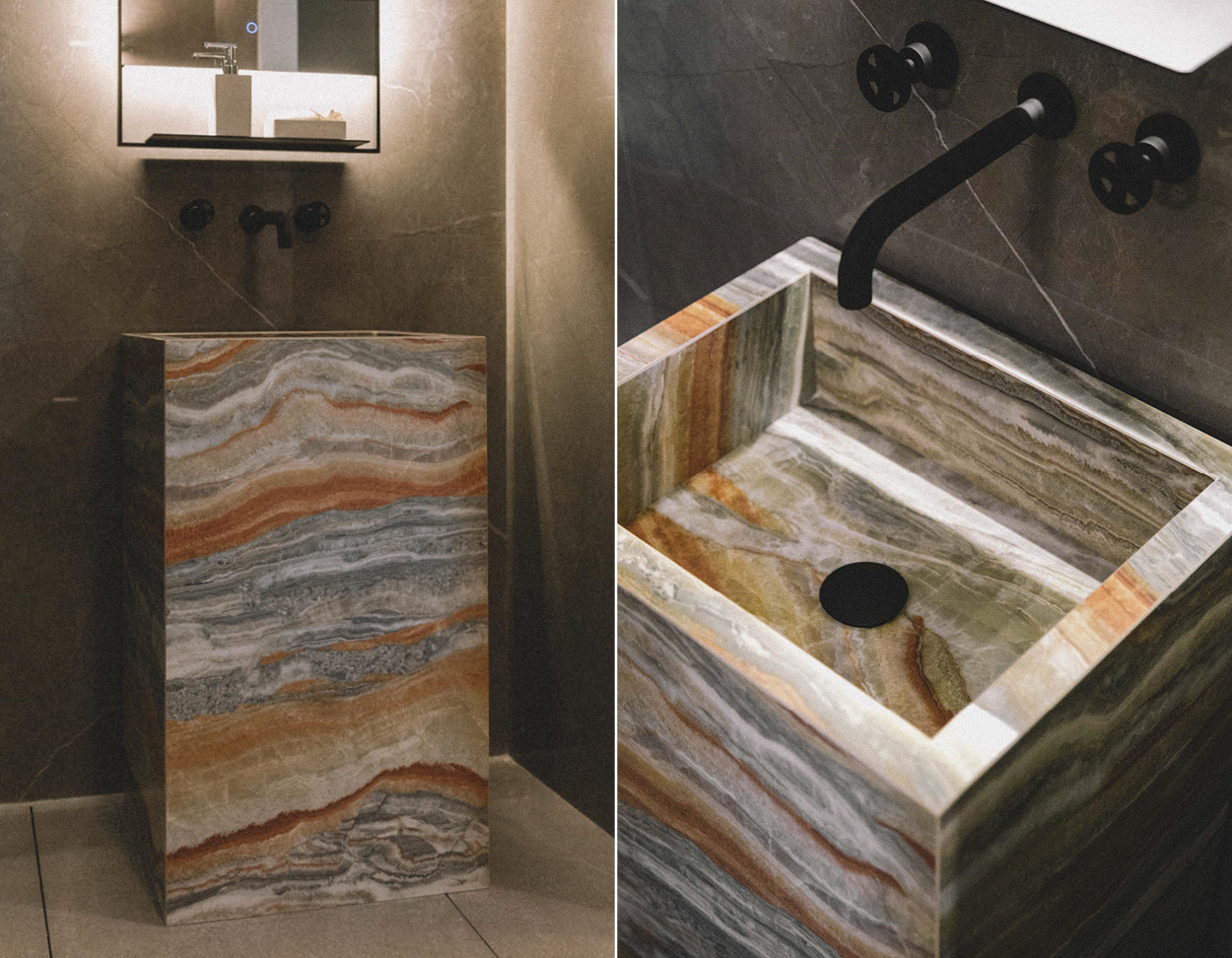
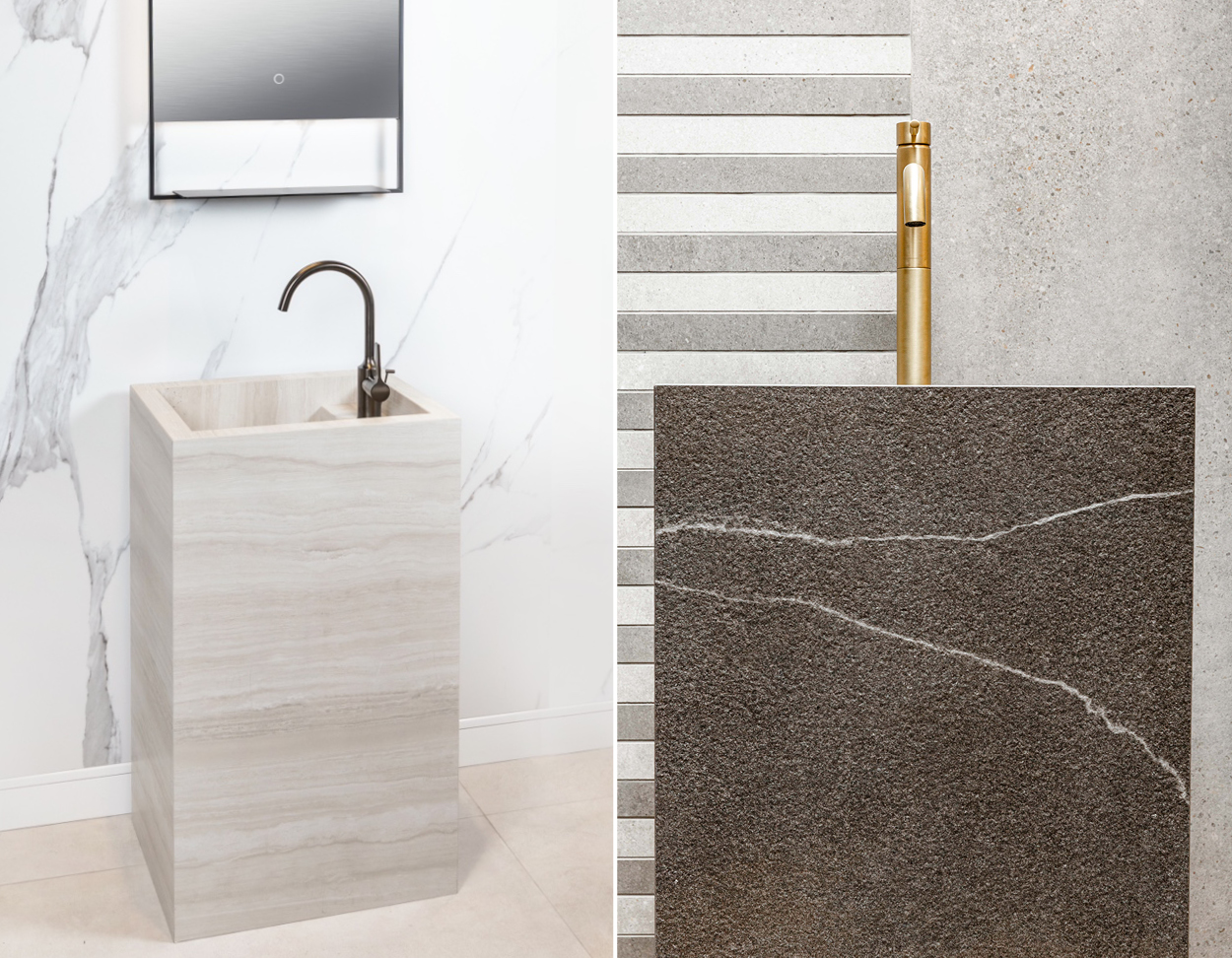
There is something about the minimal lines of a freestanding basin that makes any bathroom feel sleek and inherently contemporary. Able to make your bathroom feel elevated, luxurious and design-focused, the freestanding basin is usurping its more practical counterparts thanks to the unmistakable aesthetic it delivers, and nowhere have we encountered a better iteration than the Meribel, from Robertson Bathware.
Boasting a solid, rectangular shape with straight lines undisrupted by fussy details or shelving, this basin features high-quality, Italian porcelain tiles attached to glass fibre reinforced board, which results in a piece that not only looks good, but is hardwearing enough to withstand its inevitable daily use.
Whether your bathroom adheres to the classic, monochromatic palette (white tiles and white porcelain with silver or black fixtures) or embraces a more colourful, richly-detailed look, the Meribel is available in a range of finishes (from undulating marble to dark grey concrete), promising to make a bold design statement in any kind of space.
And beyond aesthetics alone, this style of basin makes the collection of benchtop detritus basically impossible, resulting in a level of necessary cleanliness and organisation that promises to put the messy bathrooms of old to shame. (Or that’s the idea, at least.)
The perfect way to change up the look of your space without committing to anything too dramatic, the Meribel Freestanding Basin is a piece that will deliver a luxurious edge to its more practical surrounds, showcasing how something so simple can make such a significant impact.
Whether you’re relaxing or on the go, tuning into a podcast is always a pleasant pastime, particularly if you’re in the mood for some entertainment, education, or a fresh and interesting viewpoint that challenges your perspective on the world.
We’ve rounded up the highly-anticipated and best new podcasts to listen to this September, so have your headphones at the ready, and be prepared for some excellent playlist inspiration that will have you coming back for more.
Borderline Salty In this new, weekly call-in podcast, hosts Carla Lalli and Rick Martinez talk all things food. From their latest ingredient obsessions to their thoughts on trends, this is a show for anyone with an interest in food, whether you’re a professional, an amateur or simply love to eat.
Mother Country Radicals Offering a deep-dive into The Weather Underground (a radical activist group from the 1960s) and its role in America’s cultural and social revolution, this podcast is a personal, politically charged exploration of those who wanted change, by any means necessary.
Look at Moi Marking 20 years since foxy morons Kath and Kim burst onto our screens, this fun new podcast sees host Rowie Walden joined by various special acquaintances on a nostalgic trip back to Fountain Lakes to unpack one of the most iconic Australian television shows of all time.
Griftonomics An exploration of the various online trends, metaverse start-ups, cryptocurrencies, get-rich-quick schemes and more defining the landscape of our digital age, this podcast looks to provide some necessarily real conversations that cut through the ‘dizzying, unending roster of 2020-era rackets.’
First Person This new podcast from The New York Times, offers intimate, personal conversations with people living the realities behind our headlines. From a gay Ukrainian solider who must suppress his sexuality to fight for his country, to a woman’s reconciliation with abortion, this podcast is thoughtful and moving.
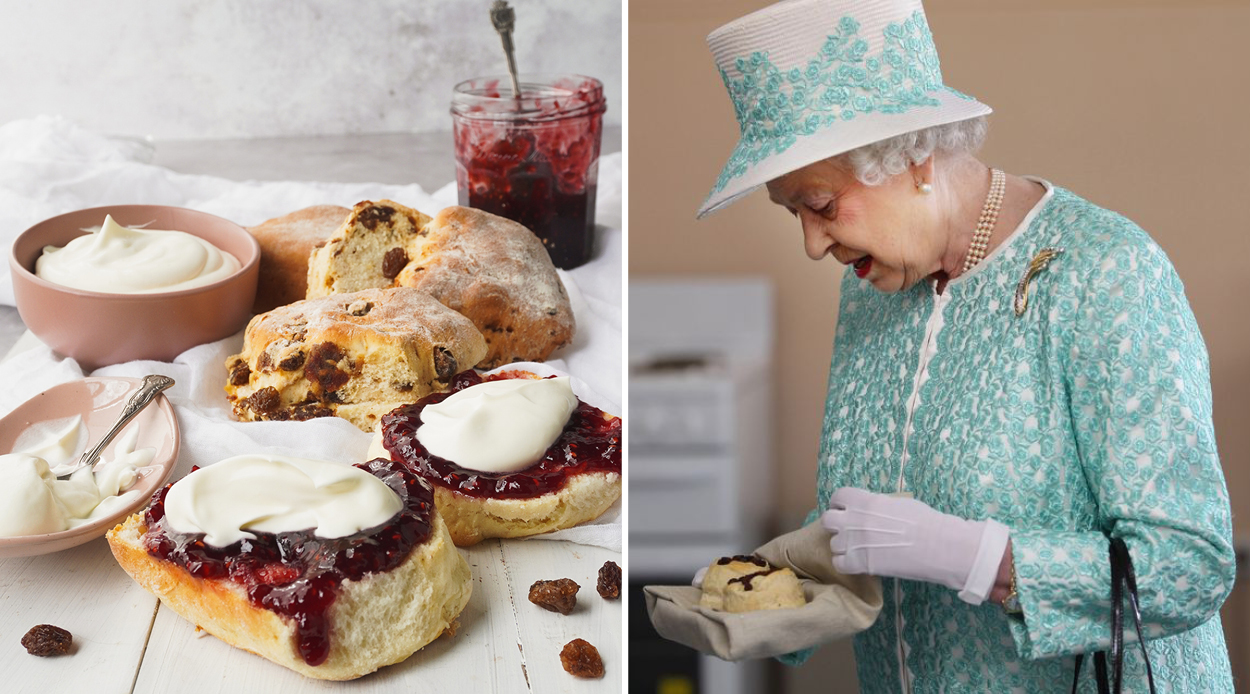
The classic scone is about as British as the Union Jack, no matter which side of the ’cream or jam first’ debate you fall on. (Queen Elizabeth II would always put the jam on first, by the way.) In fact, scones have apparently been served in cream teas since the 11th Century, their origins often credited to Scotland and Wales.
Technically considered more of a pastry, the humble scone has become a savoury mainstay in any high tea worth its salt — and while today, the cheese scone is arguably the most popular iteration of this dish (certainly the most common found in cafes across Auckland), it is the plain version, speckled with sultanas and topped with cream and jam that is the most traditional (and Crown approved).
So this weekend, as we all take an extra day off to honour the memory of Britain’s longest-serving monarch, why not take some time to whip up a batch of these fluffy, delicious scones at home? A bakery staple so important to the late Queen that, in 1960, she famously sent her very own recipe to President Eisenhower on a series of handwritten notes.
So, without further ado, we present the Queen’s own recipe for decidedly royal scones. Enjoy!
Ingredients 500g plain flour 28g baking powder 94g butter 86g sugar 2 whole eggs 140ml buttermilk 100g sultanas (optional, cover in hot water and leave to soak for 30 minutes)
Method 1. Preheat oven to 180C. 2. Mix the flour, baking powder, butter and sugar together in a bowl until a crumb is formed. 3. In a separate bowl, whisk the eggs and buttermilk together. 4. Add the liquid to the crumb mixture. Leave a small amount to egg wash later. 5. Continue to mix the dough until it is smooth. 6. Add the sultanas and mix until evenly distributed (optional). 7. Remove the dough from the bowl, flatten the dough and cover. 8. Leave to rest for approximately 30 minutes. 9. Roll out the dough to a thickness of 2.5 cm and cut to desired shape. 10. Rest the scones for another 20 minutes. 11. Gently egg wash the top of the scones. 12. Bake in the oven for 10-12 minutes until golden brown. 13. Cool before serving with jam and clotted cream.
As much as one’s jewellery collection should include conversation-starting pieces, it should also be curated with daily wear in mind. After all, most of us want to keep our special pieces close. So, when a brand creates head-turning jewellery that also feels inherently wearable, we sit up and take notice.
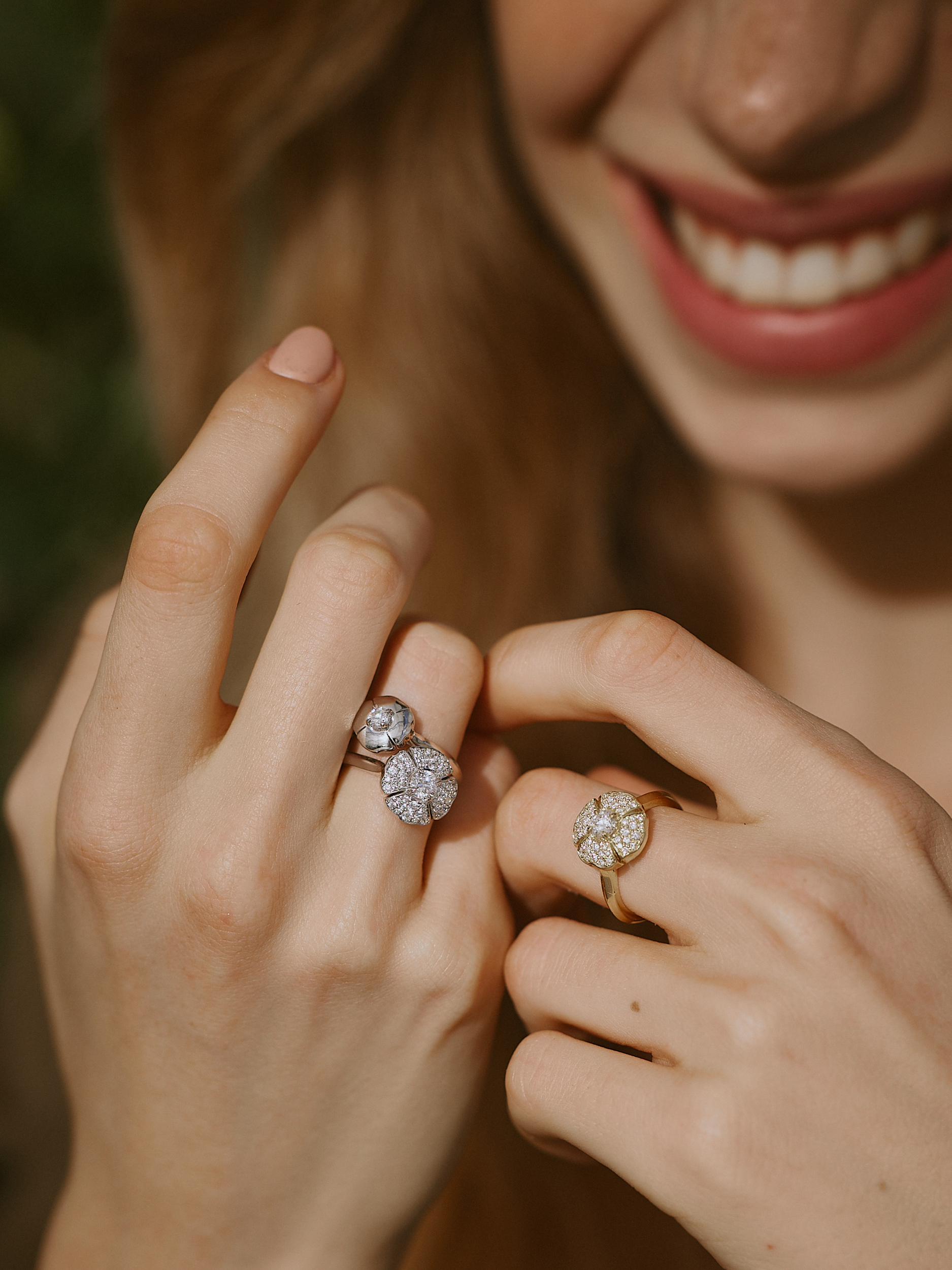
For local purveyors of iconic jewellery Naveya & Sloane, this idea is something that has long been at the forefront of its coveted collections — exquisite and timeless jewellery with enduring quality. Nowhere is this more clear than in the brand’s beautiful new collection, Romeo Flower, a line-up that captures ‘the essence of life’s breathtaking experiences that words can’t describe’, inspired by simple, organic forms, like a flower in bloom.
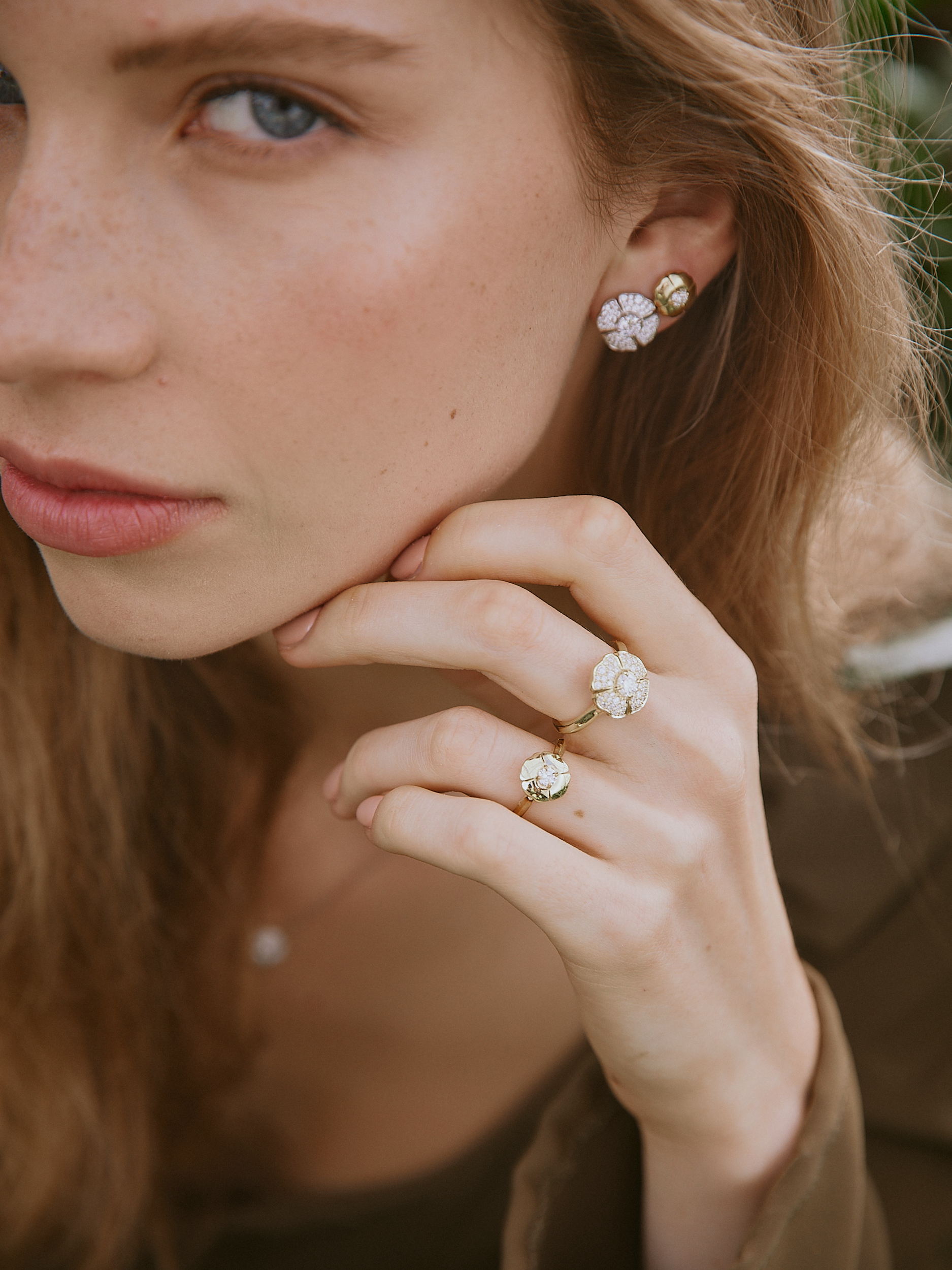
Grand Pave Ring in 18K Yellow Gold, with Petit Solid Ring in 18K Yellow Gold. Grand Pave Earrings in 18K White Gold, with Petit Solid Earrings in 18K Yellow Gold.
Conceived in lockdown 2020 while the brand’s Co-Founder and Creative Director, Rachel Sloane was dreaming of blooming spring days and the arrival of her firstborn, Romeo Flower grew from ideas of floral forms like the Winter Rose, a flower gifted by her mother when her daughter Amelie was born.
“I wanted to create a collection that was so beautiful, it would stop people in their tracks,” Sloane explains. “Similar to the feeling of coming across a beautiful flower in nature. A simple moment of pure magic and divine beauty — where time stands still and the moment takes your breath away.”
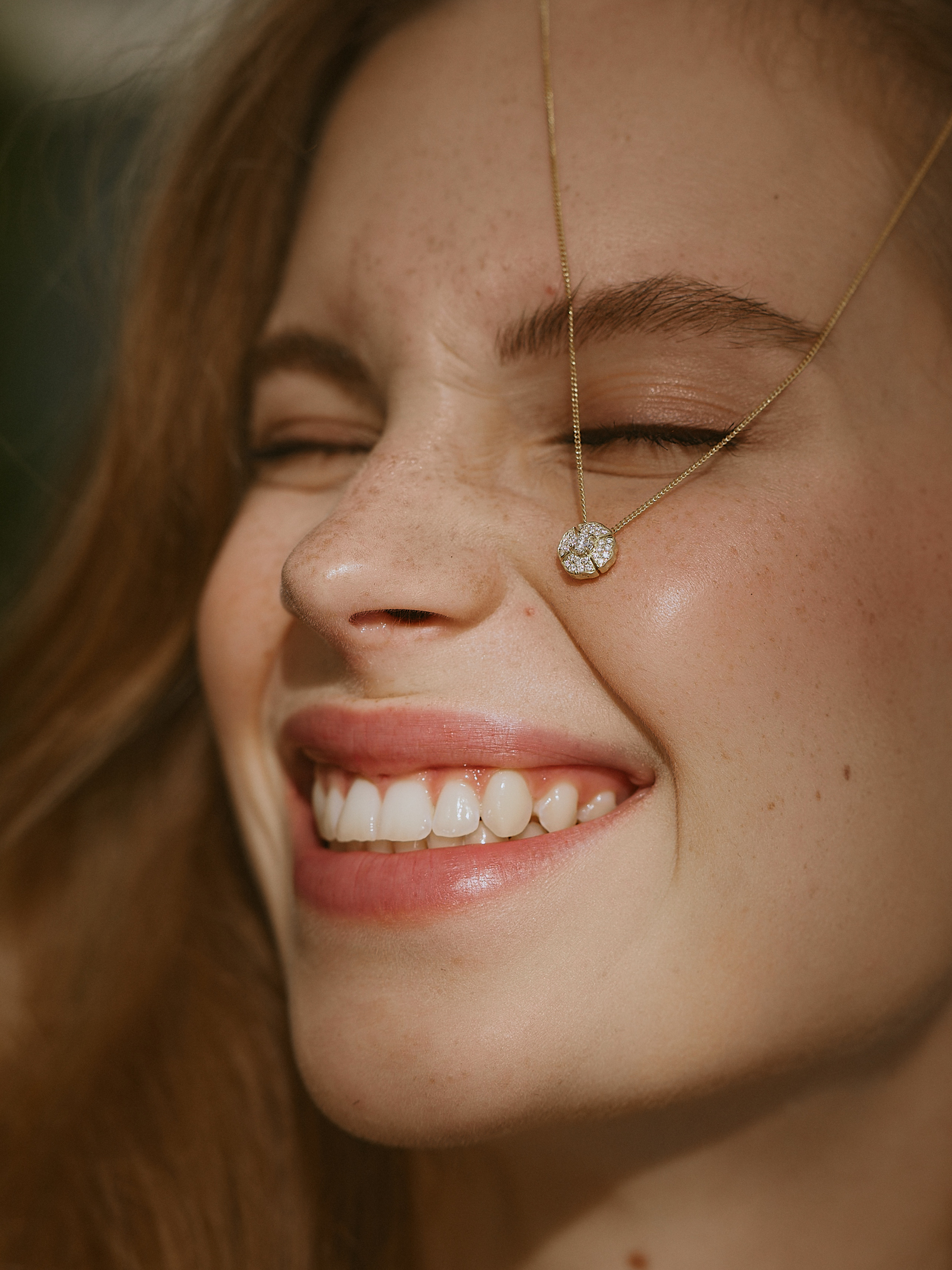
Petit Pave Necklace in 18K Yellow Gold.
Launching with 12 pieces, Naveya & Sloane’s new collection reimagines the classic floral jewellery trope with its domed flower motif, in which four structured Matisse petals are connected by a sparkling, central diamond and rendered in either 18 karat yellow or white gold or, for some selected pieces, entirely encrusted in diamonds. Here, the pieces offer a subtle nod to old-world glamour while still feeling aligned with the contemporary luxury that has become so synonymous with the brand’s designs, balancing ornamental details and modern finishes with skilful finesse.
Grand Pave Ring in 18K Yellow Gold, Grand Pave Ring in 18K White Gold, Petit Solid Ring in 18K White Gold.
By its very nature, Romeo Flower is a fine collection with wearability at its heart, where dainty pendants, intricately detailed, diamond-adorned rings (as perfect for stacking as they are on their own) and understated earrings stand as the kinds of pieces you could wear for days without taking off.
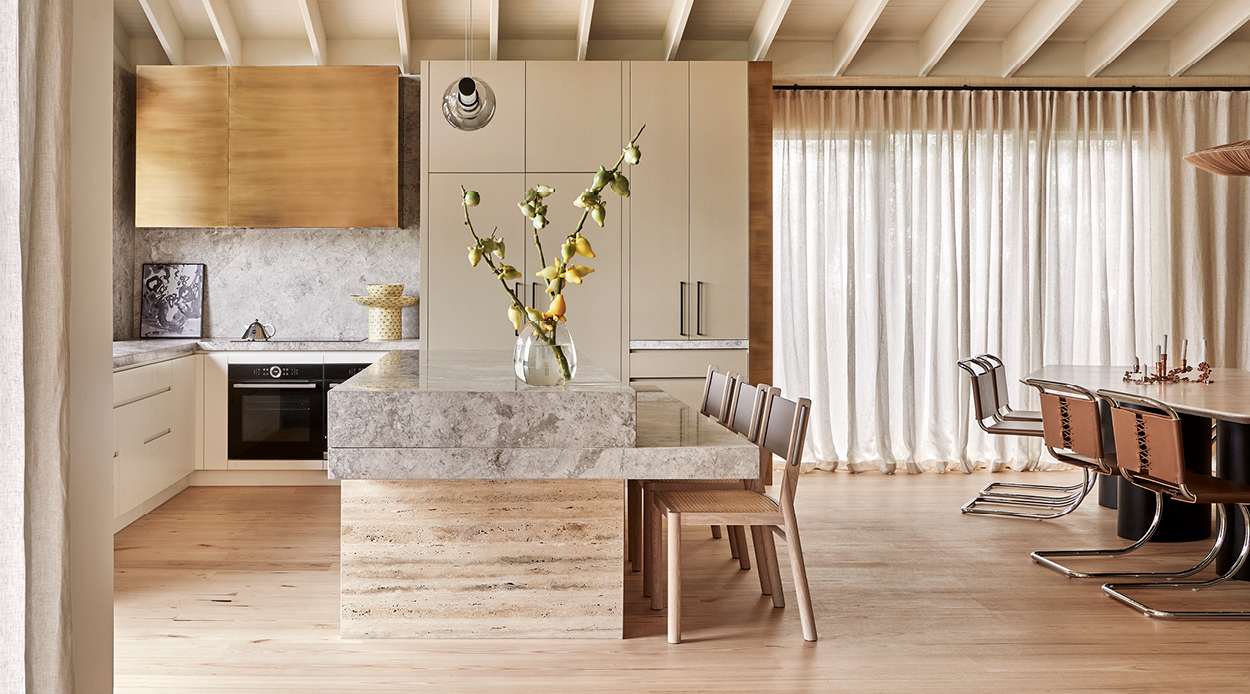
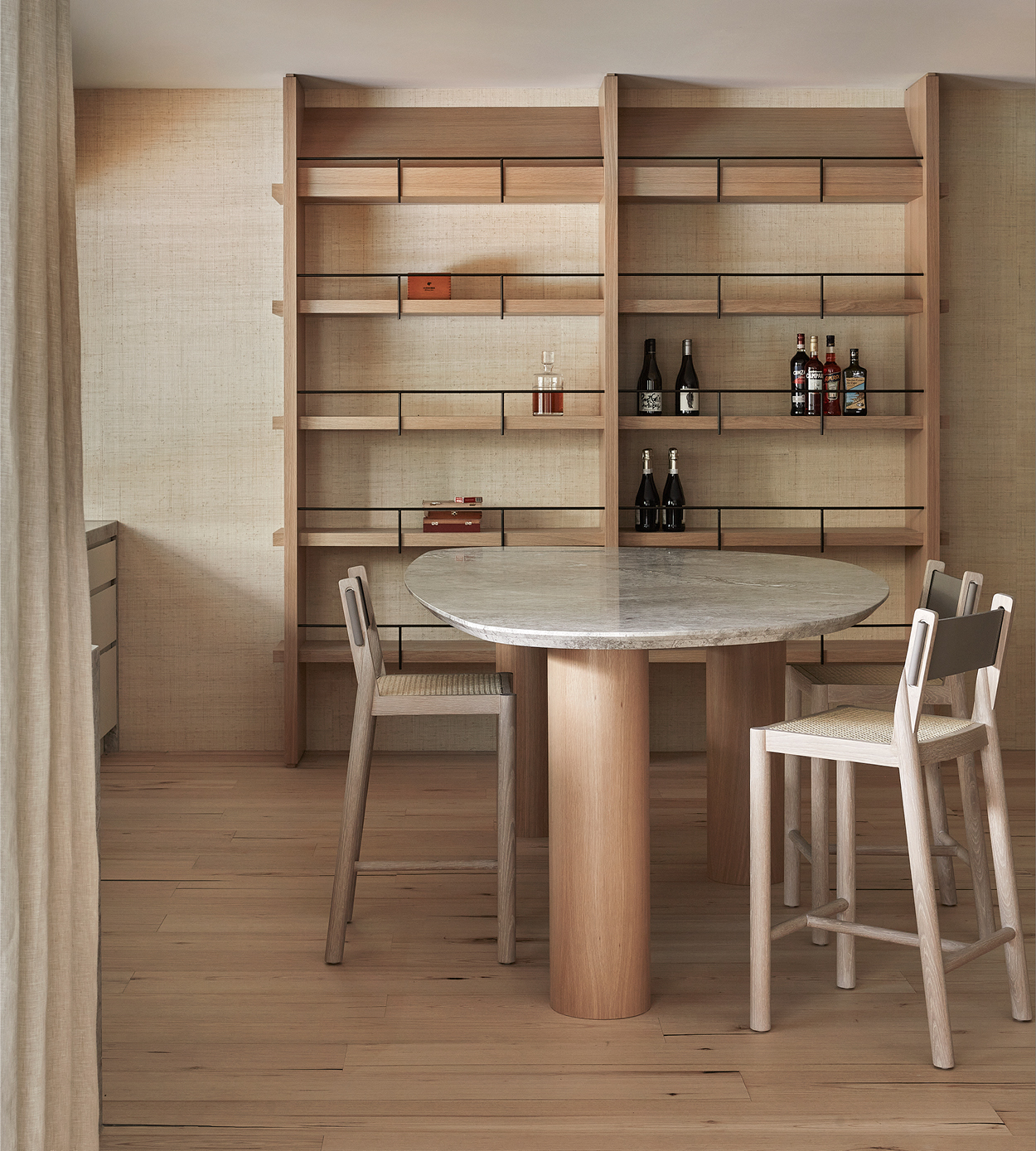
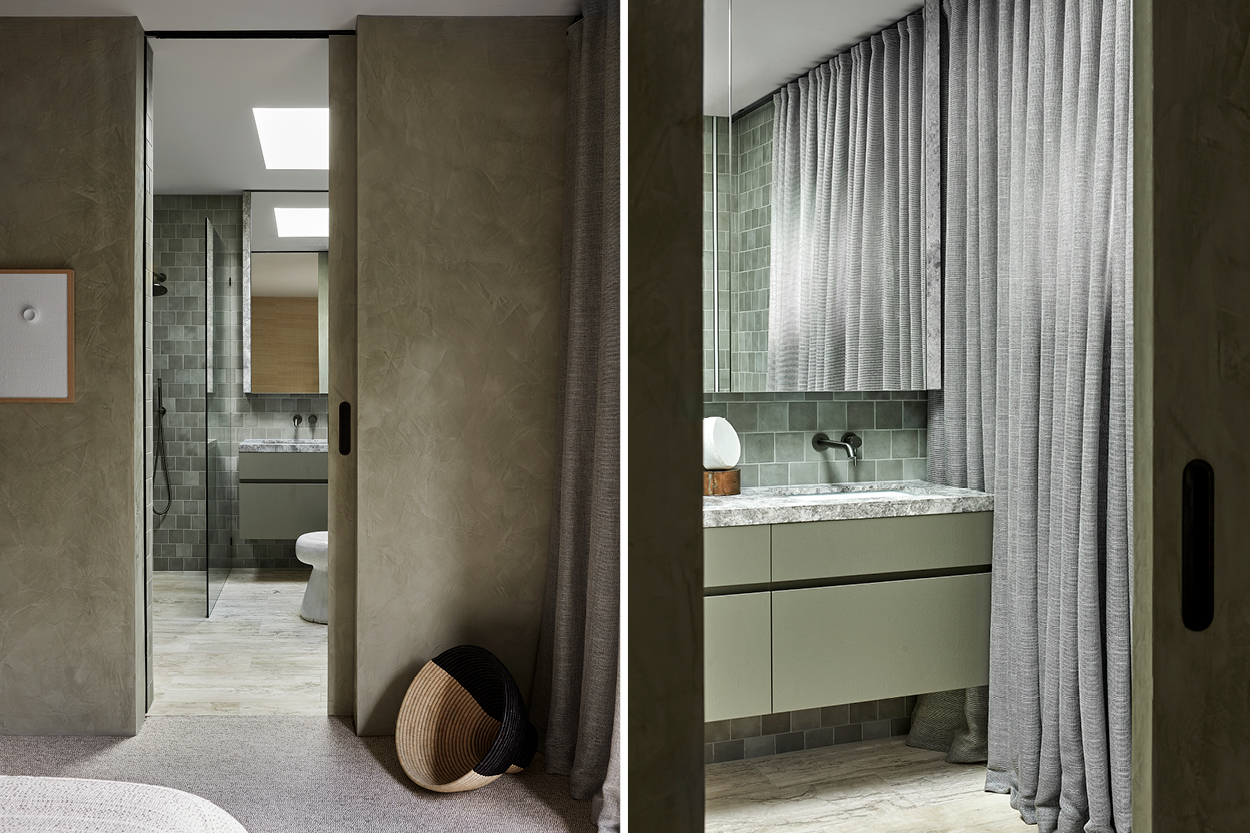
In reimagining the interiors of this residence in Sorrento, Fiona Lynch used the calm, coastal surrounds to inform her design. Taking the bones of this two-storey Merchant Builder-style home (originally constructed in the 1980s) and treating them to an extensive re-fitting, not only did the lauded designer create a sumptuous retreat to fit the client’s brief of pared-back, private sophistication, but she delivered a masterclass in modern minimalism.
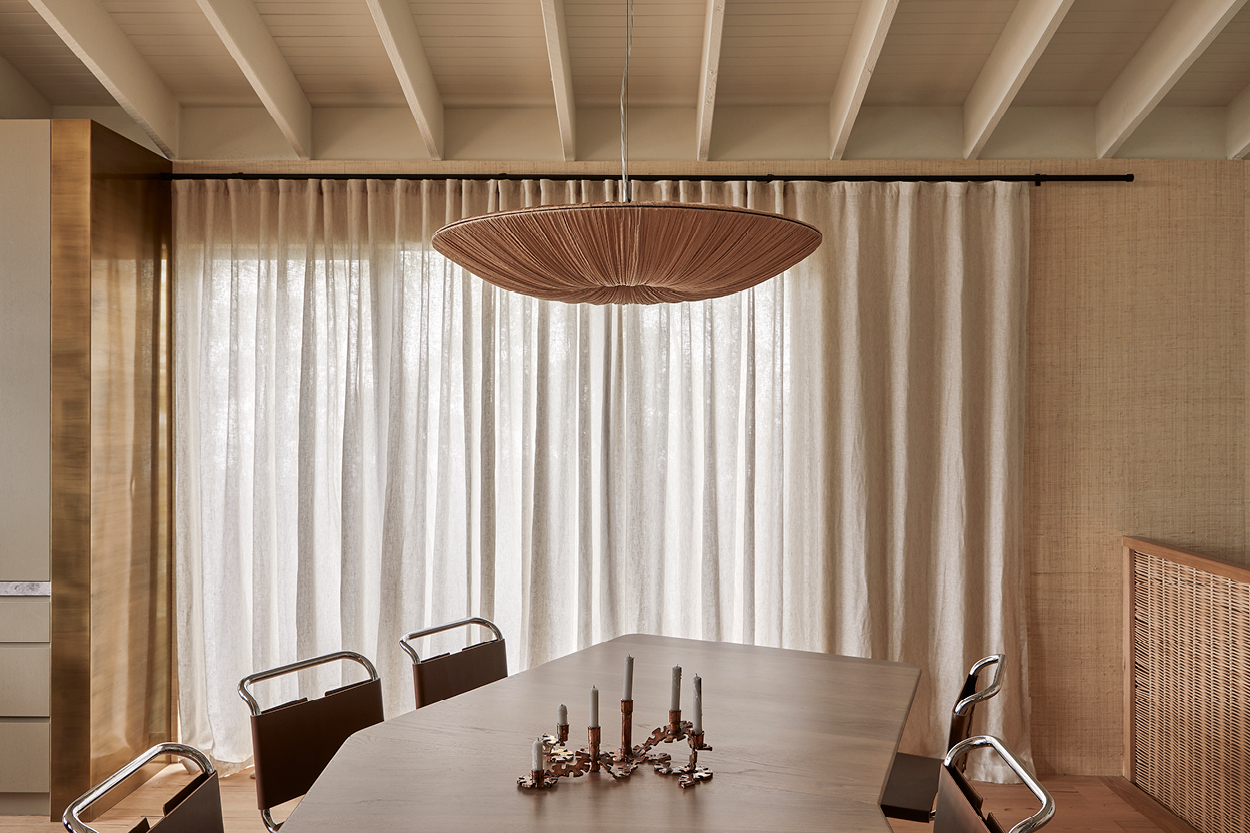
Luna Chandelier 1 Tier pendant by Gabriel Scott from ECC.
Seeking to change the feel of the existing space without altering much of its structure, Fiona Lynch ensured the home was fit for the needs of its residents by removing a dated former renovation and making small changes via clever spatial planning and expert material layering. Proving how a little can go a long way, the designer’s use of textural wall treatments, organic and porous materials and impactful artworks in key positions created tranquil spaces that feel strong and inviting, all while evoking a sense of sumptuous luxury.
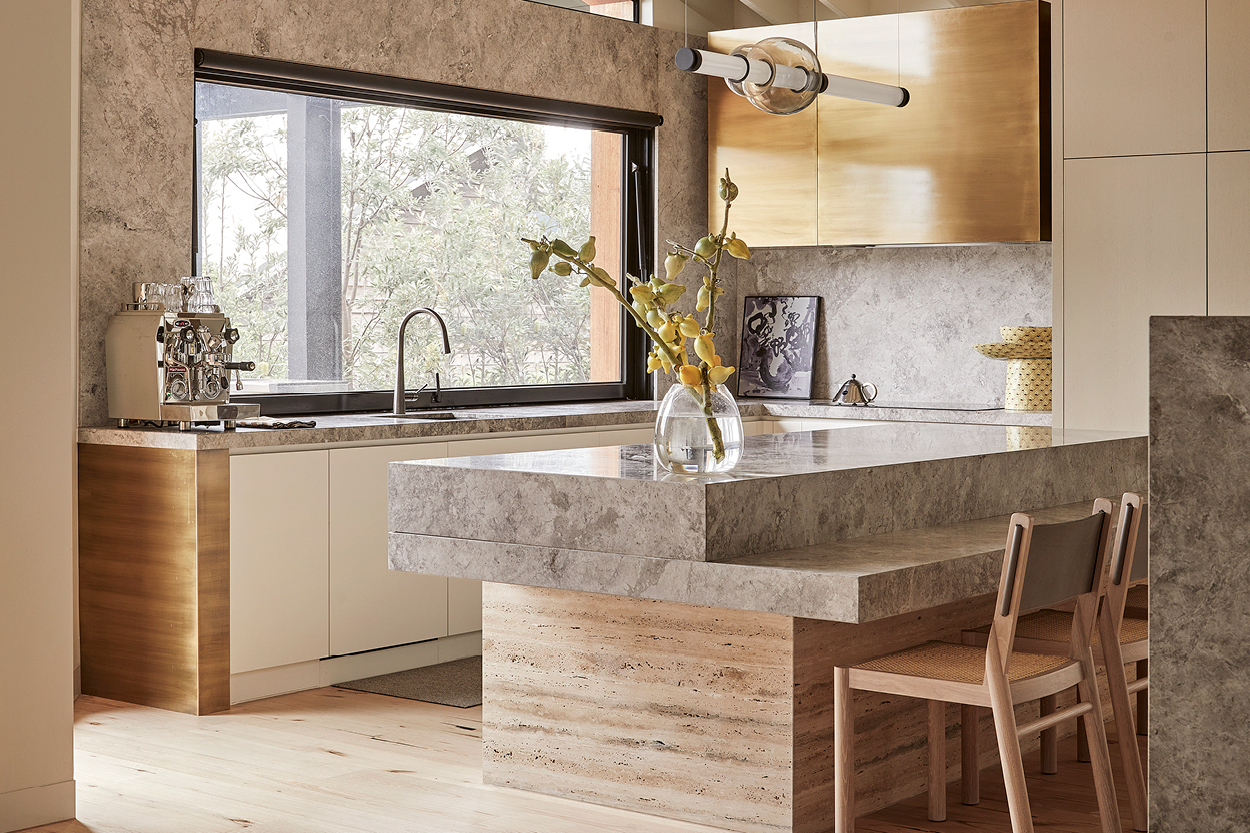
In the kitchen, for instance, a central island with a mottled limestone top and stoic travertine base is positioned to allow those enjoying a morning coffee to take in the view through the large window opposite. Careful not to sacrifice form to function, the designer conceived the kitchen as a space both befitting of family time and socialising as well as somewhere that would be practical for everyday pursuits. Here, polished brass joinery is used to deliver a golden warmth that one can only imagine would come to life when bathed in natural sunlight.
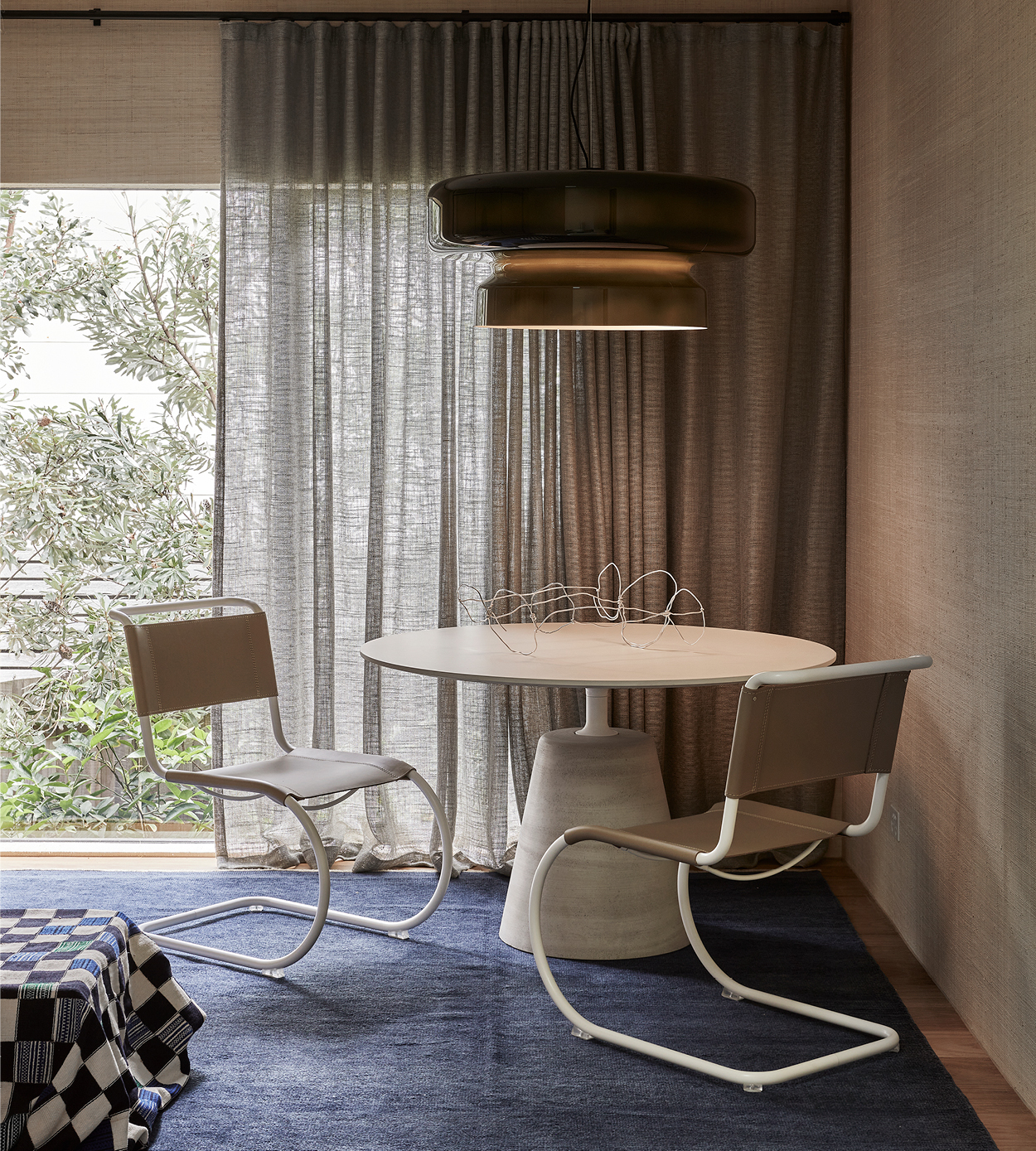
Mr Chair by Mies van der Rohe for Knoll available from Studio Italia.
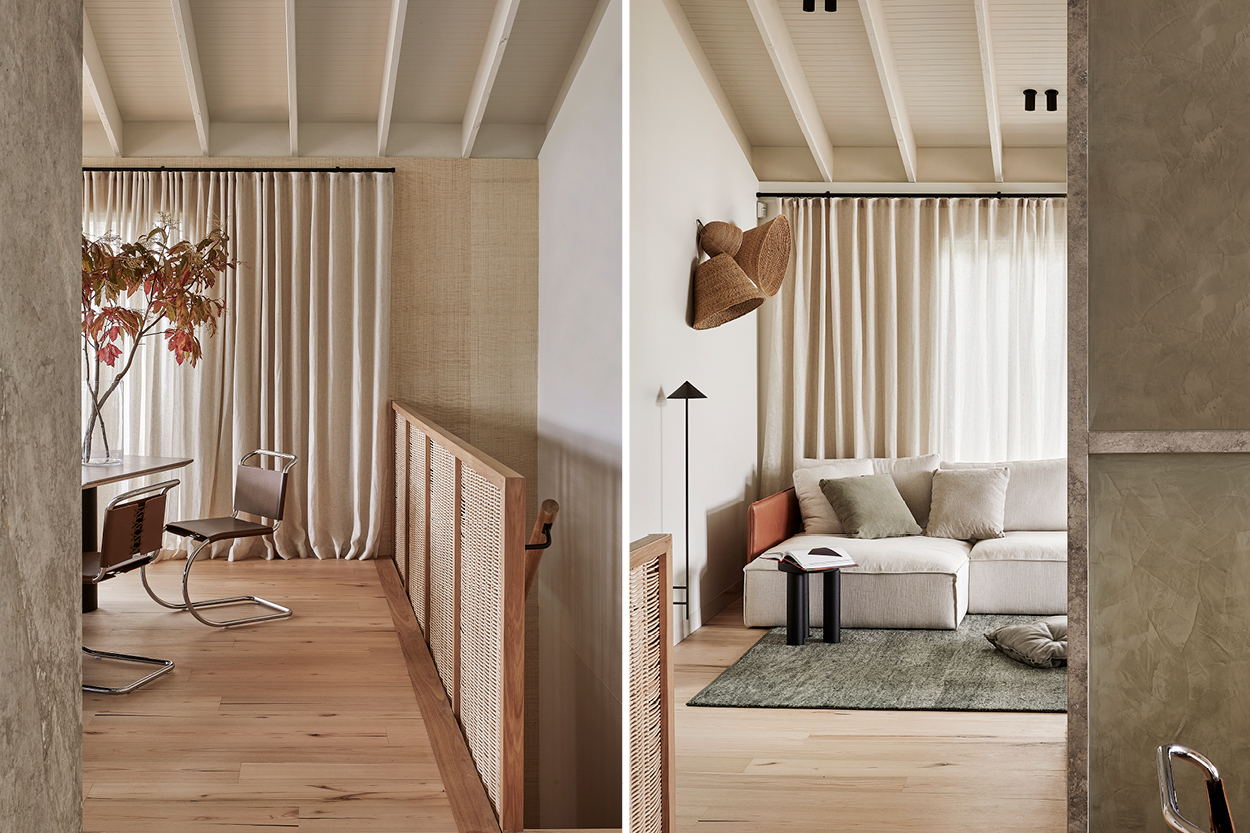
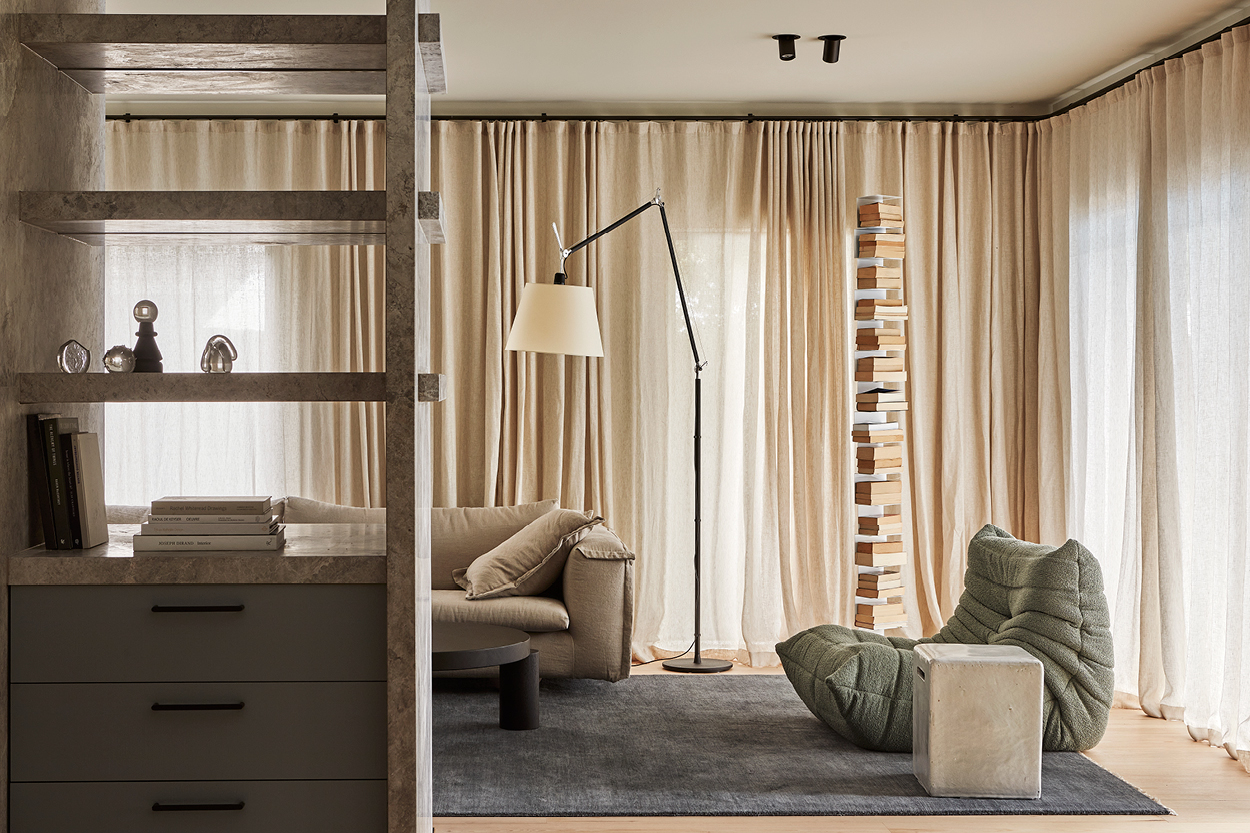
Tolomeo Mega Terra floor lamp by Artemide from ECC, Togo Fireside chair by Michel Ducaroy for Ligne Roset, Offset coffee table by Resident from Simon James, Inout side table by Gervasoni from ECC.
Elsewhere, the living areas present as the perfect places to spend days reclined on a lounge or curled in a favourite chair, where softly-draped, open-weave linen curtains diffuse the daytime light and offer privacy and warmth, while furnishings like Ligne Roset’s Togo (upholstered in an earthy green that reflects the natural exterior landscape) invite rest and relaxation. Original details like raking ceiling beams and a fireplace have been retained and given new life; the former a coat of fresh paint, the latter ensconced in stone and polished plaster.
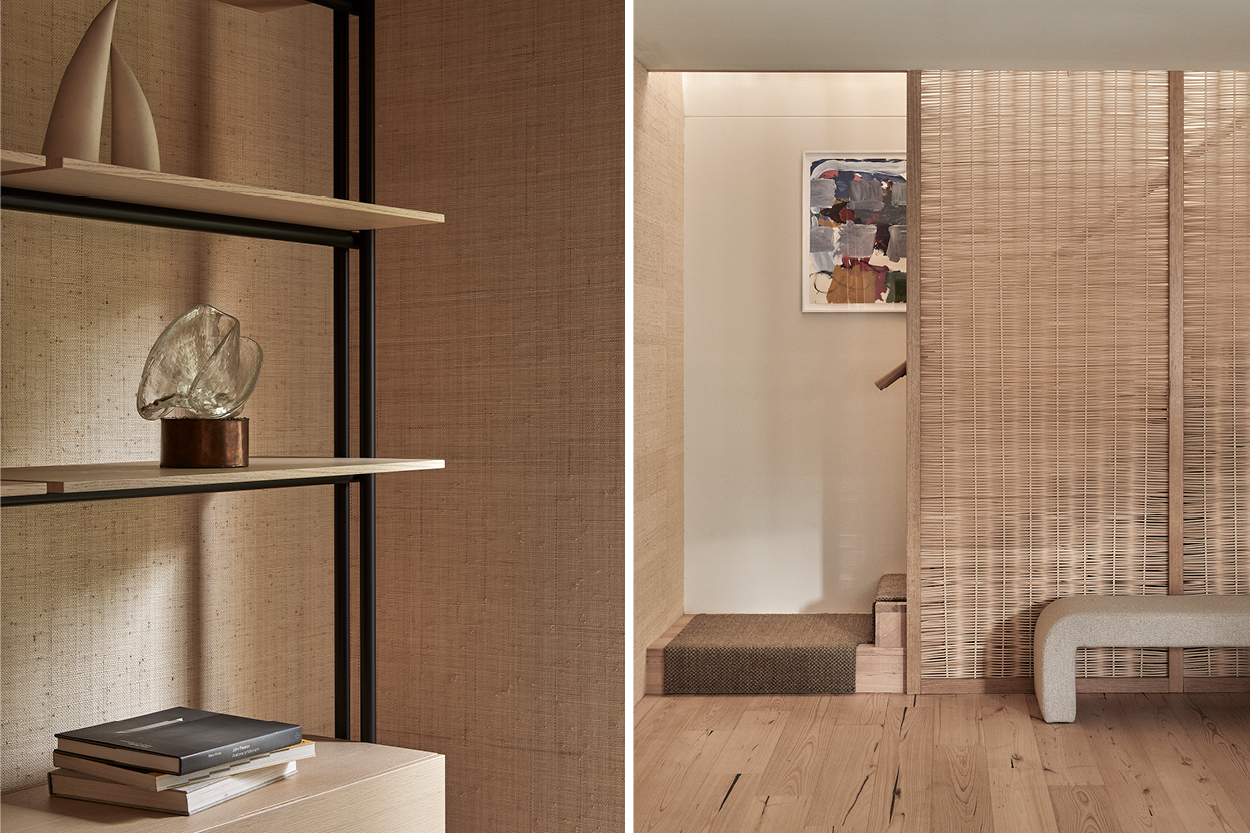
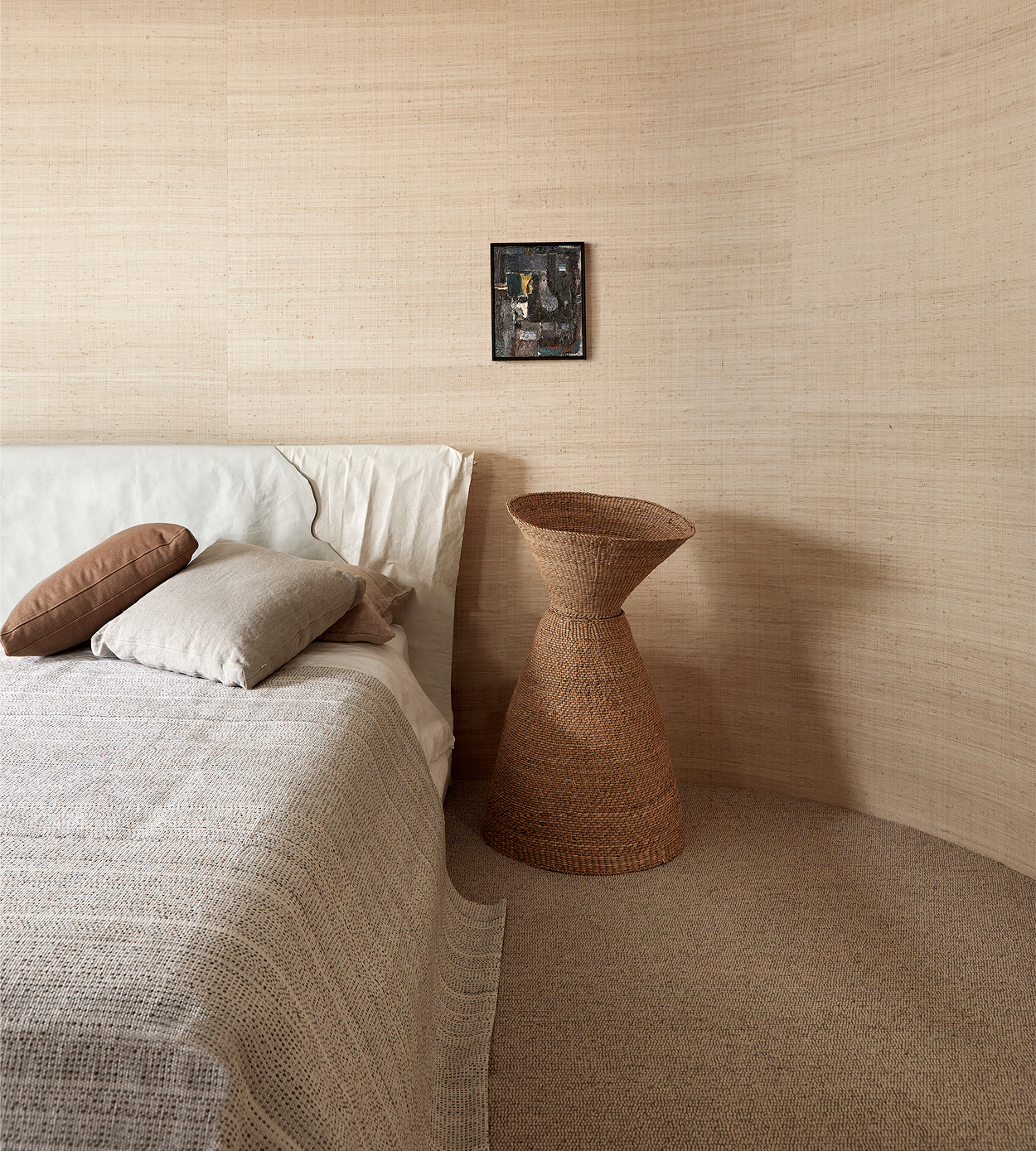
In fact, polished plaster is one of the materials that Fiona Lynch uses generously to lend depth and dimension throughout this home, an effect that is only bolstered when combined with woven wicker screens, pale timber, textured raffia wallpaper and a palette of calming pebble hues, sandy tones and chalky greens. In the bedrooms and bathrooms these tones and textures are used to calming effect, where subtle design statements are the ideal foundations against which injections of art and key furniture are showcased. And despite there being an overall sense of luxury, nothing feels ostentatious or attention-grabbing, which is what makes this residence so appealing.
Fiona Lynch has done an exceptional job at marrying hard materials with soft finishes, offsetting angular, sharp lines with rounded walls and using elements like solid timber and natural stone in an understated way. The Sorrento House is, as a result, an alluring example of restrained design. It embodies modern minimalism because it is warm and simple; layered but ultimately pared back. And while it’s a hard line to walk, Fiona Lynch does so with an expert hand and clever eye, creating a home on the coast to covet.
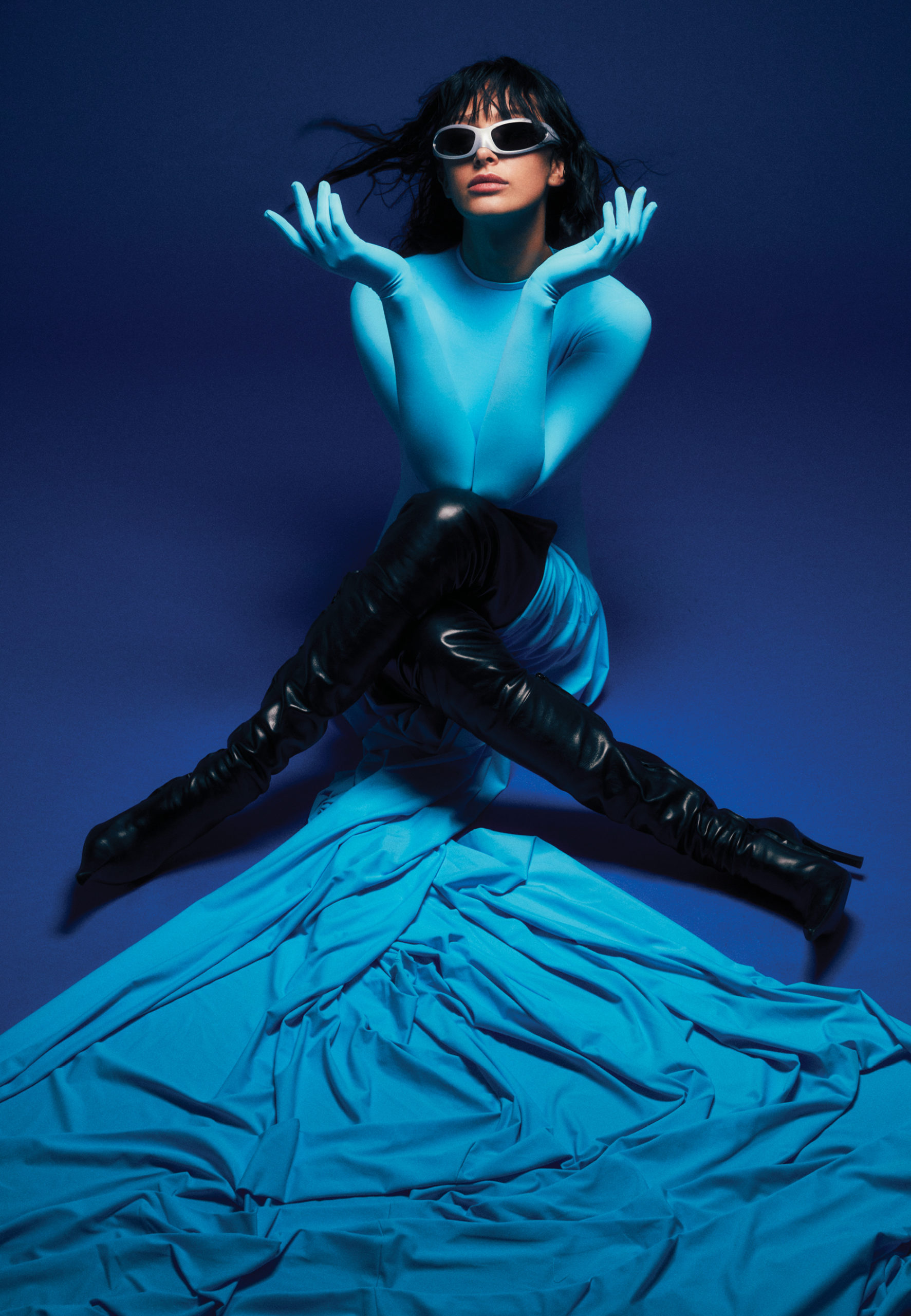
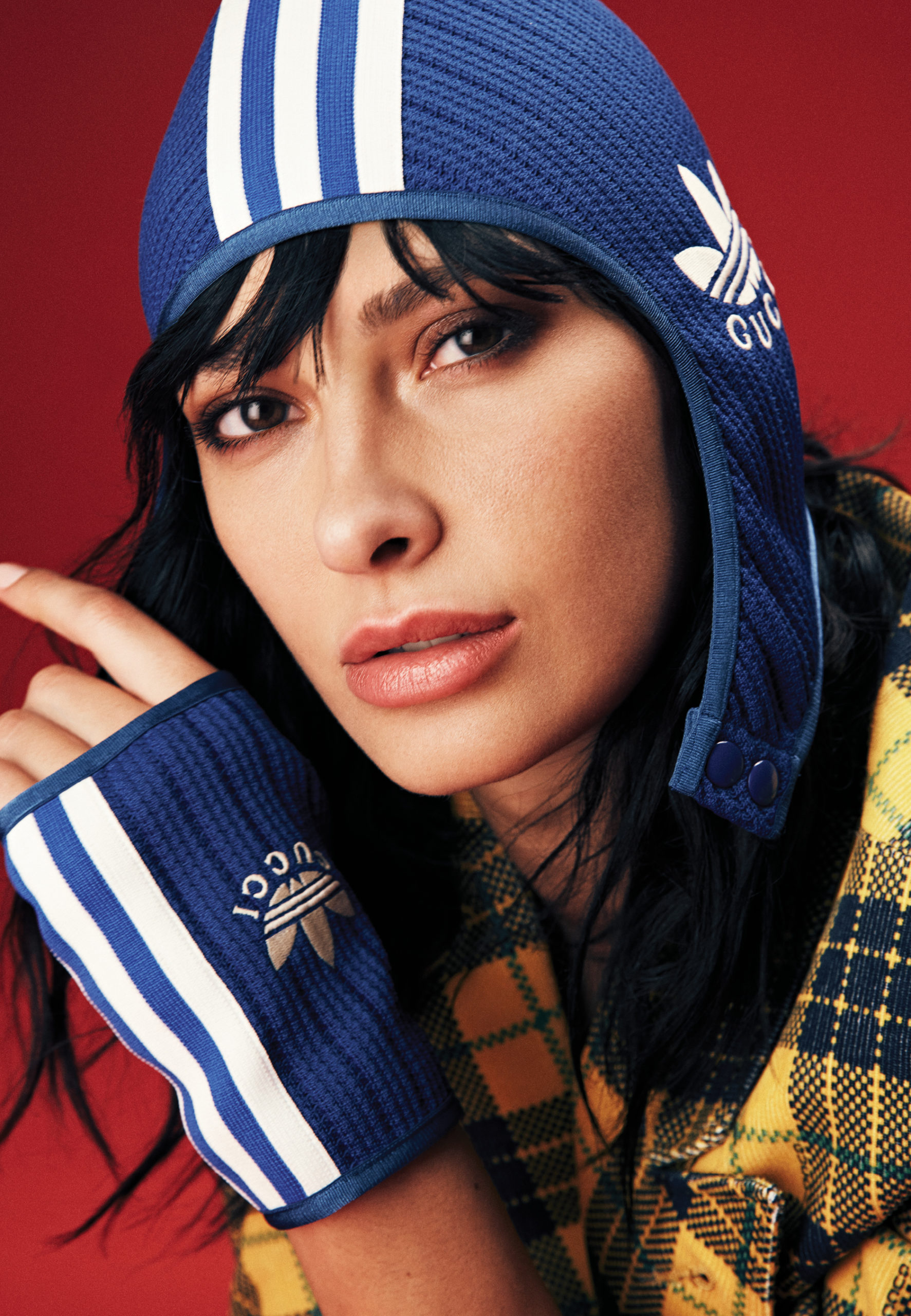
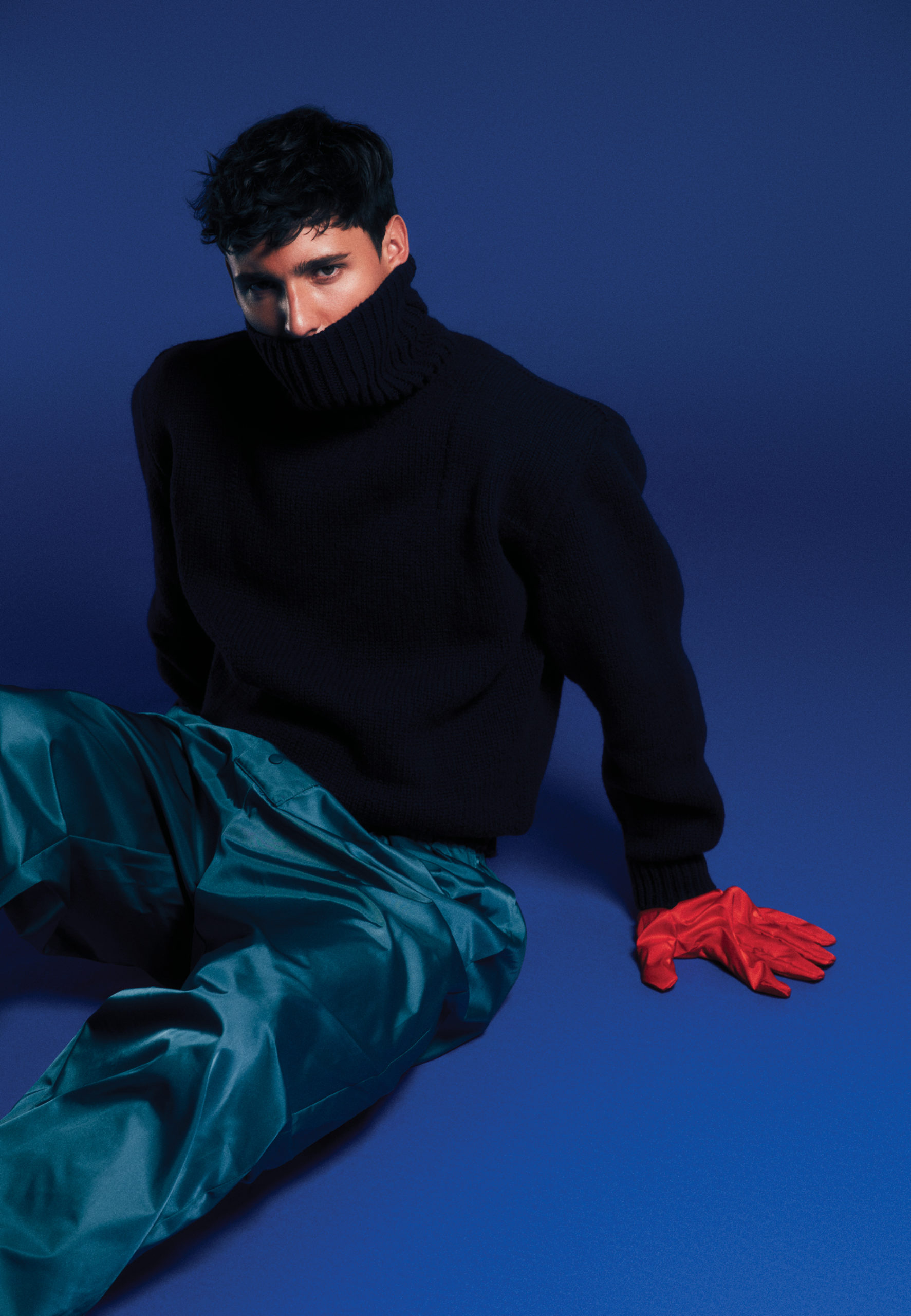
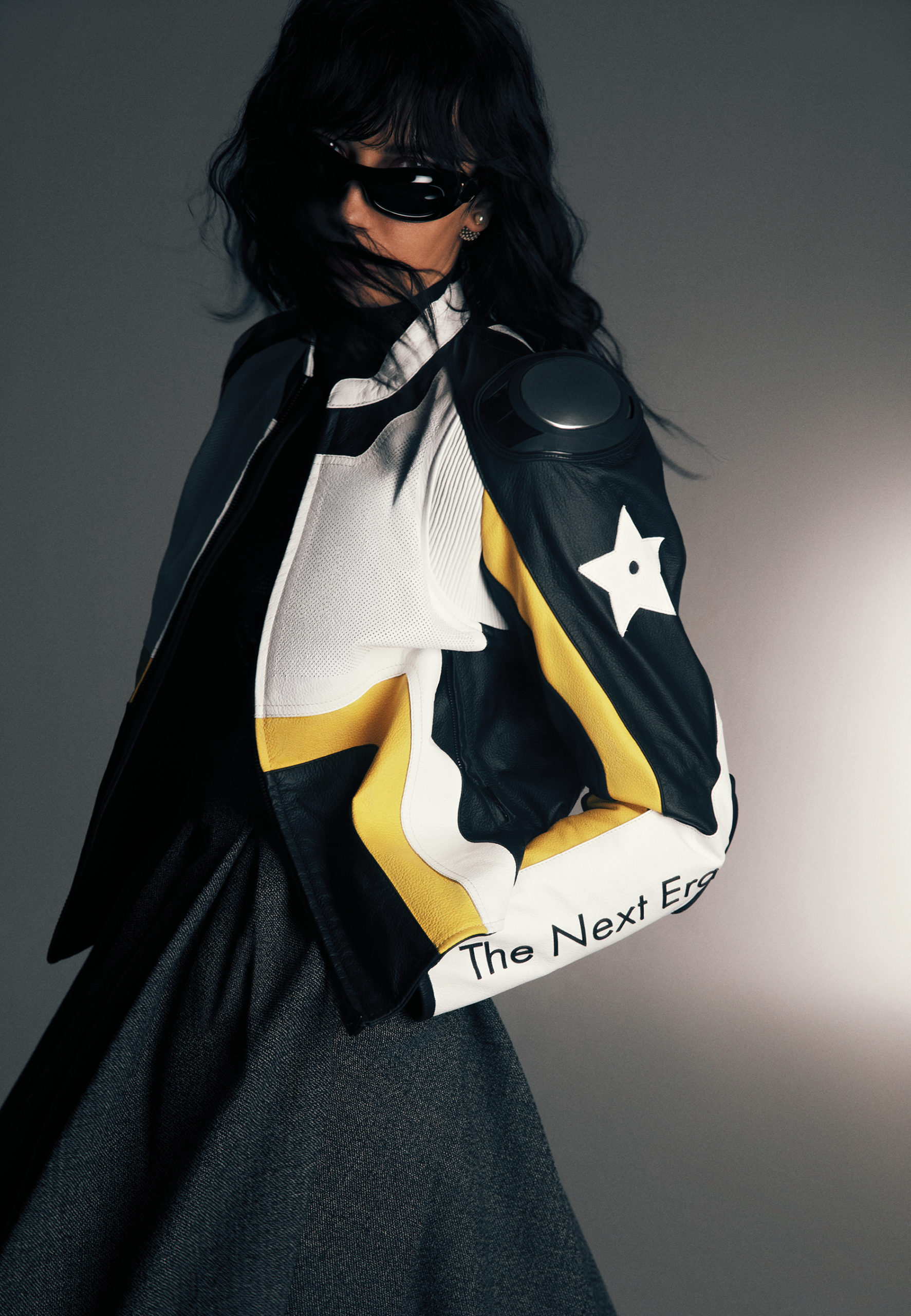
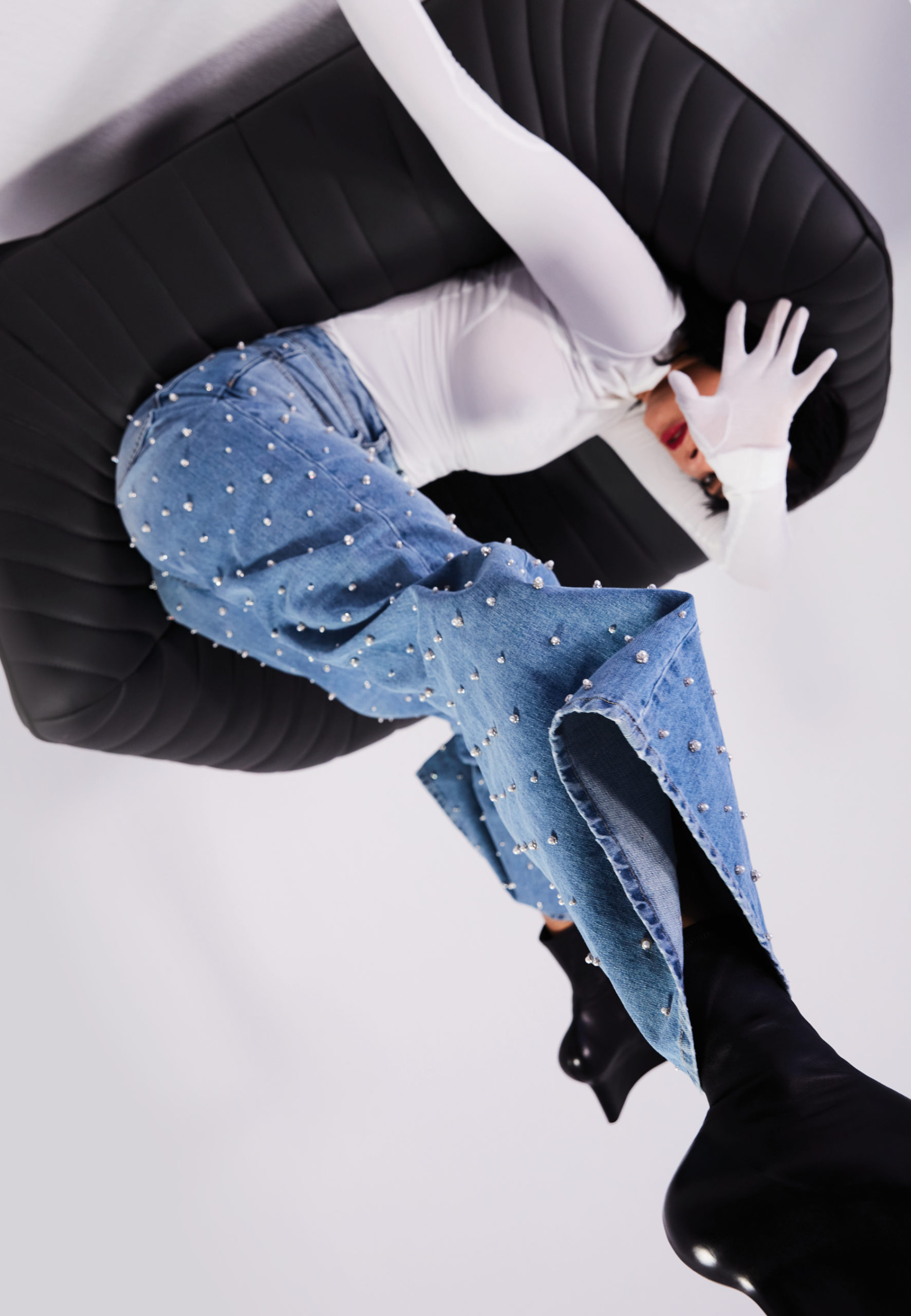
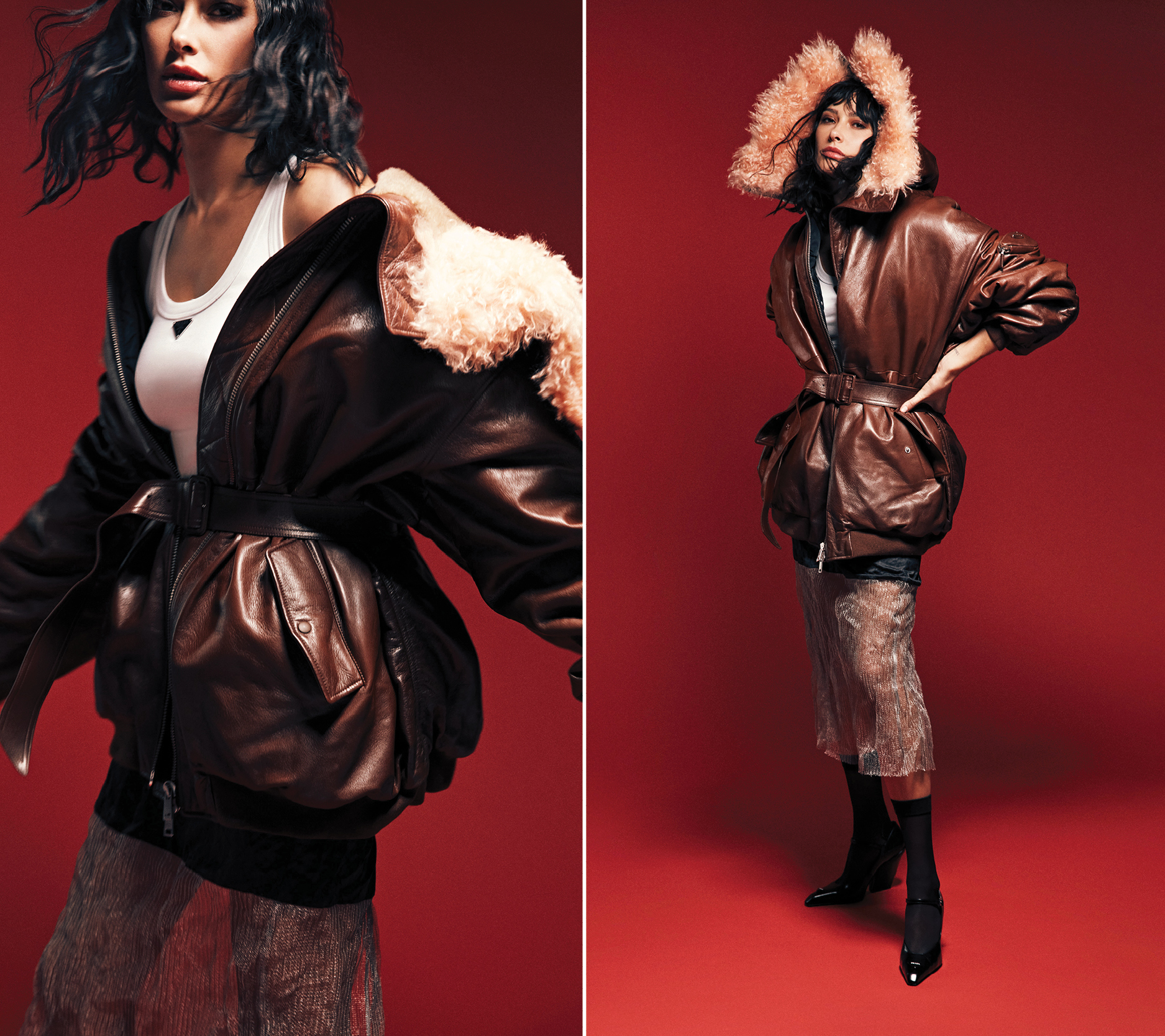
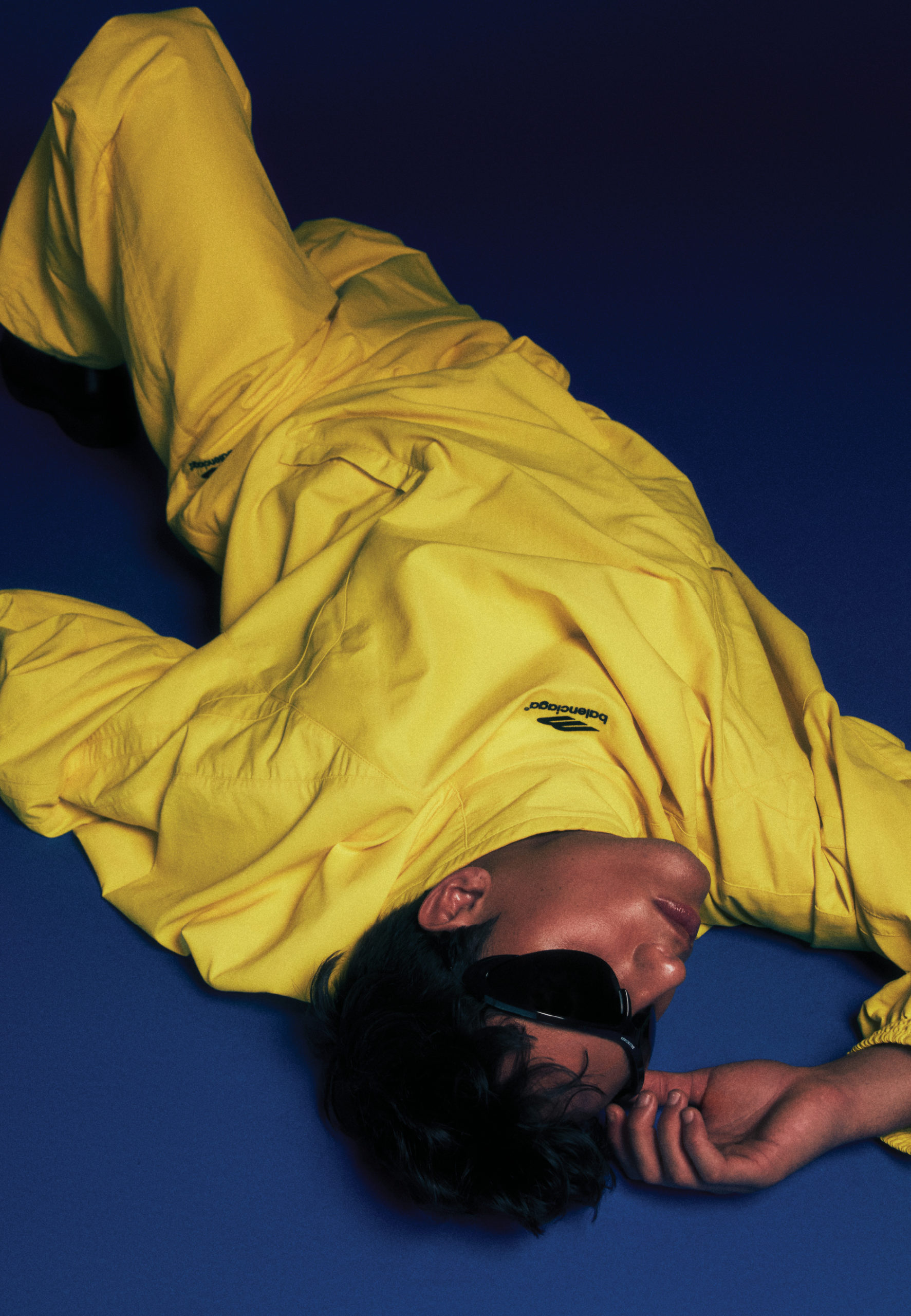
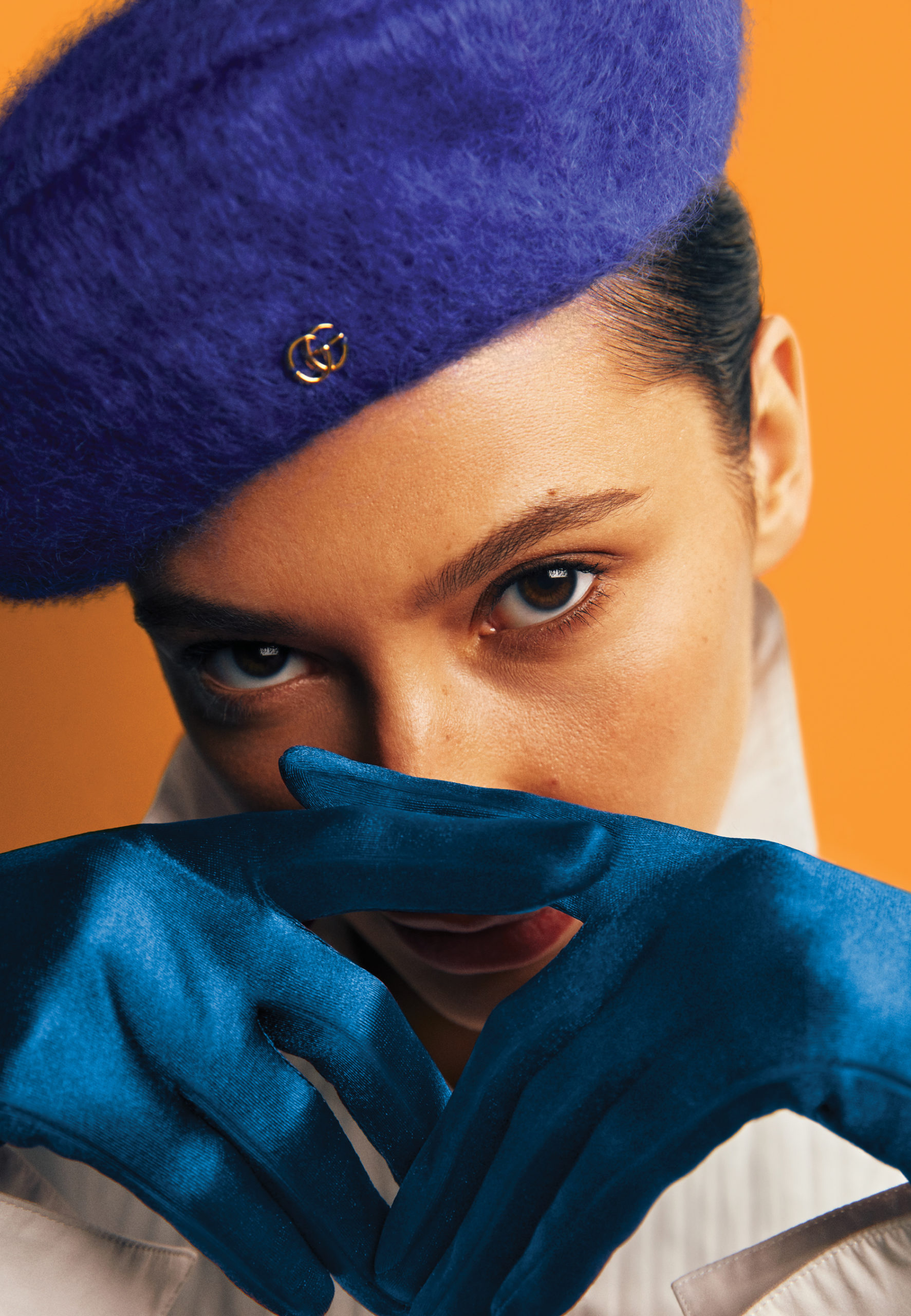
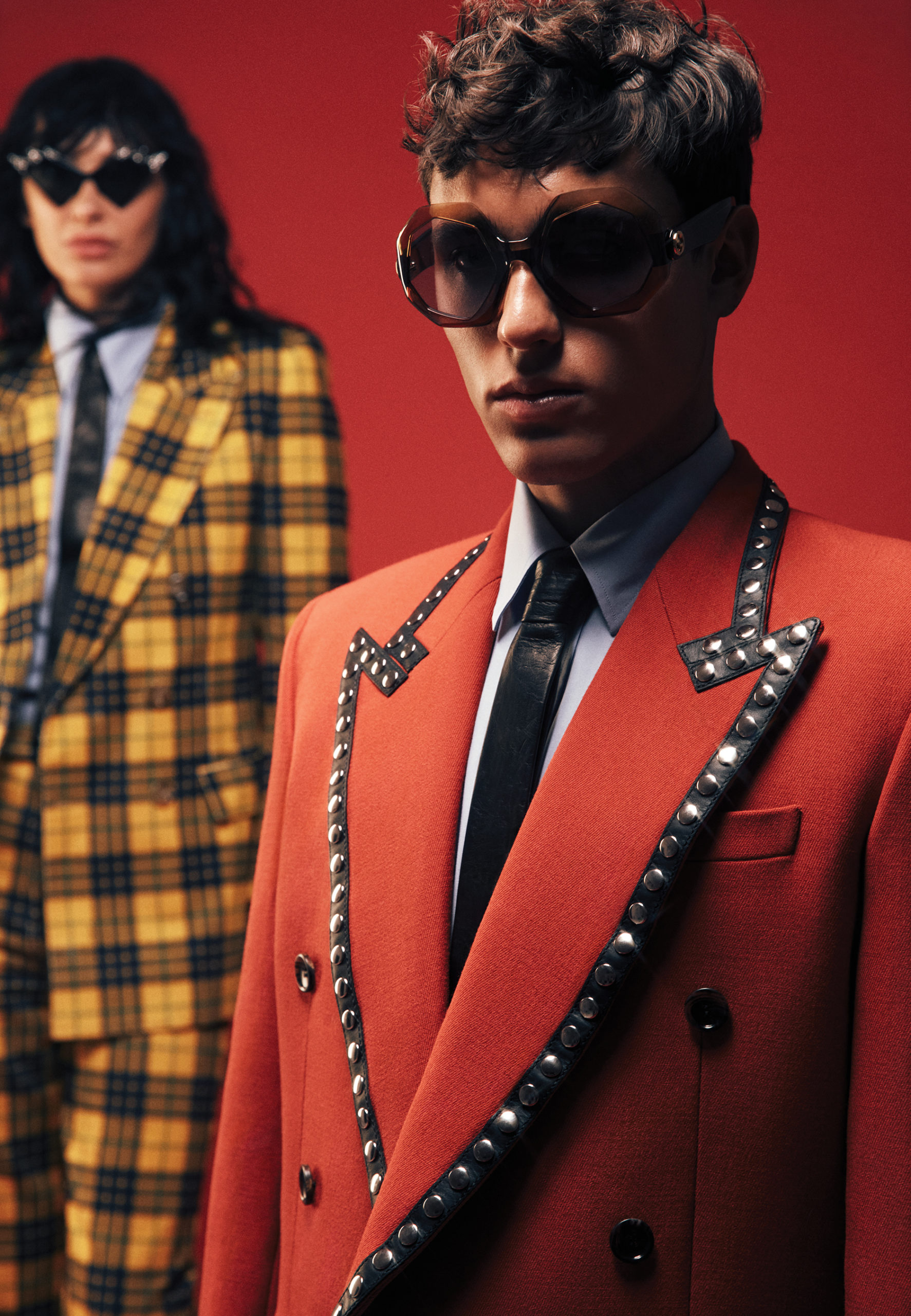
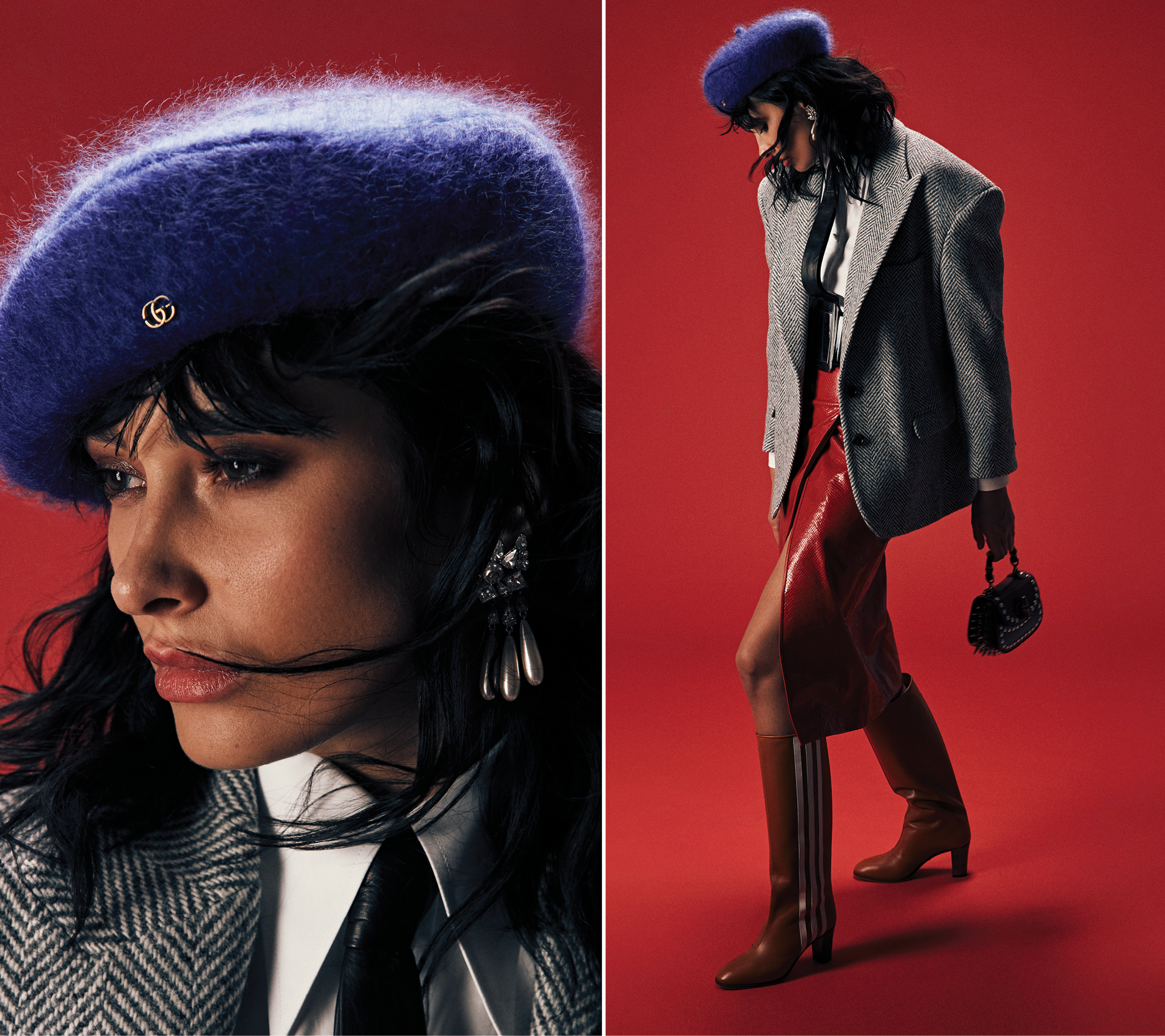
In a bid to capture the boldness and bravery that underpinned the rest of Denizen’s Spring issue, it was to high-octane hues and showstopping silhouettes that we turned in our fashion editorial. From Balenciaga’s unmistakable block colours and Gucci’s unique detailing to Prada’s polished touches, the mood of the season was audacious and the clothes a confident step away from minimalism. They do say that fortune favours the brave, after all.
Makeup & Hair: Ivan Kuz using La Bouche Rouge makeup, available from Faradays. Talent: Vita from MMG Models. Thiago from Bareface Models. Fashion Assistant: Christina Arrighi. Video: Klaudia Adamski.
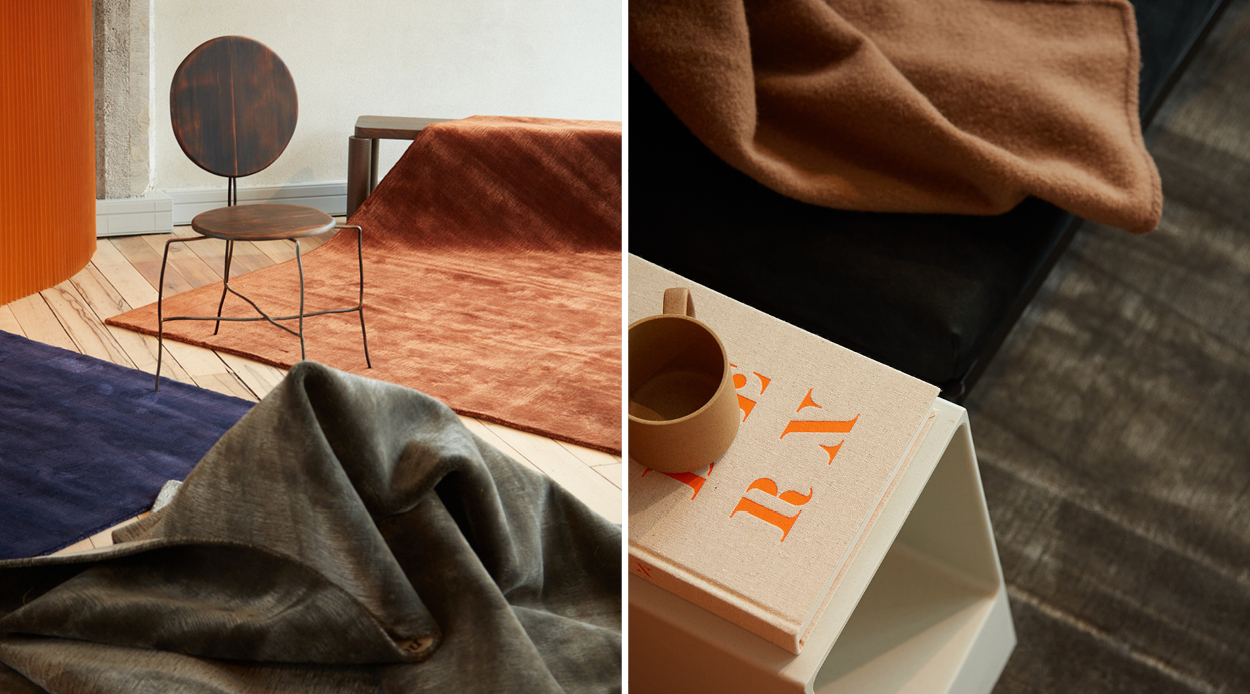
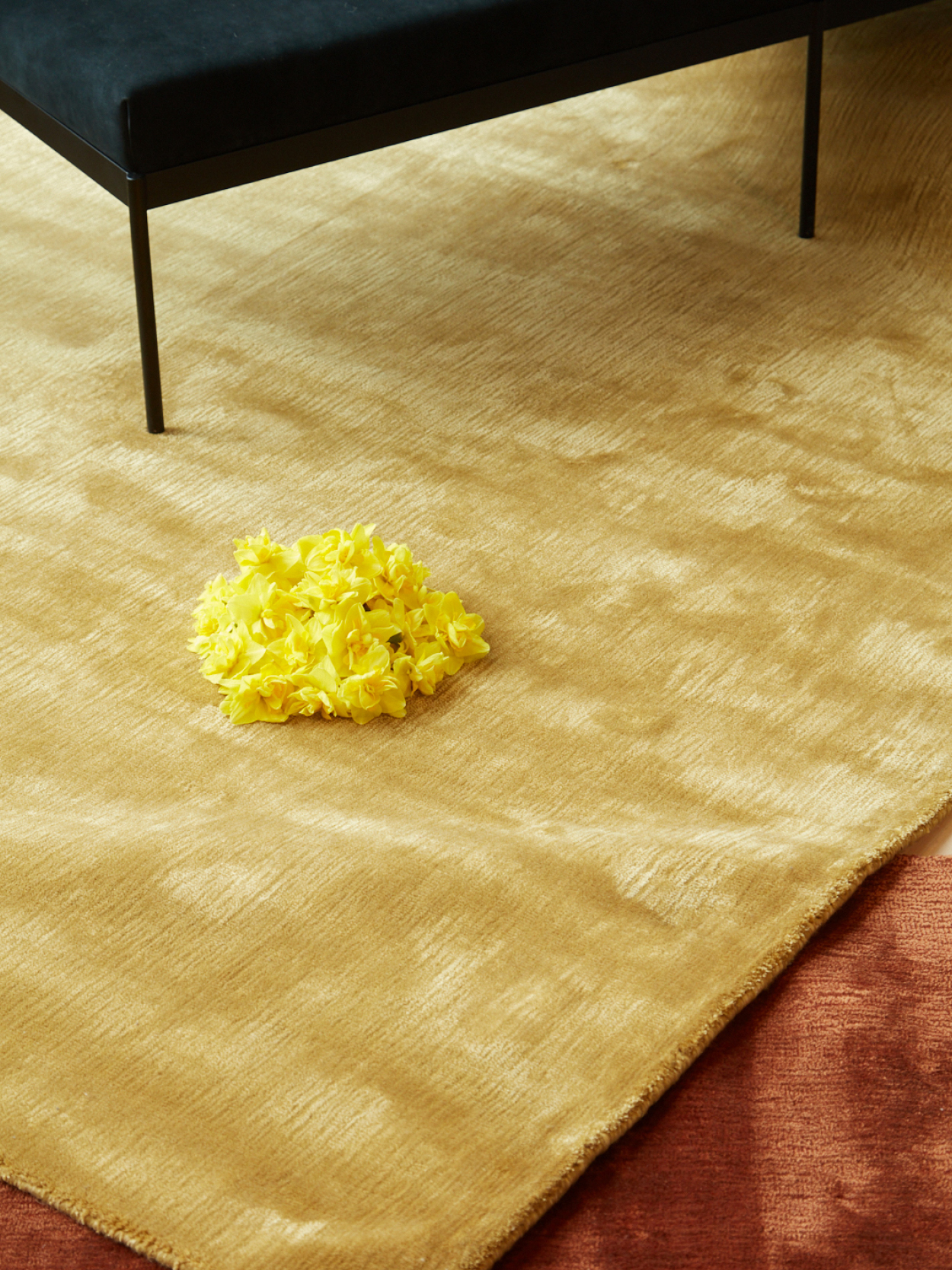
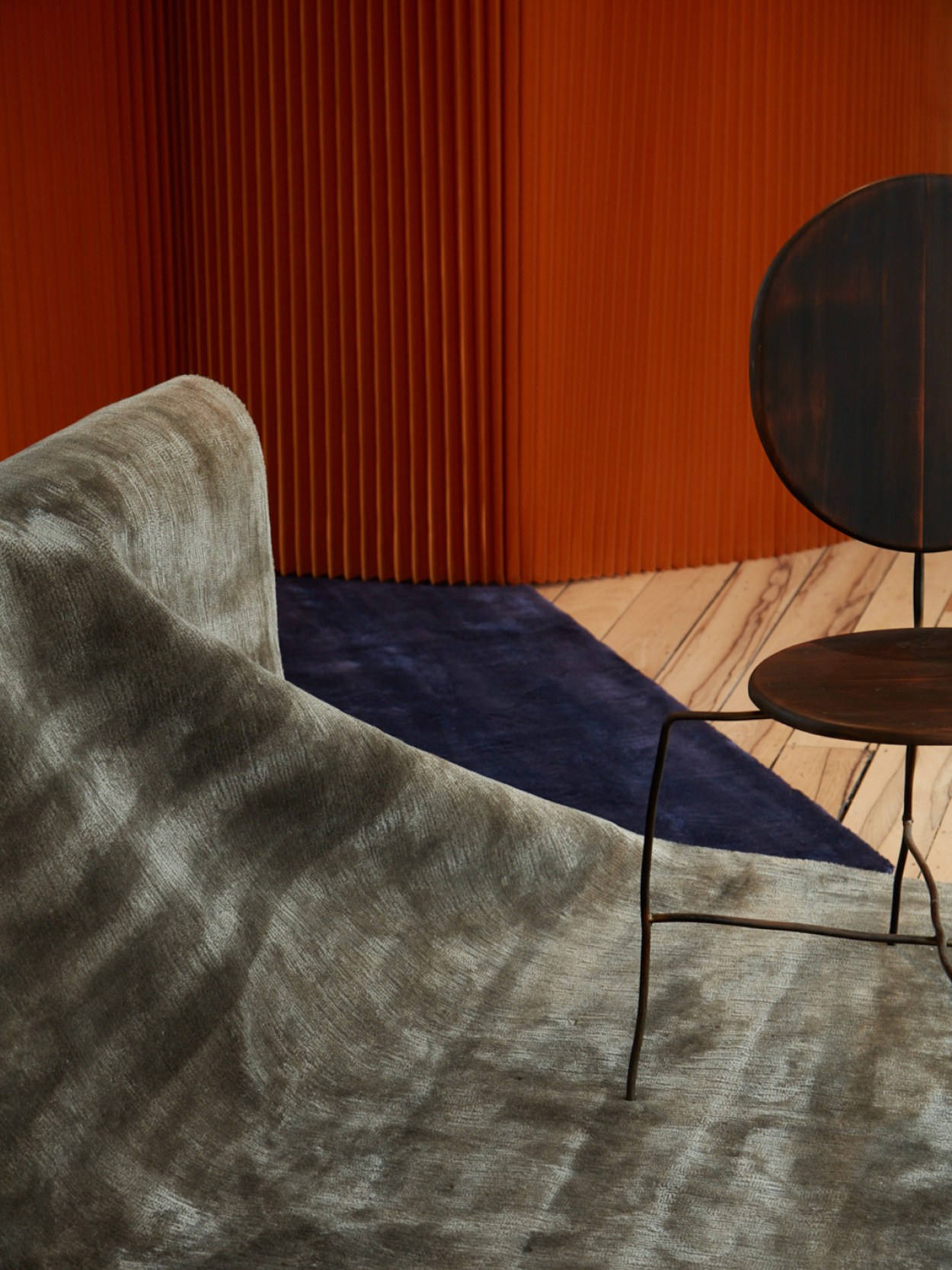
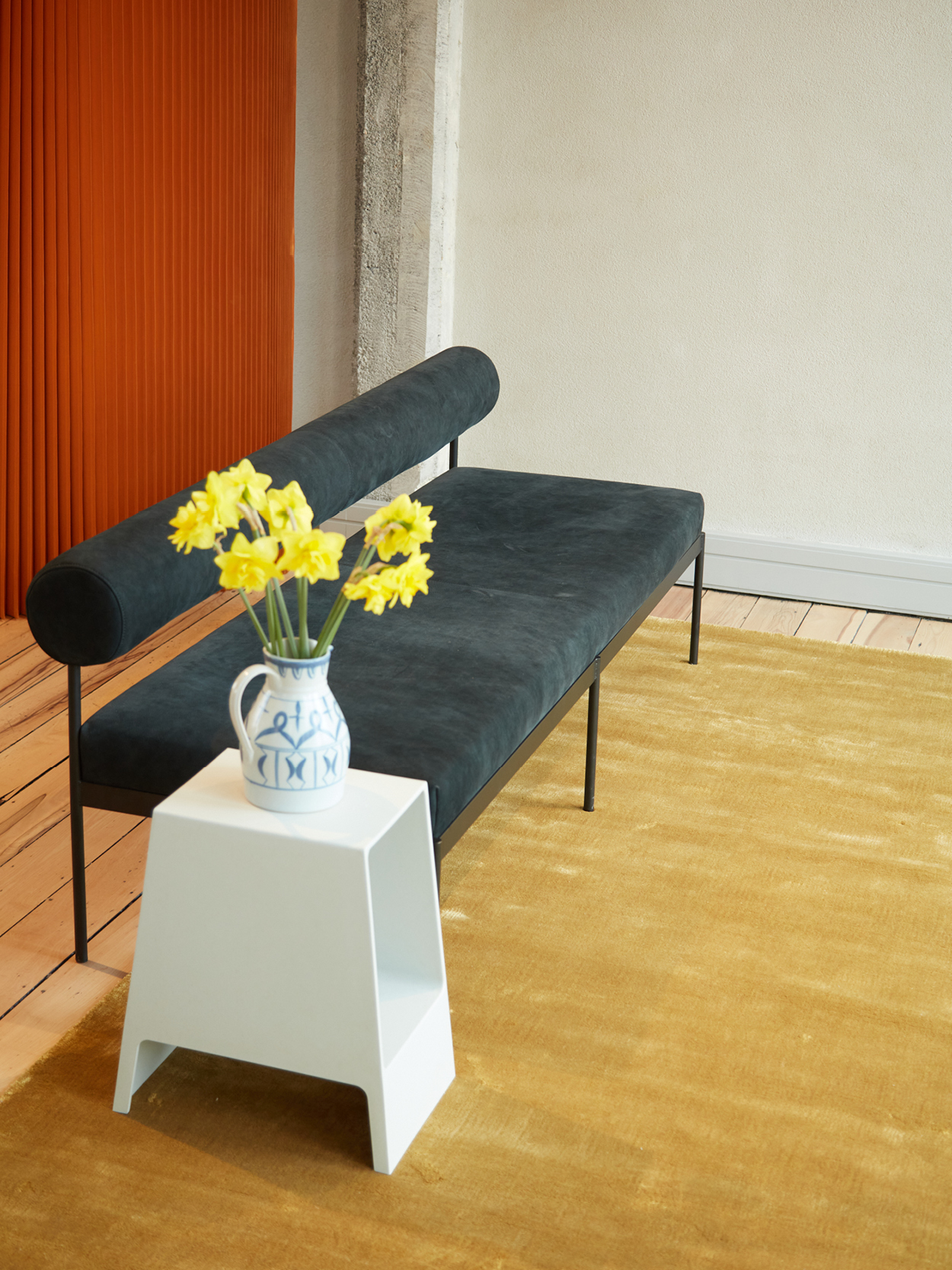
Thanks to the local purveyors of some of the finest rugs around, a new wave of vibrant hues is set to take over our interiors, suggesting that colour in the home should be employed on every surface, starting from the ground up.
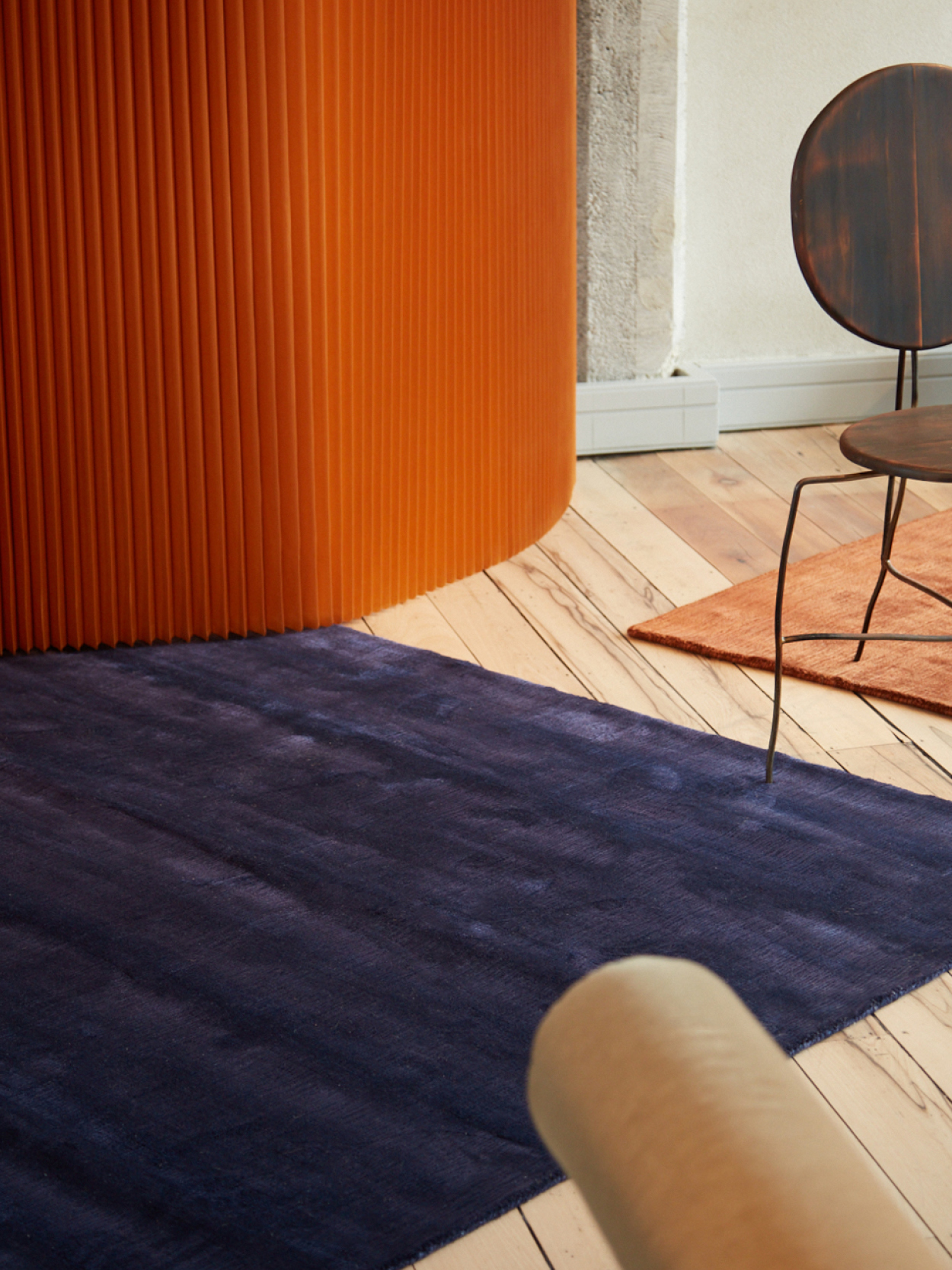
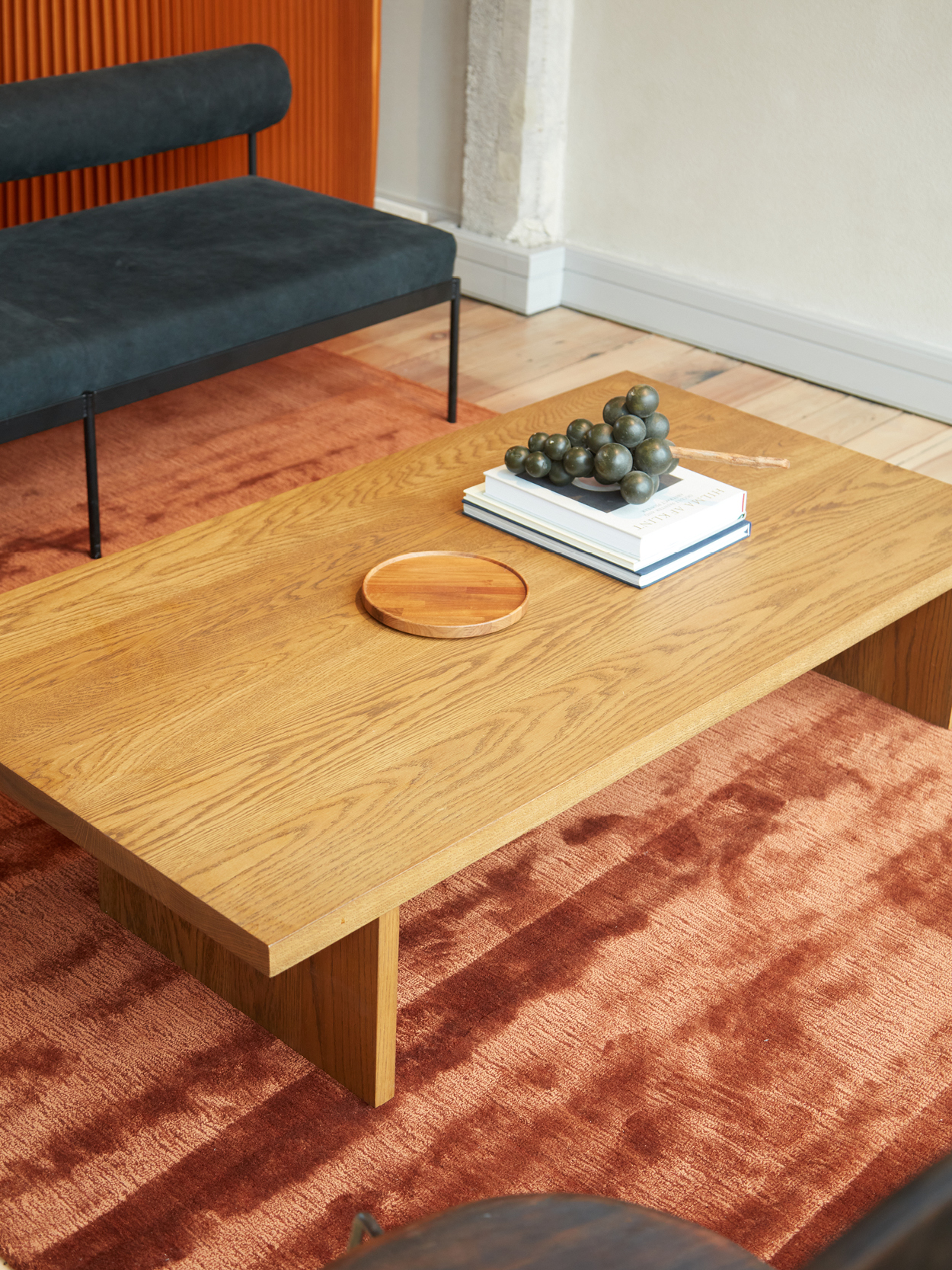
Nodi (known for creating collections that reimagine the classic rug in a bold, luxuirous way) has recently expanded its highly-coveted Bamboo Silk Wool Blend collection by adding tones like Brick, Indigo and Charcoal to the line-up, and making a strong case for colour in any living or bedroom space. Forever inspired by nature and our connection to mother earth, Nodi introduced these hues to echo the natural world while still offering the kind of cool, cosy, contemporary luxury that has made this brand so widely sought-after — and the results really speak for themselves.
For Nodi, the rug is an essential centrepiece, and a detail that (although often underestimated) has the ability to pull together an interior like nothing else. And while the brand’s collections comprise a variety of weaves, it is its handmade, 100 percent bamboo silk combined with pure New Zealand wool additions that offer the perfect combination of modernity and luxury, thanks to their sustainable materials, sumptuous silky texture and luminescent, sheen-like finish.
The expansion of Nodi’s Bamboo Silk Wool Blend range reflects not only on the popularity of the texture, but offers tangible proof that people are willing to embrace colour in their homes once more — moving away from stark monochrome as the only harbinger of a sleek, contemporary aesthetic.
So, for anyone seeking a seasonal refresh, look no further than Nodi’s newest Bamboo Silk Wool Blend colours. After all, the simple act of adding or swapping a rug is the most effective way to give any interior space a new lease on life, requiring barely any effort at all.
Julie Pelipas is talking to me from London, but it’s not her home. And while home is only a three-and-a-half hour flight from London, returning right now is not an option. Pelipas, the former fashion director of Vogue Ukraine and founder of upcycled clothing platform, Bettter, is one of the roughly 12 million Ukrainians who have been forced to flee their country since its invasion by Russian forces in February, with millions more displaced within Ukraine, and hundreds of thousands left without any home at all. Considering the circumstances, Pelipas is one of the lucky ones, but talking to her, it’s clear that the emotional toll of war has weighed heavy.
“I’m safe but I feel enormously tired,” Pelipas says when we first speak, “it’s not easy to work normally and live life while trying to handle the huge mental pressure of everything we see happening in our country every day… particularly now that the media has stopped covering Ukraine as much.” For Pelipas, London is a haven, but it will never feel the same as the dream home she had meticulously designed and only recently moved into, set in the heart of Kyiv and surrounded by beautiful gardens and a sparkling river. If anything, the rushed relocation of her and her family has only made her appreciate her country more. “I love my country, I love my people,” she tells me, explaining how she recently went back for a visit, surprised to find that the people there were choosing to continue on as normally as they could. It’s a testament to the incredible resilience that has defined the Ukrainians’ retaliatory fight and utter refusal to back down. “Being back in Ukraine was a very surreal experience,” Pelipas explains, “there are parts that feel so normal but you can be killed at any moment… when we were shooting for Bettter’s MRIYA project with Dover Street Market, rockets hit the city centre, about two-kilometres from our studio.” This comes as Russia is reportedly ramping up its attacks on Ukrainian civilians, a result of what Pelipas says, is an attempt to break their spirit. “There’s no military logic anymore,” she tells me, “they’re trying to lower our bravery, they want us to be scared.” But, fear, I learn, is not in Julie Pelipas’ vocabulary.
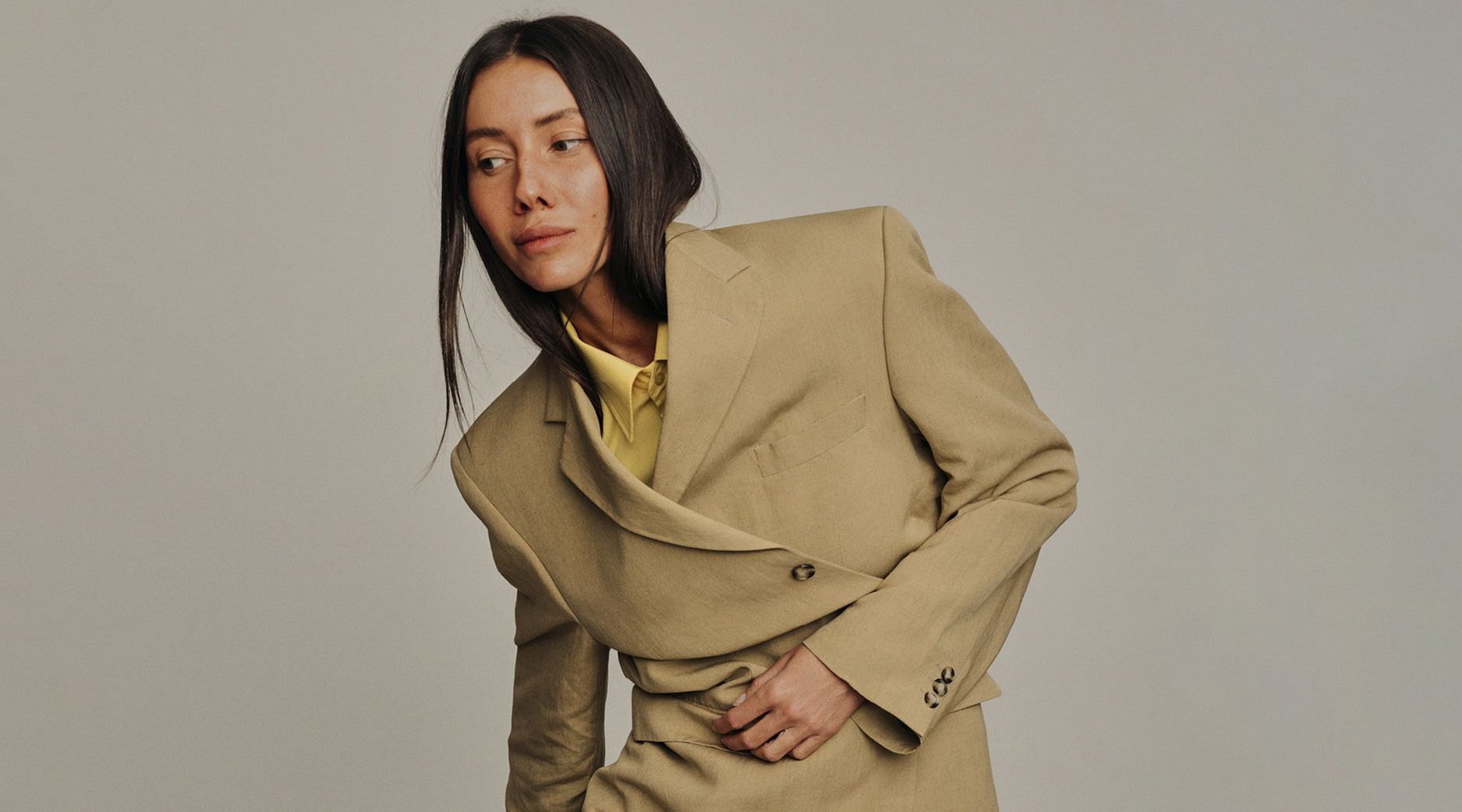
For those of you who haven’t heard of Julie Pelipas, there is a high chance you’ll have seen a photo of her on Instagram, probably at fashion week, probably surrounded by photographers. Tall and slender, with a strong, memorable face and a particularly elegant way of dressing (usually in a suit), Pelipas has long been the subject of ardour from those in the fashion industry — as much for her personal style as for the globally-renowned work she has produced over her decades-long career. An integral part of the teams that set-up both Harpers Bazaar and Vogue in Ukraine, Pelipas has, since her earliest days in fashion, been an advocate for creatives in her country — magnanimously giving them a platform in print to publish their work, opening doors for them internationally and encouraging them to push the envelope and to rewrite the traditional editorial rules. It is something that has underpinned much of her work, and now, she tells me, is more important than ever.
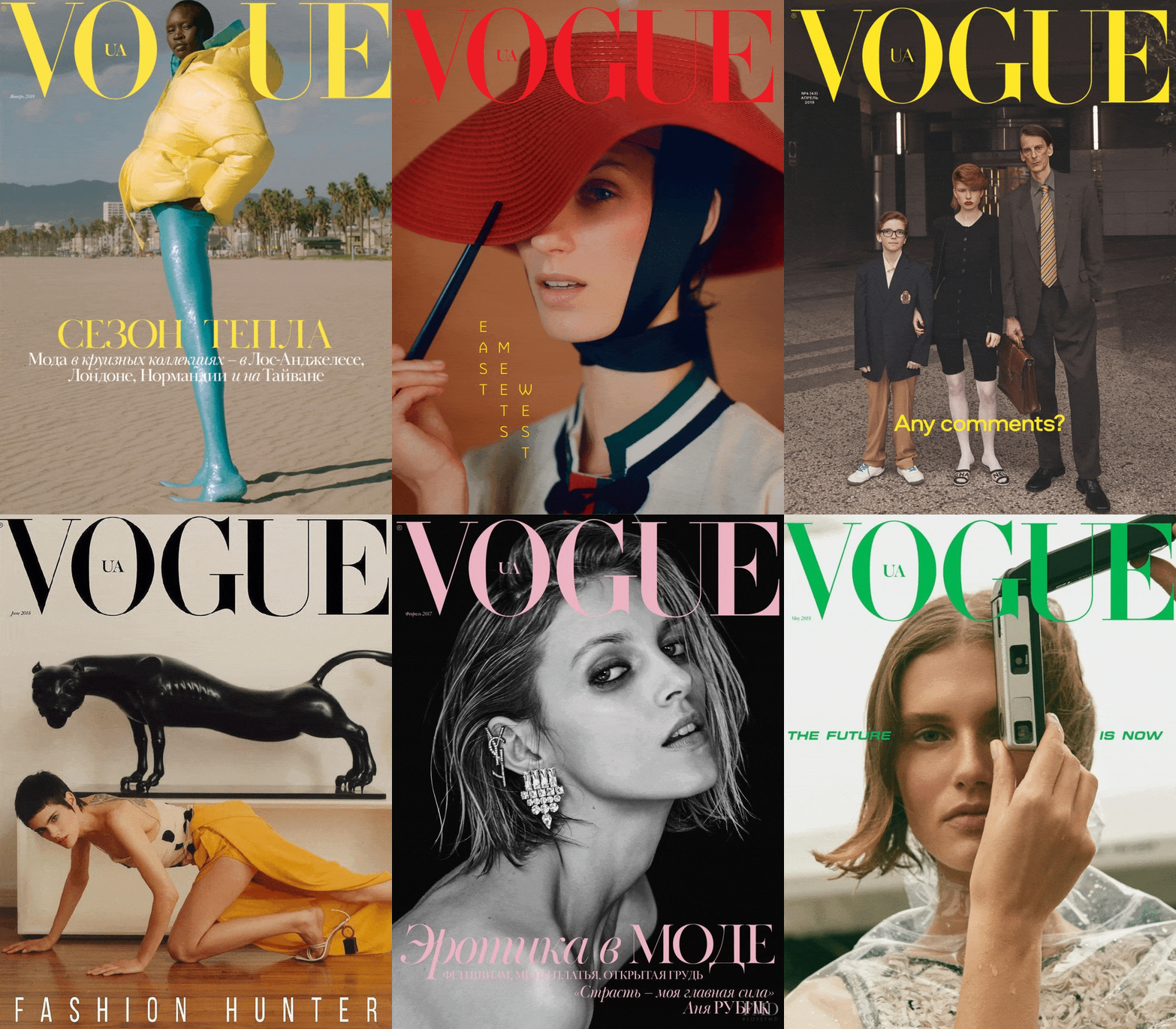
“At Vogue, we really didn’t have any budgets,” Pelipas explains, “so we used to pay young, local creatives with the freedom to do whatever they wanted, which saw most of them take incredible risks to produce these beautiful shoots and covers for us.” Indeed, the covers released under Pelipas’ tenure at Vogue Ukraine redefined the style for publications the world over. They were pared-back and artistic, often anchored by an overarching or esoteric theme that lent them the kind of depth and gravitas that other fashion titles were sorely lacking. Importantly, they also thrust Ukraine into the international fashion spotlight, showcasing the country’s burgeoning industry, and giving it an impetus for growth.
Vogue Covers by Julie Pelipas.
Through her experiences building Vogue Ukraine into the visually-renowned and globally-replicated magazine it now is, Pelipas was able to hone a unique ability to create greatness out of virtually nothing, explaining how in the early days of Vogue, not only was there no local industry (aside from models, of course) but no international brands or creatives were interested in working with them. It was only due to some scrappy determination, as well as a clear vision and the decision to never take ‘no’ for an answer, that Pelipas and her team were able to build Vogue’s reputation and bring Ukraine’s talented pool of designers to the world. “A lot of people didn’t even know what Ukraine was in the beginning,” she says, with a laugh, “but when we started producing all this different content and changed our covers, I remember being in Paris at a dinner for International Condé Nast editors and Jonathan Newhouse said to everyone in his speech, ‘have you all seen the amazing work that Vogue Ukraine is doing with their artistic covers?’ It was such a proud moment because we had worked so hard for so long and we were finally getting recognition.”
Because far from the glamorous world that ‘Vogue’ might conjure, those years, Pelipas explains, were marred by a level of dedication and grit that really eclipsed anything else in her life. “When you are working with no budgets, no connections, no system behind you, you dedicate yourself completely to your work… you have to put in extraordinary hours to get extraordinary results,” she reveals, “I was sleeping in the office some nights… I lost a lot, and I missed a lot of things in my life but it really turned me into a person who wasn’t afraid of anything. After that, anything felt possible.”
For Pelipas, who I discover is deeply empathetic, with a disarming authenticity and a particularly strong moral compass, the work at Vogue started to feel like it no longer aligned with her values. “I realised that I couldn’t serve this classic system anymore,” she explains, “I wasn’t bringing happiness to people but really, just the opposite, because at its core it was all about telling people that they weren’t good enough or skinny enough or trendy enough… and I felt a responsibility around the messages we were sending.” Sustainability was one issue that Pelipas tells me she pushed to cover more consistently at Vogue, despite it often being shut down for fear that raising the idea on a cover would do nothing for magazine sales. “I wanted to talk about sustainability in a really honest way, without all of the greenwashing,” she says, “because when I would travel for fashion weeks, and go to the trunk shows and the showrooms, I would see so many clothes and how similar they all were and the amount of deadstock that was left behind… so I started thinking about how we could stop producing so much while still creating beautiful clothes with that timeless quality that our parents’ generation had… that was where my idea for an upcycling system began, and it was in my head for three years before I decided to quit Vogue and do my own thing.”
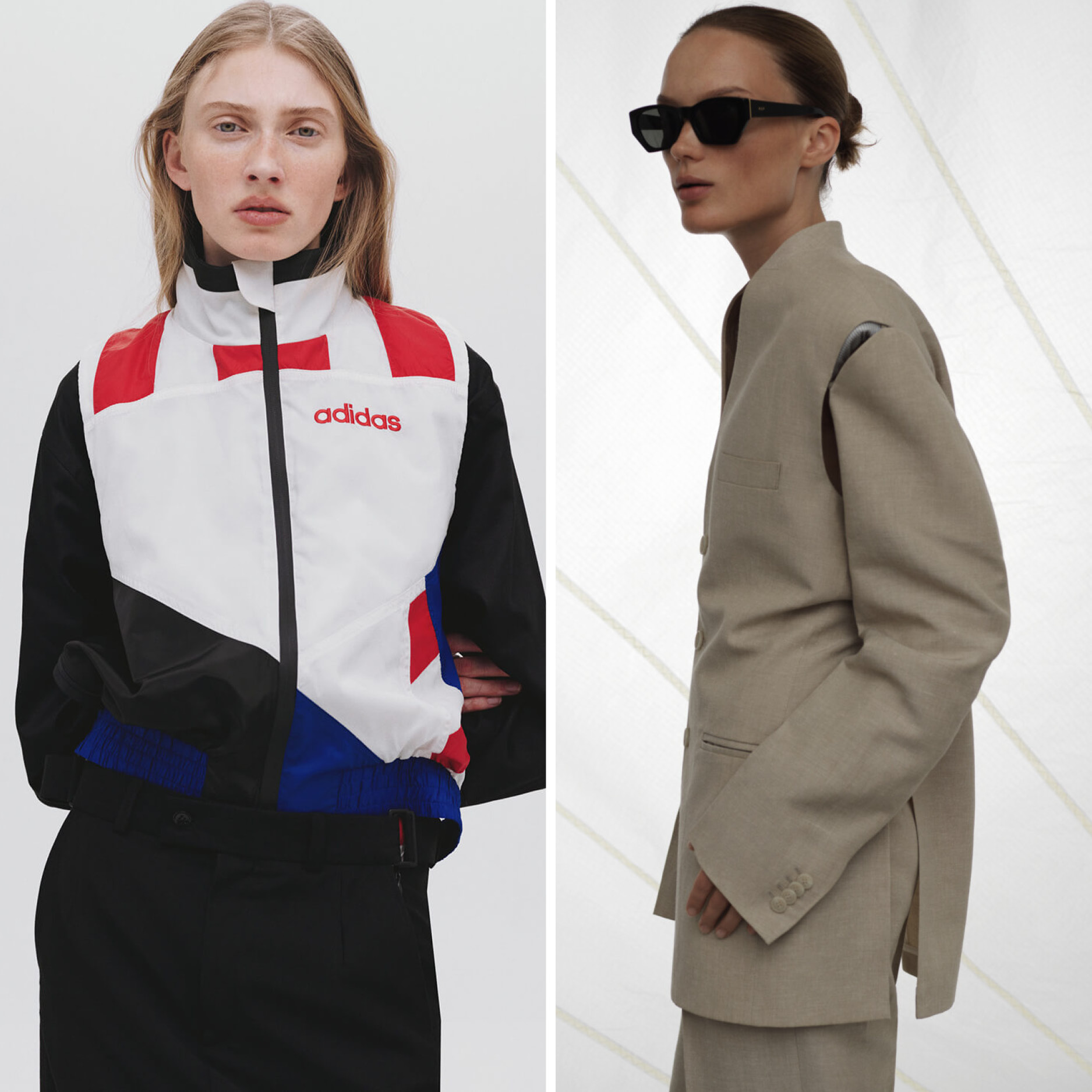
That thing was Bettter, a company reimagining our current fashion system and now, Pelipas’ main focus. Bettter identifies itself, not as a fashion brand, but is a multifaceted platform based around the idea of upcycling. For Pelipas, it was the only feasible way to combat the rampant over production she had witnessed over her years in publishing — years that instilled in her a belief that all the clothing we need has already been produced. So, she founded Bettter as a way to take deadstock and vintage textiles — including men’s suiting, old athletic-wear and even beach towels — and repurpose them into sleek, beautifully-made contemporary clothing with quality, cut and fabrication at the forefront. “I hope that Bettter will become a system that can change global production,” Pelipas tells me, “upcycling is transparent and truly a green technology…and the idea behind it is actually very old, much like mending or patching clothes.”
To look at Bettter’s collections is to see Pelipas’ unmistakable aesthetic stamp. The suits have that Phoebe Philo-esque androgenous quality (perfectly proportioned and effortlessly chic) while the more casual pieces are all made with a tailored edge. Crucially, Bettter stands apart from its ‘sustainable fashion’ contemporaries for the way in which it eschews catchy marketing lines or shouting about its ‘green’ goals. Instead, as with most things Pelipas does, the work speaks for itself. “We are all about sustainability but we don’t scream about it,” she tells me, “we have never used PR or influencer marketing, it has all been organic… At the beginning, I wanted to prove that the product was actually something people needed, and now we have such high return rates from our customers, which makes me really happy.” She continues, “One hundred percent of our products are upcycled and we are fully transparent about every step in the process, from where we source fabrics to exactly how a piece was produced… because beyond the clothes, we want to communicate our vision to our clients and we want them to buy into it too.”
Unsurprisingly, Pelipas has big dreams for Bettter. Her “north star,” she revealed, would see Bettter open a number of R&D facilities around the world, each of which would source, produce and sell their collections locally. “If the platform I build now is around much longer than I am, and inspires people to shift the way they produce and consume and the way they think, that would be amazing. But we need to grow more before we get there,” she clarifies.
I wonder how Bettter has fared in the face of the ongoing conflict. “Seventy percent of the team left Ukraine,” Pelipas says, “and the thirty percent who remained, absolutely refused to leave.” For Pelipas, not only did the start of the war mean the necessary shut-down of Bettter’s ability to produce and sell, it also meant a fracturing of her team, as she shifted to putting their wellbeing as her first priority and thinking about how the platform she had worked so hard to build could become useful in other ways. “My team is like my family,” she explains, “and even when we didn’t have any sales, I continued to pay full salaries.” It was during the early days of the war that Pelipas realised the critical importance of creative work, not only for the sense of purpose it offered, but because, as she says, it was healing.
“I just realised that we had to keep moving forward… once you stop, you’re lost” she tells me, with a hint of that steely determination that has long underpinned her success. “So we did this pivot at Bettter and we created Bettter.Community as a way to support creatives in Ukraine.” Tapping into her vast, global network of brands, designers and publishers, Pelipas transformed Bettter’s platform into a database of talented, Ukrainian creatives in a bid to get them work and money. “When I was in Paris for fashion week I had all these people from my old life asking how they could help and I realised that we needed a very clear, transparent structure that would help them direct their support into something meaningful,” she says. “I know so many young, talented creatives and it’s so easy for them to get lost in the system, especially during wartime… So this way, not only were they able to be financially supported but I think the process of being on a shoot or creating again allowed them… allowed all of us… to temporarily forget about all the horrible things that were happening.”
Now, Bettter.Community has merged with Given Name (who will take on more of the administrative responsibilities of artist management), to become more of an official agency and continue in its quest of supporting and uplifting Ukrainian creatives globally, while Bettter resumes its original work.
Photo: Haris Farsarakis
“I had relocated most of the Bettter team to Portugal, where we had set up an R&D facility and found some great production locally,” Pelipas explains, “but a few weeks ago, we actually made the unexpected decision to reopen our facility in Kyiv, with most of my team telling me how, in spite of everything, they just want to go home.” Having recently undertaken a collaborative pop-up in Paris’ Dover Street Market (in which Bettter’s MRIYA collection was unveiled via an immersive VR experience) and with Pelipas revealing a number of new collaborations in the works, it would seem that Bettter is on the brink of big things. “This is just a new chapter for Bettter,” she says, “it’s becoming more about collaborating with other brands and doing drops together… it feels new and exciting, and while there are so many challenges at the moment, I feel optimistic… I’m a very optimistic person.”
Indeed, the fact that Pelipas manages to hold onto her positivity even in the face of such gruelling circumstances is a testament to her spirit — what she would call “the mystery of the Ukrainian soul.” And while it’s obvious that she is incredibly hard-working and clearly cares about her country and countrymen, what strikes me most about her is her deep authenticity. It is rare to encounter someone with such a strong sense of self and an intuition that seems to have never led her astray. Her creative inspiration, she tells me, comes from a place within her that she can’t quite pinpoint (“my father told me once that I have a connection with the universe,” she says laughing) and when she was working her way up the ranks at Harpers Bazaar, on the brink of a big promotion, she fell pregnant and took two years off to live in Bali and enjoy time with her baby. “It was the smartest decision I ever made,” she says. “My advice to anyone is that if you’re talented, if you have brains, you will always be able to come back and build your career at any time… but it’s only a few times in your life that you have babies… to me it was very important.”
Pelipas has a track record of doing what she knows in herself to be right. Recently, she was involved in styling Ukrainian first lady Olena Zelenska for Vogue’s October digital cover — a powerful portrait of wartime leadership, shot by Annie Leibowitz. The photographs sparked a backlash, with some claiming they glamorised war and others bristling at the juxtaposition of Vogue (and its elitist connotations and past editorial missteps) with the realities that so many are facing in Ukraine right now. That said, most critics missed the crucial nuance of the shoot; the powerful image it portrayed of strength and leadership in the face of conflict, and the platform it gave the Ukrainian designers that Zelenska was wearing, their names listed simply below each image. More than any of that, it lent the war a human face and thrust Ukraine back into the international conversation, just as mainstream coverage seemed to be dwindling. As Vanessa Fridman wrote for The New York Times, “is the magazine romanticising war, or is the first lady weaponising glossies?”
“Spreading the word really works,” Pelipas tells me, “it’s the only benefit of social media… use it to talk about the truth, because if there is silence then nothing will change.” With Ukraine’s economy predicted to shrink by 45.1 percent this year and Russian forces having already damaged an estimated $105.5 billion worth of infrastructure, both those still living in Ukraine and those supporting from afar are painfully aware of the difficult road ahead. As Pelipas explains, this war is more than just a territorial or ideological conflict. It is a battle for the soul of Ukraine and for its independence from a neighbour who wants to rewrite history. “I do have hope that something extraordinary can come out of this,” Pelipas says, “but we have to win the war… a Ukrainian victory will be a win for humanity, for light over darkness.” As far as what the rest of us can do to help, Pelipas points to the significant impact just a small donation can make. “Every day we wake up and donate what money we can, and in the end, that becomes an important part of the Ukrainian effort… it literally saves lives.”
Having recently stepped back from her social media after months of relentlessly posting about the hardships being faced by the country she loves so much, Pelipas is finally taking some time for herself. Time, I hope, she uses to recharge her creative battery and return with the kind of purpose that has long been a driving force in her life.
Whatever she does next, Pelipas’ career proves the power of fashion far beyond its glossy facade. Scratch the surface and it is about community, people and creating a path for the future. A future that, to those like Julie Pelipas, is full of hope and potential.
It’s rather widely agreed that, unless you’re a certain kind of person, cleaning up the house is nothing short of a drag. Quite honestly, there are more enjoyable ways to spend our days, so we’re all about celebrating solutions that make this tedious task all the more enjoyable.
We know that Denizens have an affinity for interior design trends, and with emerging research from Ecovacs Robotics suggesting that more than 82% of New Zealanders are embracing home robots and smart technology, this recent discovery of ours is poised to be a game-changer for homes across the country.
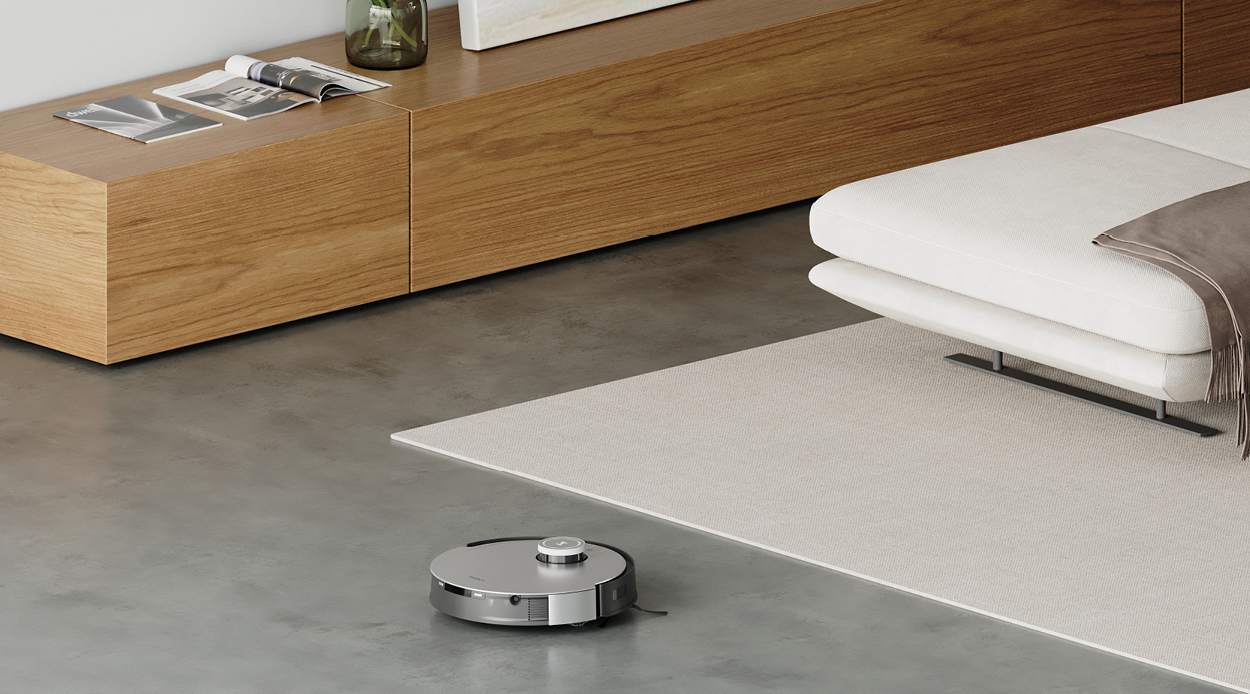
Despite only recently entering the local market, Ecovacs has been a global pioneer in robotic home solutions for two decades. It makes sense then that the newest iteration of the Ecovacs range is design-led, the brand combining forces with the European prowess of Jacob Jensen Design. The result is a beautiful design that doesn’t compromise on output, fulfilled in the recent release of the Deebot X1 Plus.
Sure, we could wow you with the Deebot X1 Plus’ technical details of horsepower and speed (in case you were wondering, it offers an impressive industry advancement of 5,000pa of suction, literally double the power of what suction used to be). Yet where competitors’ designs have been woefully lacking, this model embraces the philosophy of no detail left unconsidered.
Functioning as a vacuum and mop, the Deebot X1 Plus is powered by AI, 3D and mapping technologies, and a YIKO interactive voice assistant for the times you need it most. The voice assistant is another industry first for the model, offering a realm of possibilities never seen before on the market (and something that Ecovacs’ engineers are extremely proud of), where you can speak directly to the robot and it will follow your every command. With this innovation, you can direct it to collect the crumbs under the sofa or mop up muddy footprints on fresh floors.
Adding to the Deebot X1 Plus’ capabilities is an intuitive air freshener (the first and only robot vacuum with this feature included), and it leaves behind no trace of a mess. Of course, when the job is done, Deebot X1 Plus returns to its home base — a docking station that automatically empties waste, seals dust and allergens, and in doing so, holds up to 60 days of everyday household mess before it requires refreshing.
Where the Deebot X1 Plus excites us most (aside from a pretty exterior) is the realm of possibilities that open up with an addition like this at home; a new mode of housekeeping that adapts to the needs of modern living. Be those in-the-moment commands, like a kitchen mishap, or the daily purge that busy lives need, the Deebot X1 Plus has proven itself capable of taking care of everything.
Ultimately, Ecovacs’ commitment to a vacuum that integrates seamlessly into everyday life is a detail that shouldn’t have to be sacrificed when living in the age of innovation.
Ecovacs’ Deebox X1 Plus is available locally from Godfreys, JB Hi-Fi and Robomate.
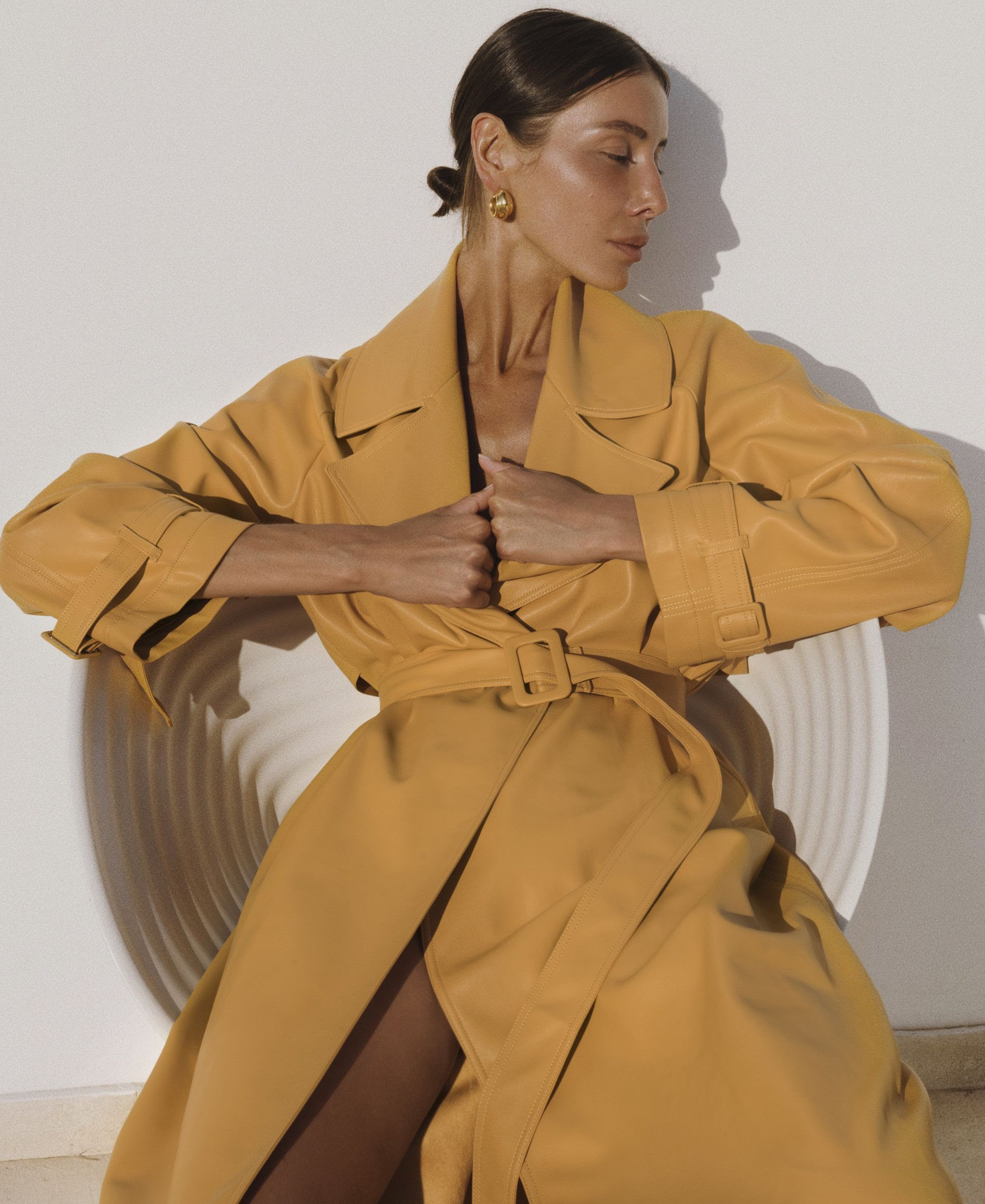
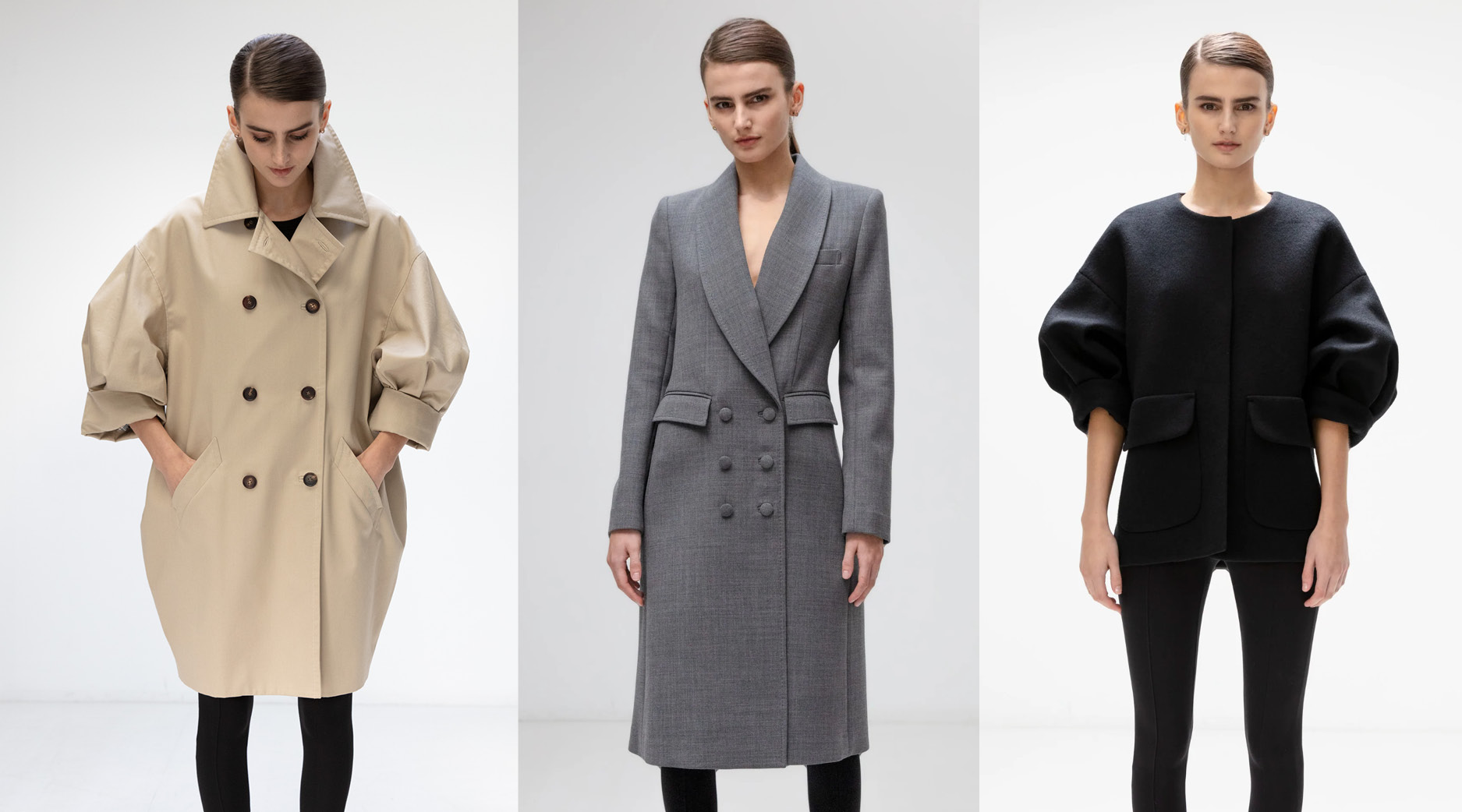
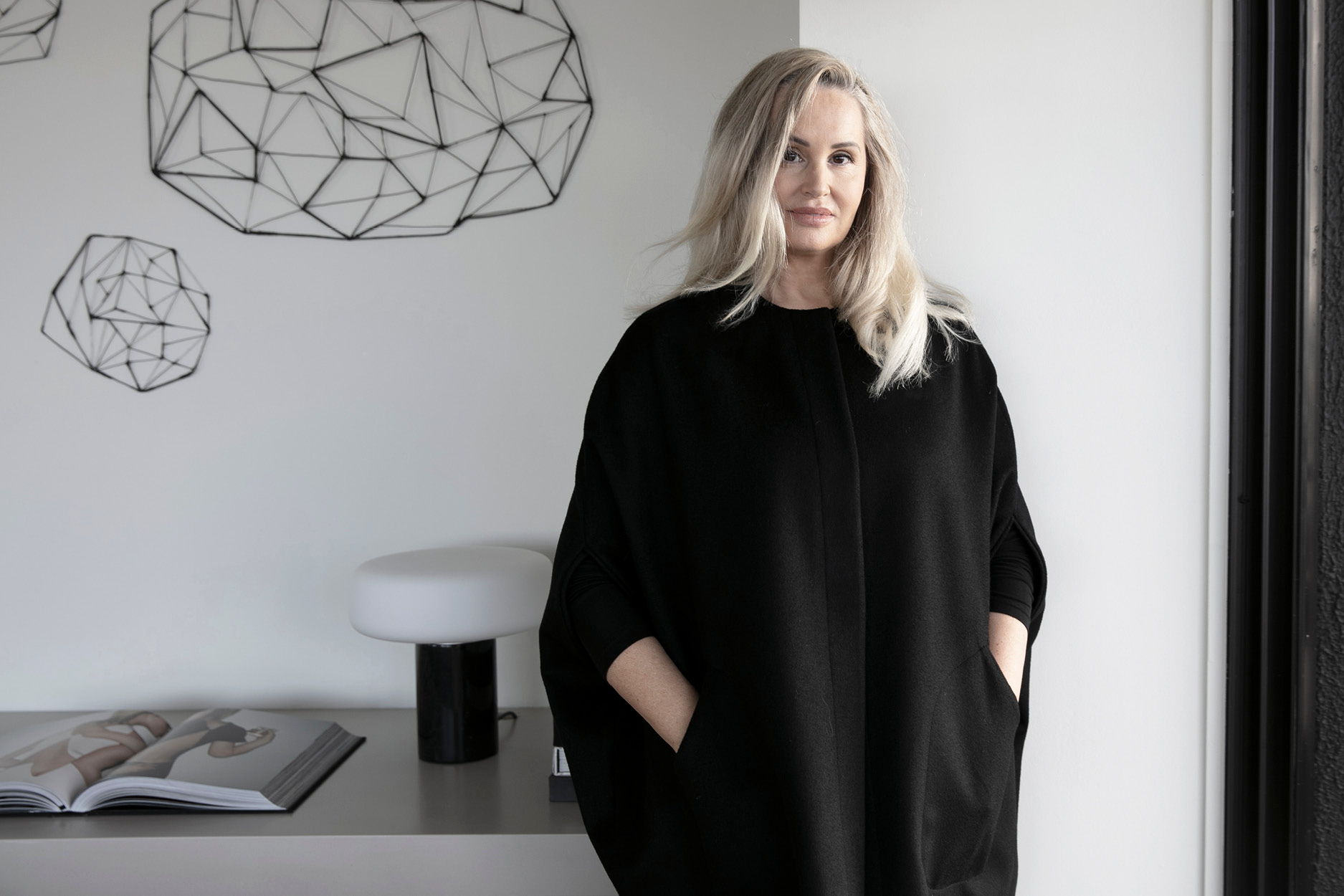
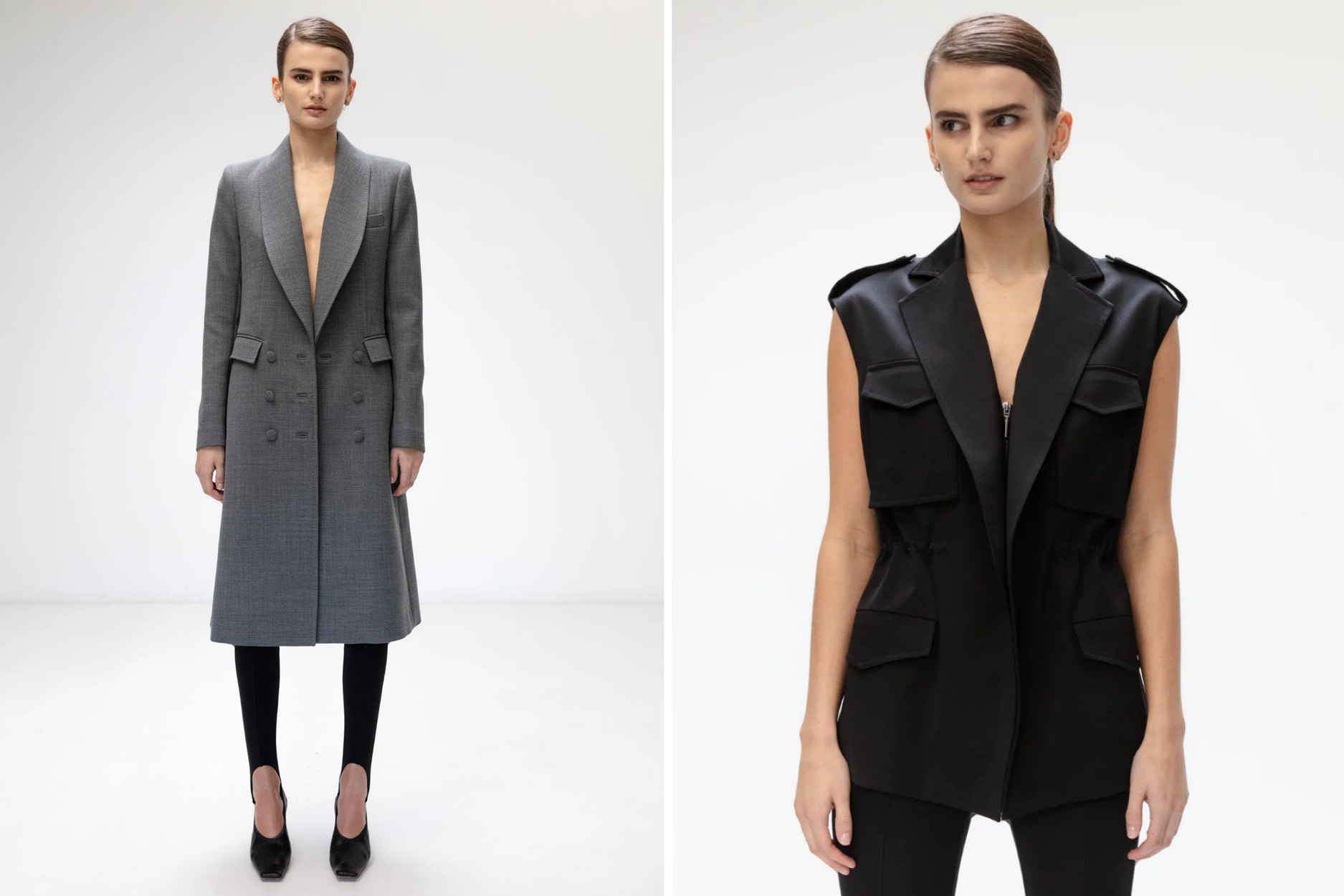
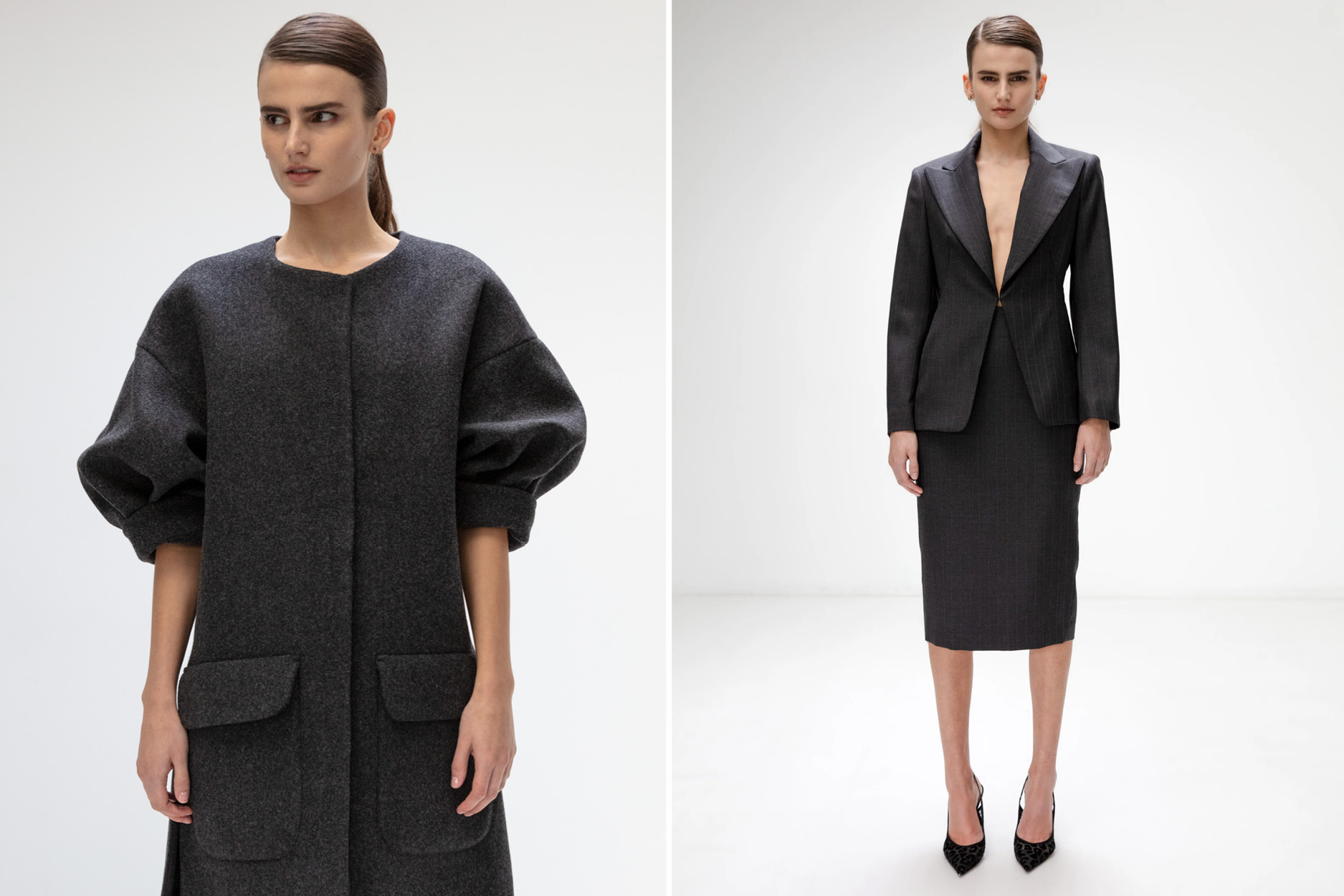
There’s always room in our wardrobes for chic and classic tailoring, especially if it’s custom made. Auckland-based fashion label, Reine, is offering a tight edit of refined garments handcrafted from premium textiles in the brand’s Herne Bay workroom. With limited collections and bespoke tailoring at the core of Reine’s approach, and an aesthetic driven by founder Fleur Clarke’s 12 years of pattern making in international couture and luxury fashion houses, this exceptional new label is creating pieces grounded in timeless, elegant design, destined to be on rotation in your wardrobe forevermore.
Founder, Fleur Clarke.
Playing into the trends of the moment, which conveniently ground themselves in an enduring sense of style, Reine’s designs embrace the elevated minimalism that so many seek. Clarke takes classic cuts like trenches and blazers, all as timeless as ever, imbuing them with her signature elegant appeal. The result is a refined curation of wardrobe essentials our editors can’t get enough of for the days, months and even the years ahead.
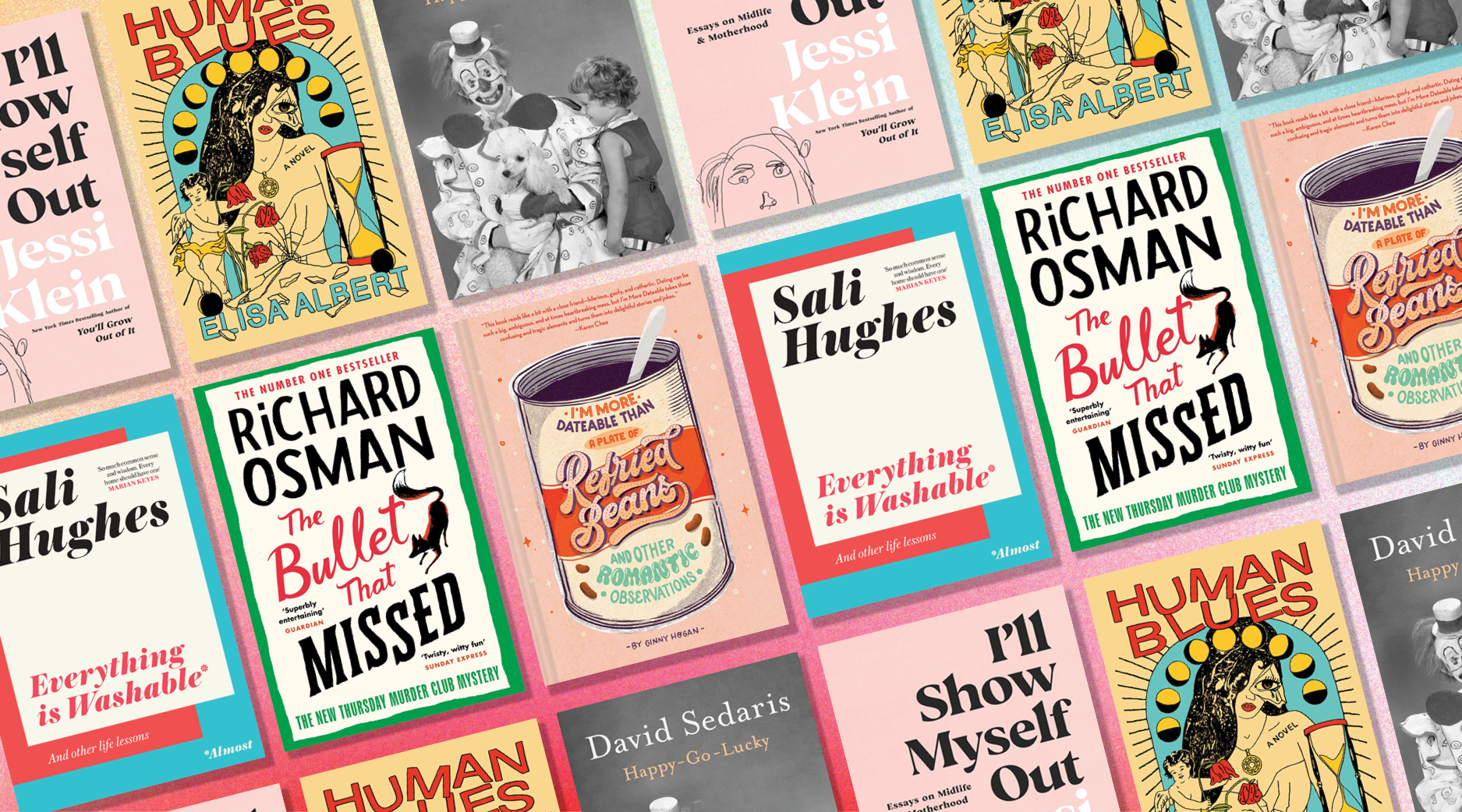
When it comes to rediscovering your reading spark, nothing is quite as enticing as a book that makes you laugh. And while there are a plethora of new titles emerging from great literary minds and formative thinkers, these hilarious new books are offering the kind of brevity, dry wit and warm humour that remind us of the joy to be found in reading. Trust us, these books will make you forget about your phone for an afternoon — and what a relief that will be.
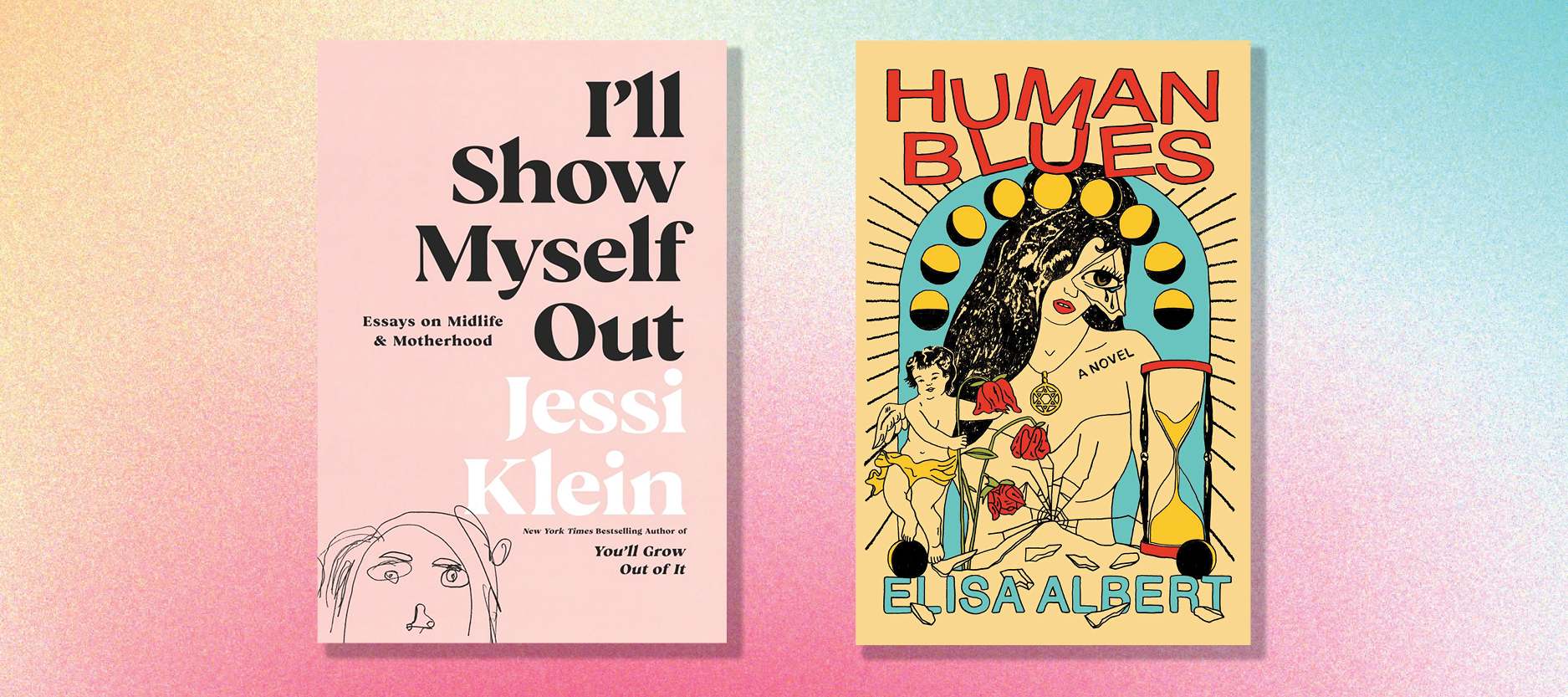
I’ll Show Myself Out by Jessi Klein Penned by the former head writer of Inside Amy Schumer, this book takes a self-deprecating look at life for a woman in her 40s, and mines the various absurdities of midlife motherhood to find nuggets of comedy gold. Marrying candour and humanity with her award-winning wit, Klein writes essays that include, ‘Listening to Beyoncé in the Parking Lot of Party City,’ and ‘Your Husband Will Remarry Five Minutes After You Die,’ that will have you laughing from start to finish.
Human Blues by Elisa Albert In this hilarious, provocative novel (told over the course of nine fertility cycles) the story of singer-songwriter Aviva Rosner and her struggles with infertility plays out in bold, fearless fashion. Touching on femininity, fame, art, commerce and autonomy in a brilliant and utterly original way, this funny and heartfelt book looks at our cultural obsession with childbearing in a searing new light.
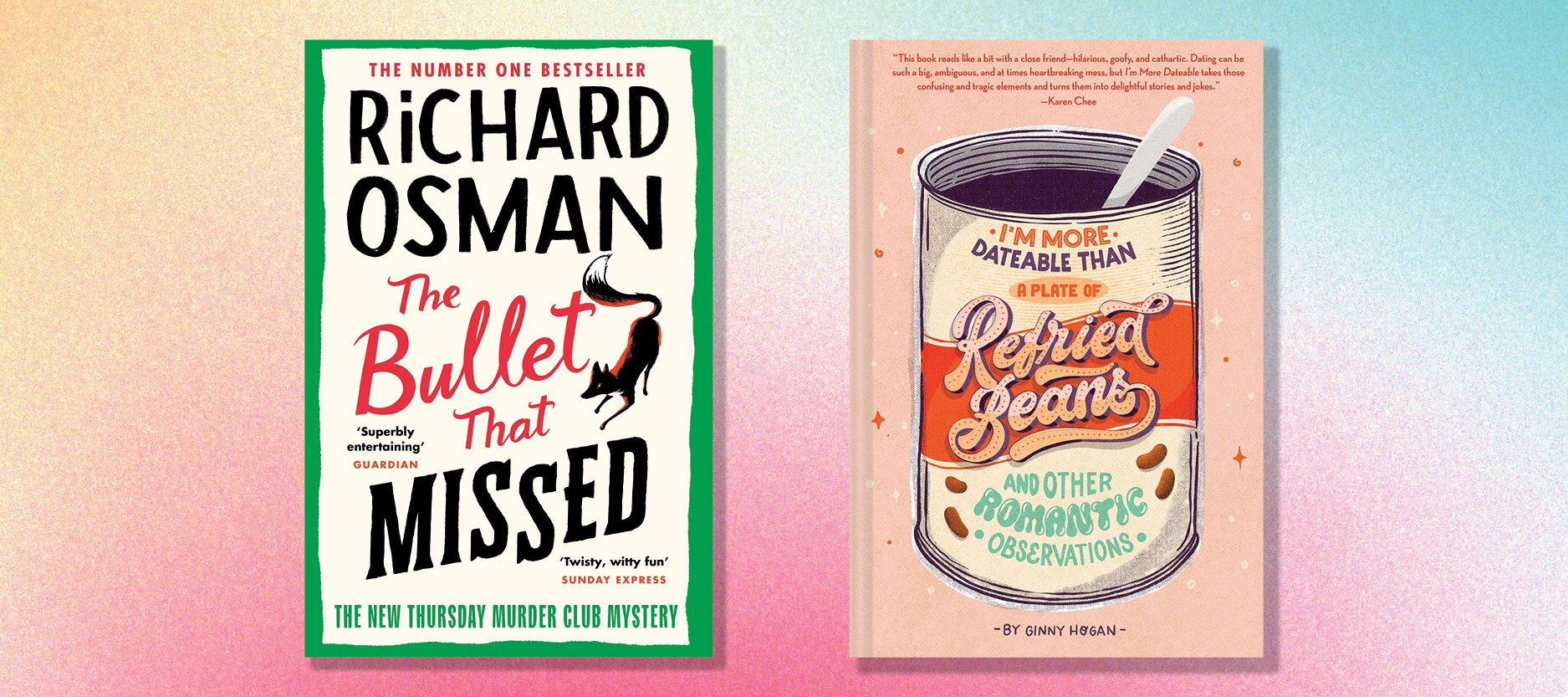
I’m More Dateable Than a Plate of Refried Beans: And Other Romantic Observations by Ginny Hogan Expect to laugh out loud at this humorous collection of observations of the peaks and troughs of modern romance. Comprising a series of absurd yet relatable stories in which comedian Ginny Hogan sends-up the arbitrary rules of modern dating, this book is perfect for anyone who needs a giggle.
The Bullet That Missed by Richard Osman In this thoroughly entertaining read, beloved British author Richard Osman returns with the third iteration of his Thursday Murder Club series, this time involving a decade-old cold case, a local news legend and a murder with no body and no answers. Told with Osman’s signature wit, this thrilling mystery will draw you in for its story and keep you there for its humour and heart.
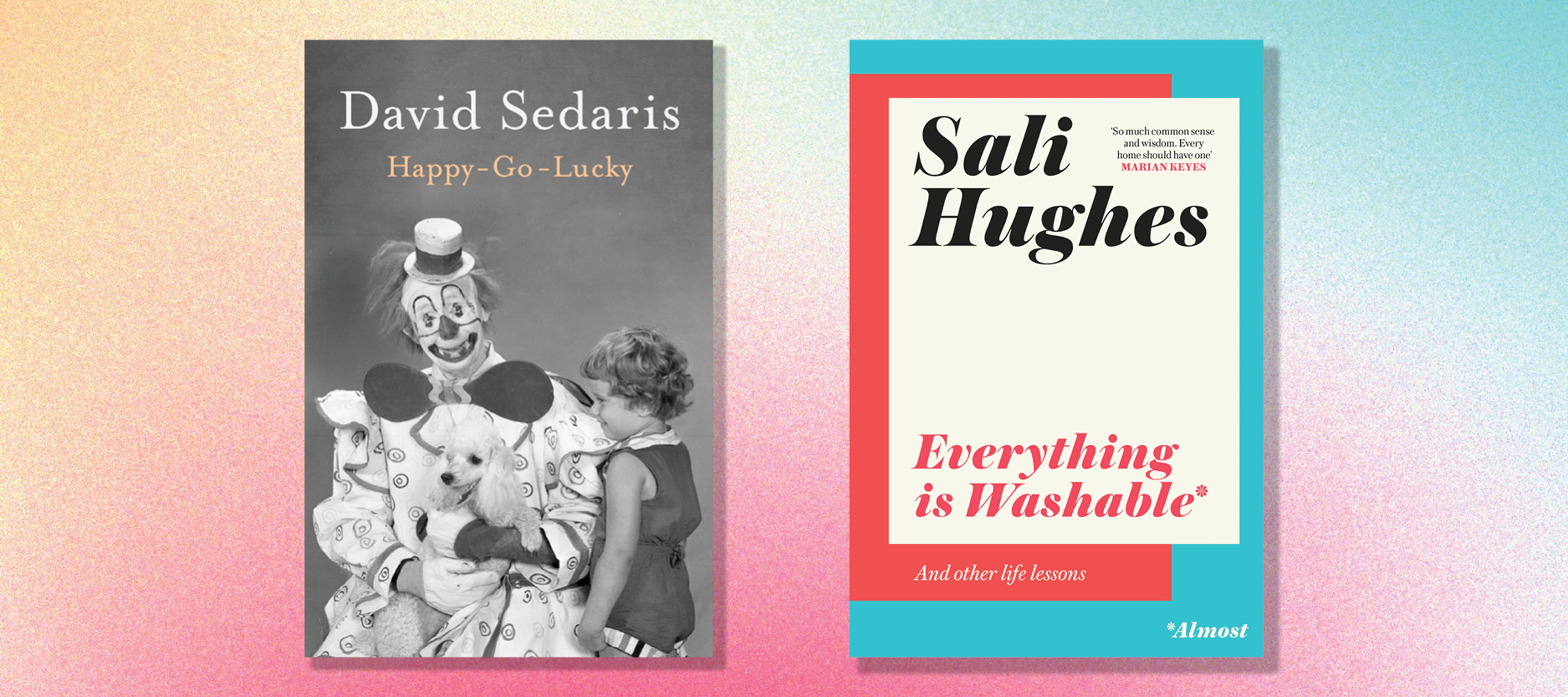
Happy-Go-Lucky by David Sedaris Having long set the standard to which other humour essayists can only aspire, renowned writer and storyteller David Sedaris is back with a new collection of personal essays. Here, Sedaris offers a moving, deeply personal and undeniably funny analysis of his complex relationship with his father, through 18 stories set in the lead up to, and just following his death.
Everything is Washable by Sali Hughes Offering the advice you need, but none you ever seek, journalist Sali Hughes has curated everything she has learned thus far that has carried her in good stead. From her signature martini recipe and 37 things to have in your cupboard to how to support a friend going through IVF, it is humourous, with only an iota of seriousness, and is utterly relatable for everyone at some level. Everything is Washable is a forever bible that makes a superb gift to friends, or even your own library as a guilty pleasure. Released next month, you’ll want to pre-order a copy, stat.
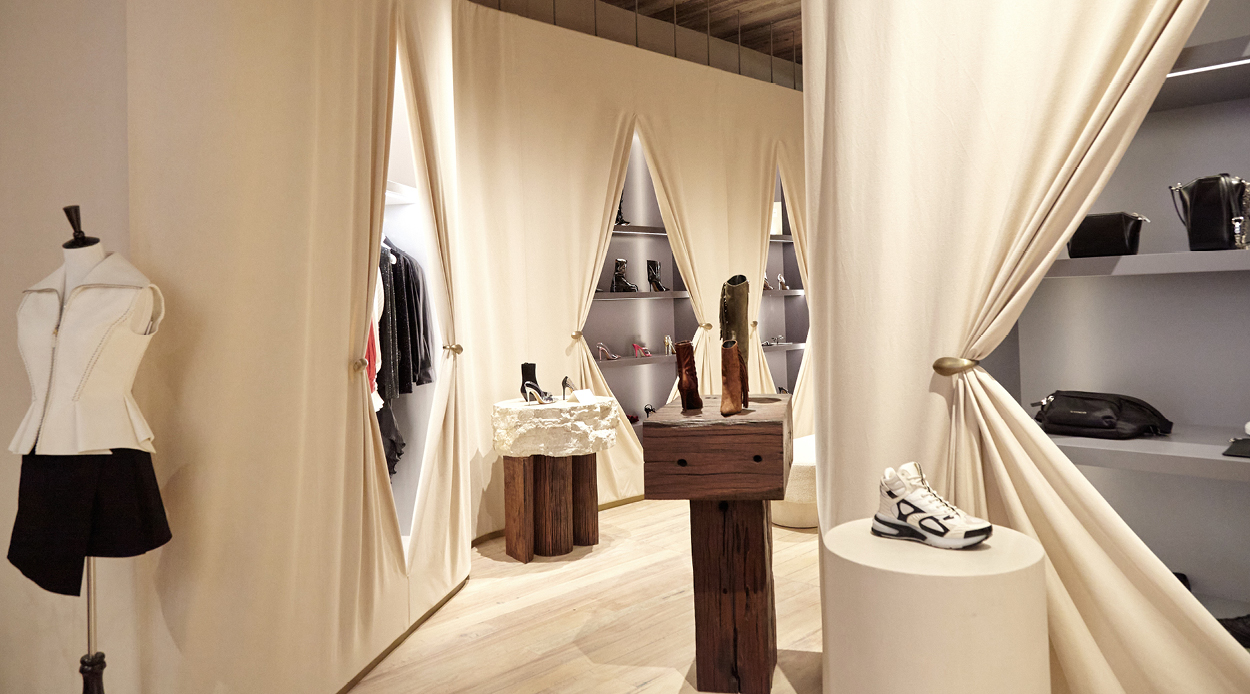
Since opening almost a year ago, Faradays has become a haven for Auckland’s most discerning fashion and homeware collectors. Its curation of high-end brands is one of the most impressive in the country, and its chic interiors offer the kind of experience you might expect to find overseas.
More importantly, however, Faradays is a store that acknowledges our collective appetite for high-quality, fashion-forward, luxury, with the clever minds behind it refusing to underestimate the taste of the New Zealand consumer and buying collections that feel fresh, elevated and international. Naturally, it has become one of our favourite retail destinations in Auckland.
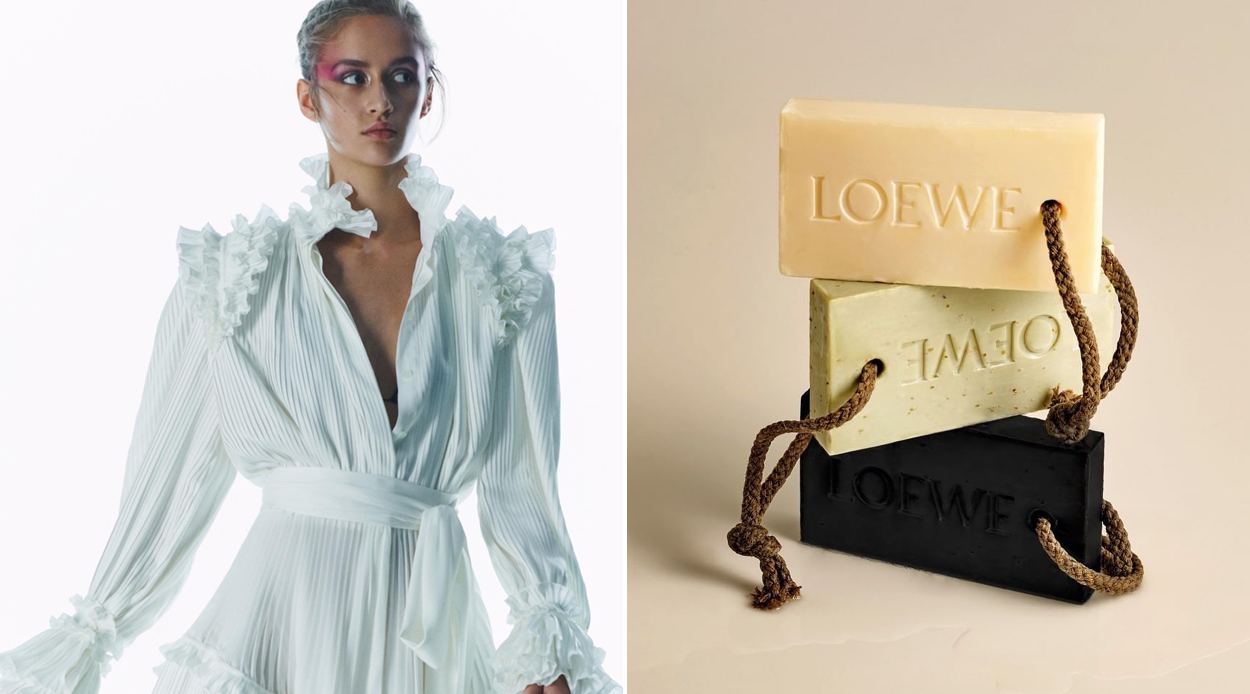
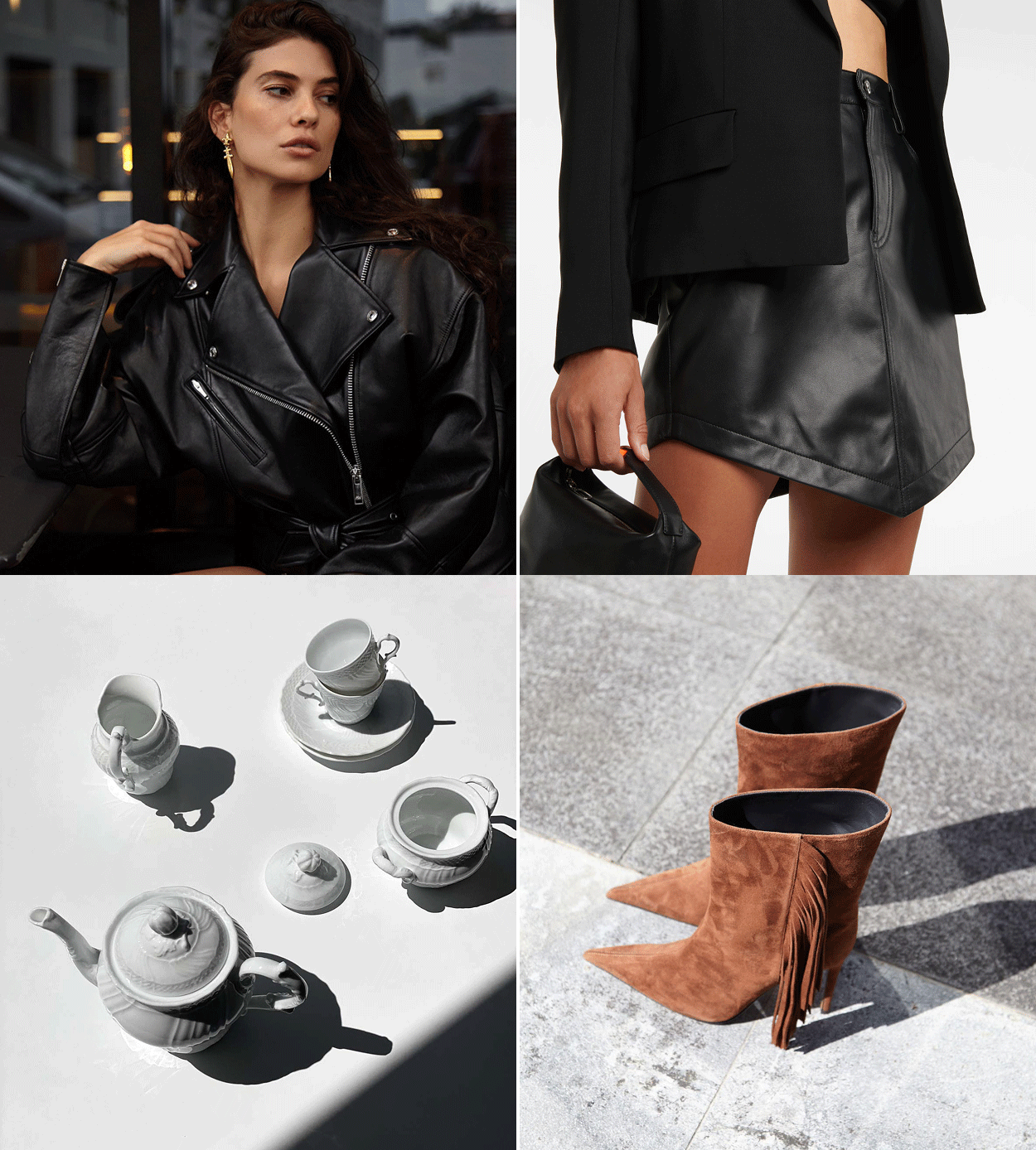
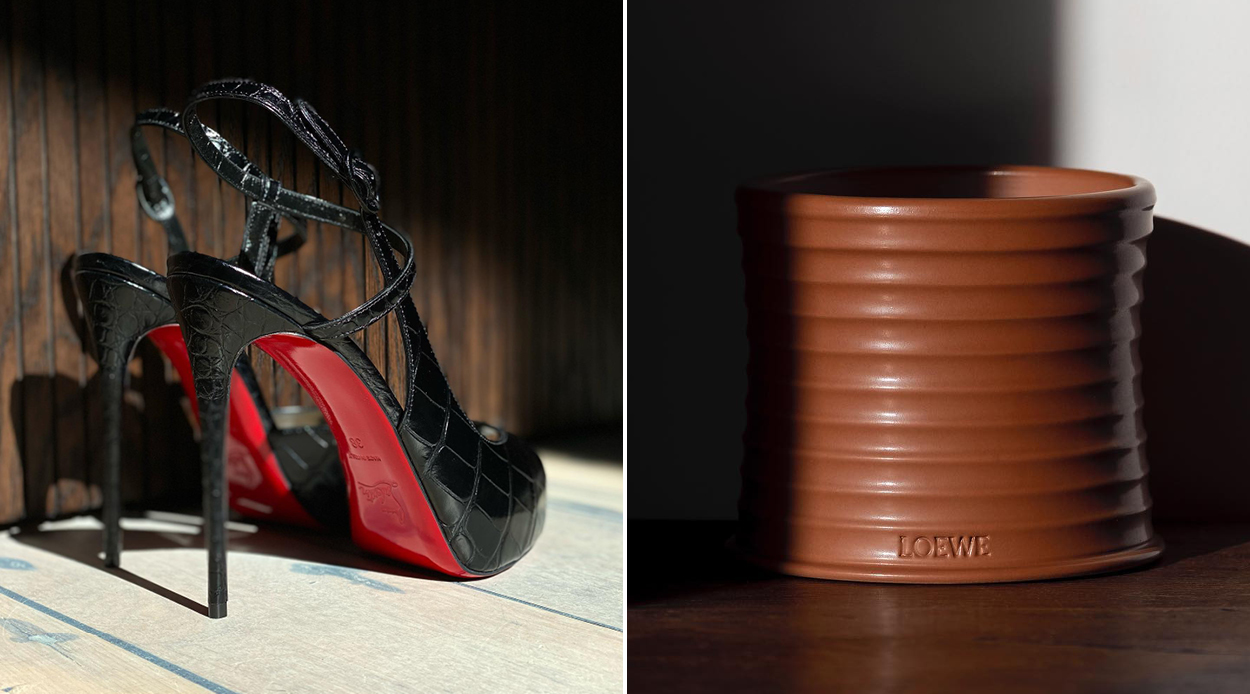
Now, Faradays is about to kick off its inaugural Spring Sale, offering an unmissable opportunity to pick up a special piece for anywhere between 40% and 70% off. On from tomorrow (Saturday the 17th of September) and running for one week only, the Faradays Spring Sale will see a huge number of pieces from brands like Loewe, Givenchy, Christian Louboutin, Bordelle, La Perla and more available at enticing prices, and will span ready-to-wear, accessories and selected homewares.
Only running for a limited time and given how rare it is for a store of this calibre to offer discounts, the Faradays Spring Sale is set to be wildly popular. So, we suggest popping over to Parnell promptly this weekend, lest you miss out on the best in-store exclusive deals.
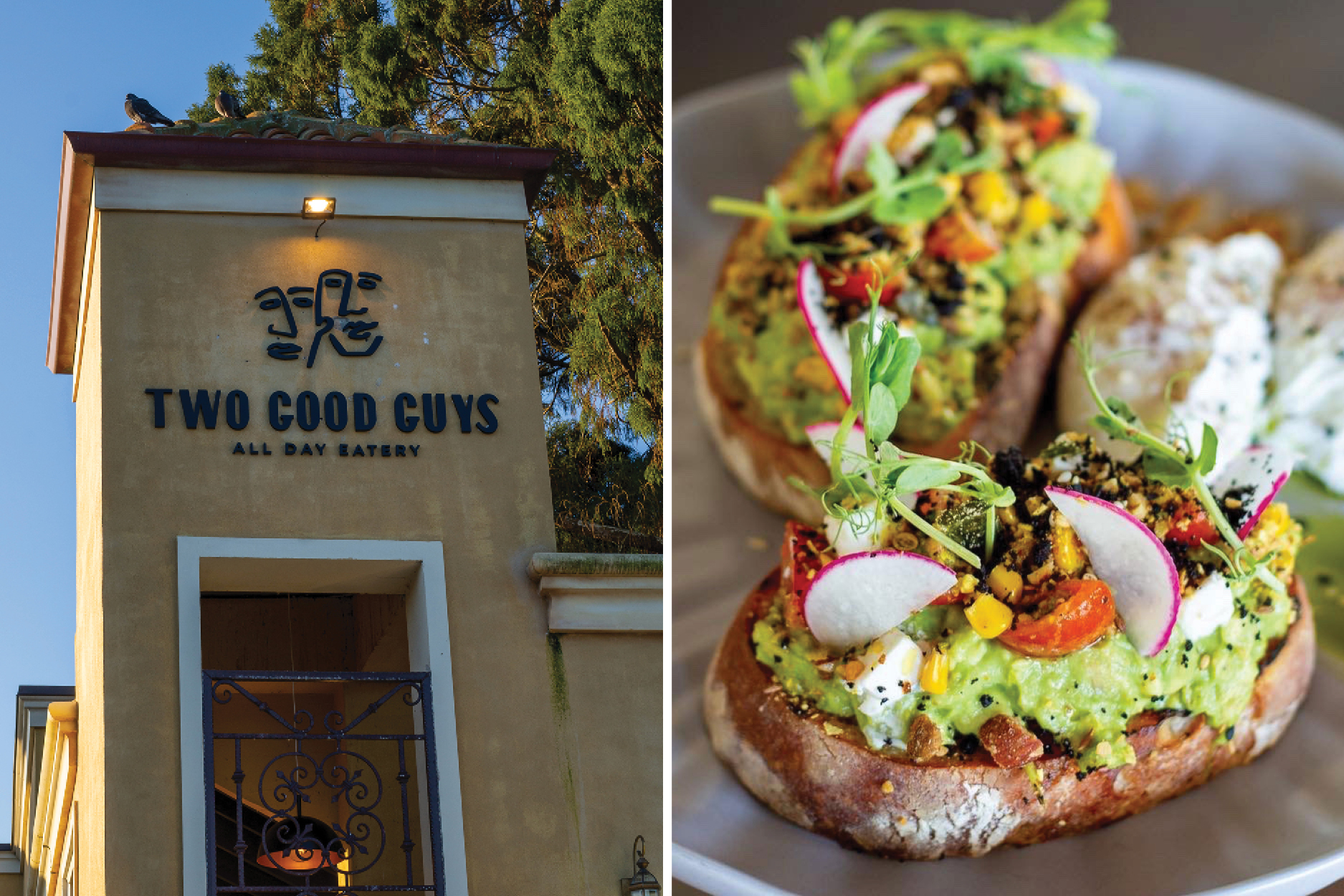
Taking inspiration from the best of the Mediterranean, West Auckland’s delicious new dining destination clearly indicates the calibre we can expect in suburban dining across the city. Two Good Guys is the latest eatery that we anticipate will soon be the talk of the town. (Although if local reviews are to be trusted, it looks as though it already is.)
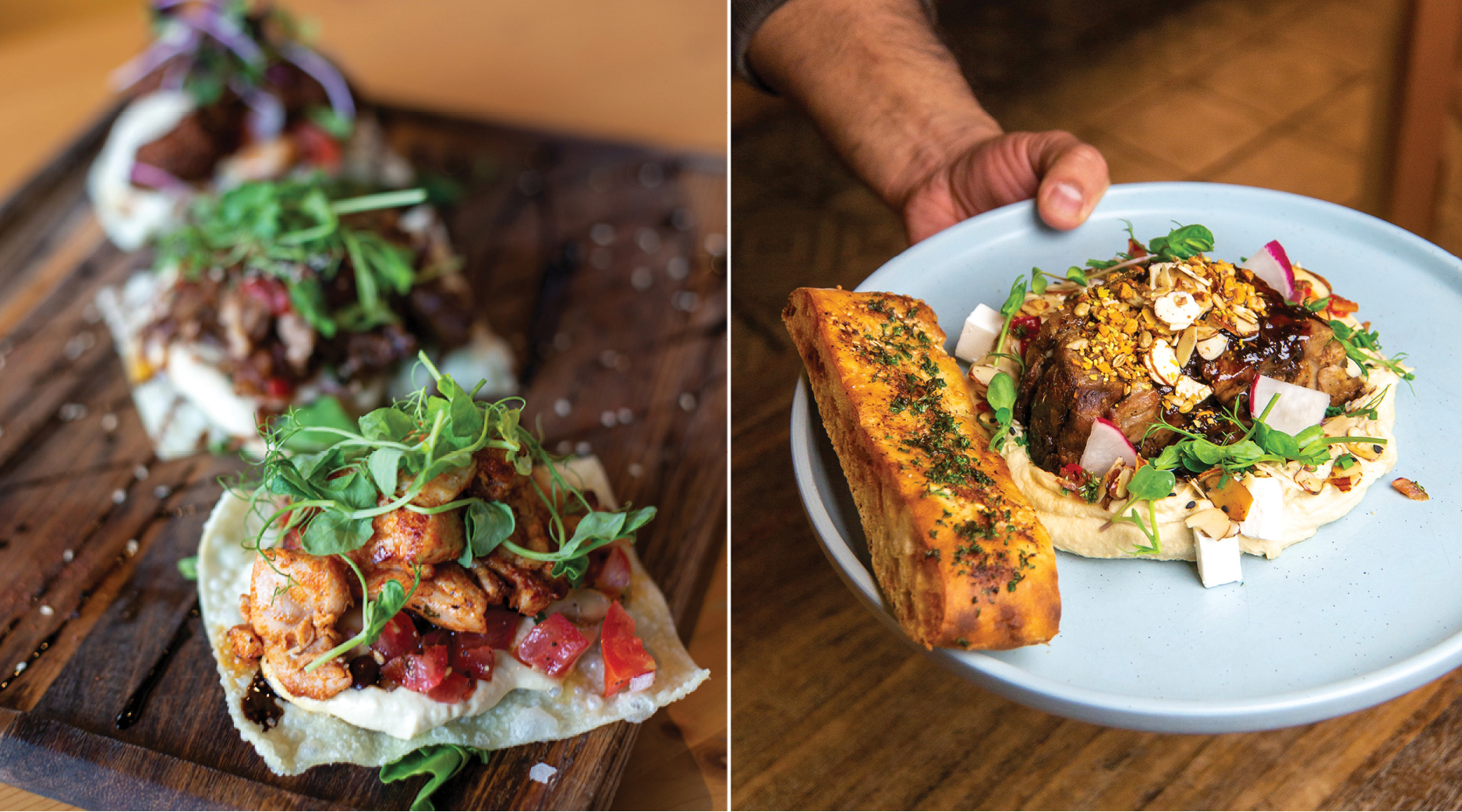
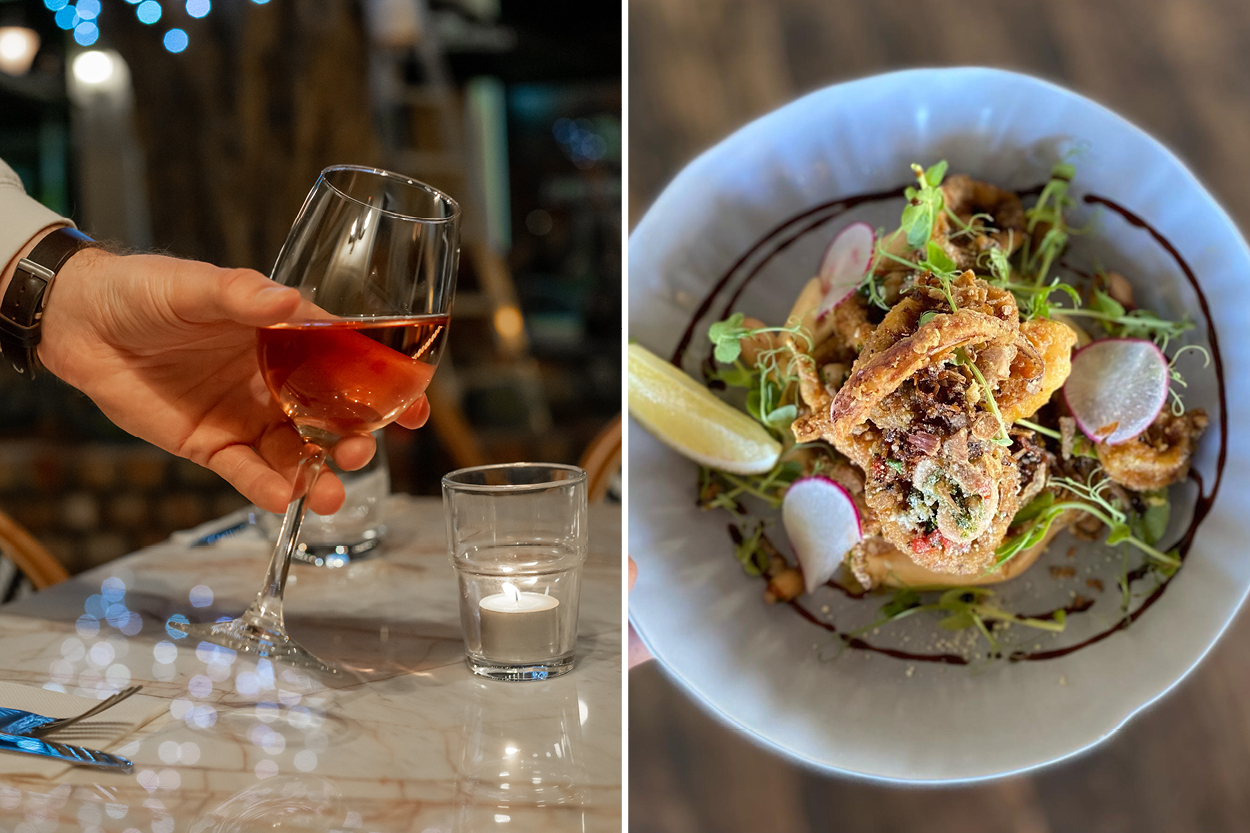
Co-owners Lovepreet Lubana and Vasu Pulka met when working together at Titirangi’s Deco Eatery, before going on to Point Chev’s Nomad and The Beekeeper’s Wife in Riverhead.Now, at Glen Eden’s Two Good Guys, inspiration is found in the kind of food that would feel right at home in Ottolenghi’s kitchen, offering fresh, South East Mediterranean-style dishes with mouthwatering flavours. And given that it is open from the morning until late into the night, Two Good Guys offers a wide variety of dishes across both its day and night menus — promising to cater to every persuasion.
Right: Sesame Coated Calamari, green leaves, sambal mayo.
For brunch, we’re inclined to reach for something like the Two Good Guys wrap, where the Mediterranean influence results in a tasty morsel that will get any day off to a good start. Yet Singh confesses that the most popular dishes have been the unbelievably fluffy vanilla pancakes or the aptly-named ‘Hangover Breakfast’. And we have it on good authority that, come dinnertime, the 24-hour braised beef cheek is a clear winner, served with a butternut purée, horseradish parfait, onion jam, dates and a bordelaise sauce.
“Our food combines the best flavours of the Mediterranean with high-quality New Zealand produce,” Singh explains to me. “We offer a wide range of vegetarian, gluten-free and dairy-free dishes, and our meat is Halal, to ensure that we can cater to everyone.”
Mediterranean inspiration isn’t just left to the food, either. Even the space at Two Good Guys offers a summery sojourn. We recommend booking a table in the plant-filled brick courtyard, reminiscent of the kind of al fresco Italian dining we’ve been scrolling past enviously on our Instagram feeds of late.
Right: Smashed Avocado.
When Singh first moved to New Zealand, Glen Eden was the first suburb he called home, although he quickly noticed that there were no places to go out for breakfast and dinner that were fully licensed. So, in conceptualising Two Good Guys, the co-owner was drawn back Glen Eden, and naturally, everything fell into place.
And while it might not be an obvious location choice for an eatery of this kind, for the Two Good Guys team, it couldn’t be a more perfect address. Most of the staff are locals and inherently passionate about catering to the growing hospitality needs of the community. But these delights shouldn’t only be shared among neighbours — if you’re looking to escape your regular haunts and try something new, it is the perfect pitstop on your way to the western beaches this sunny weekend.
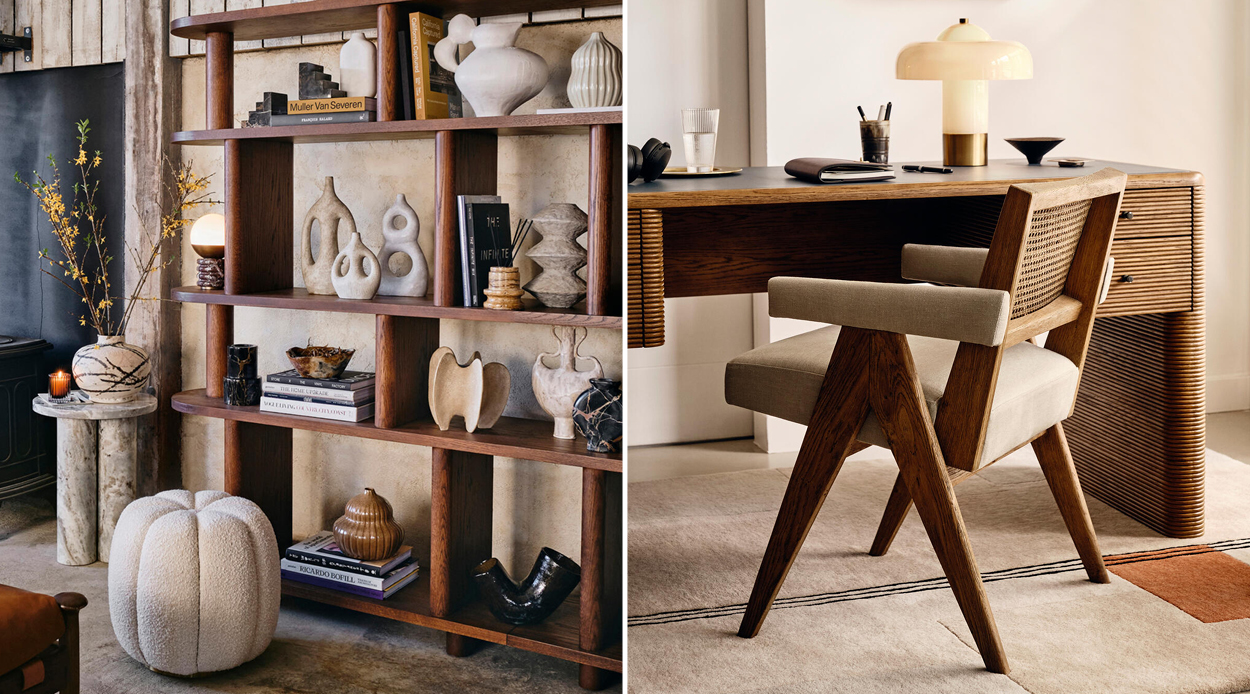
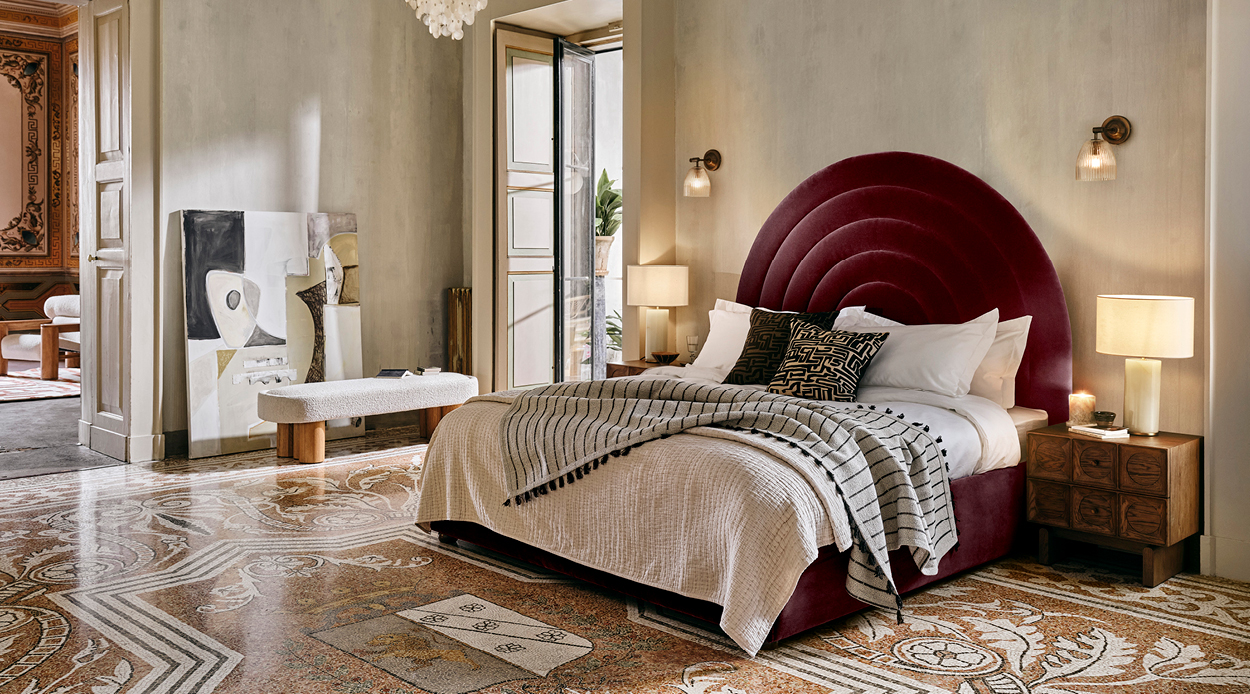
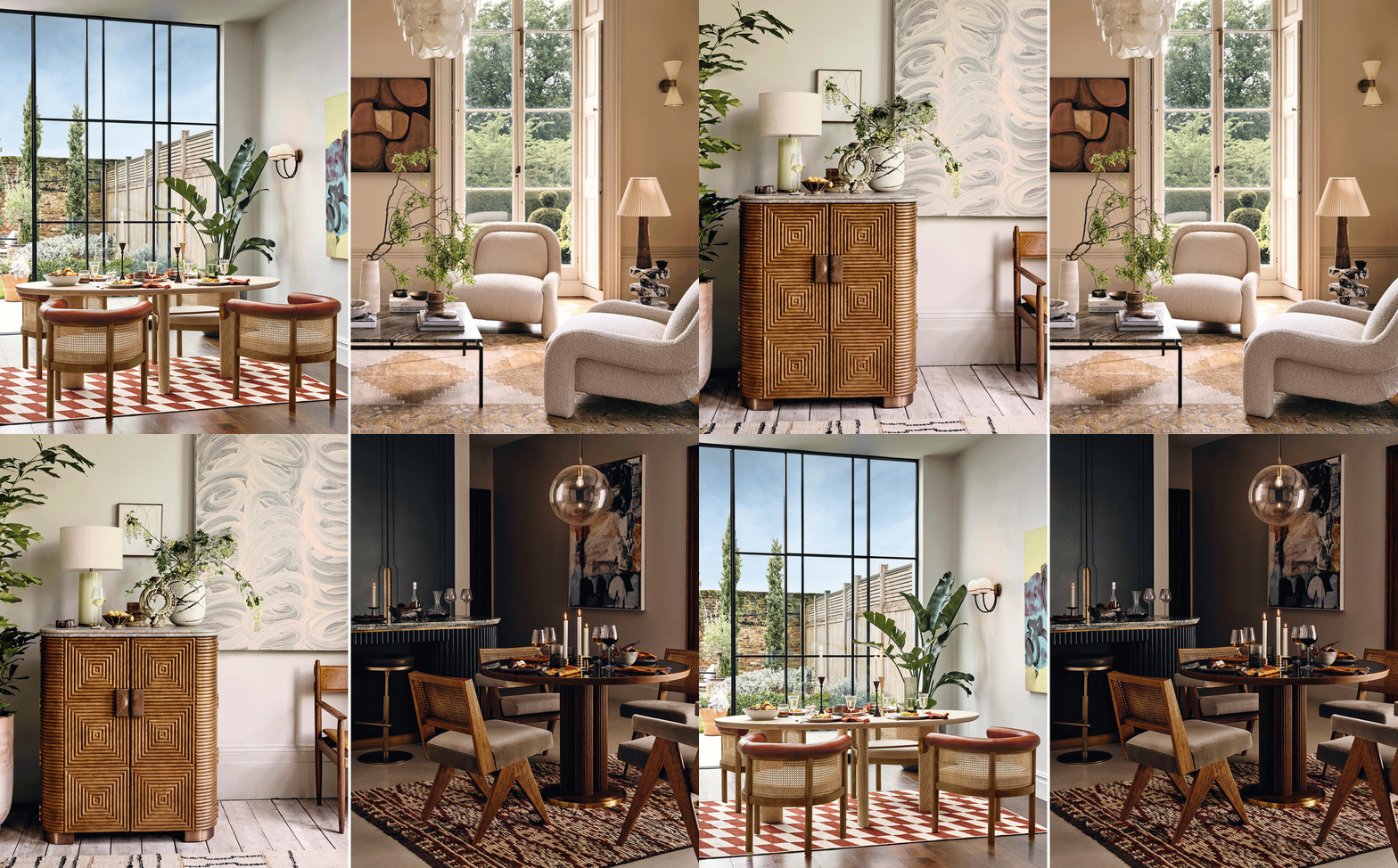
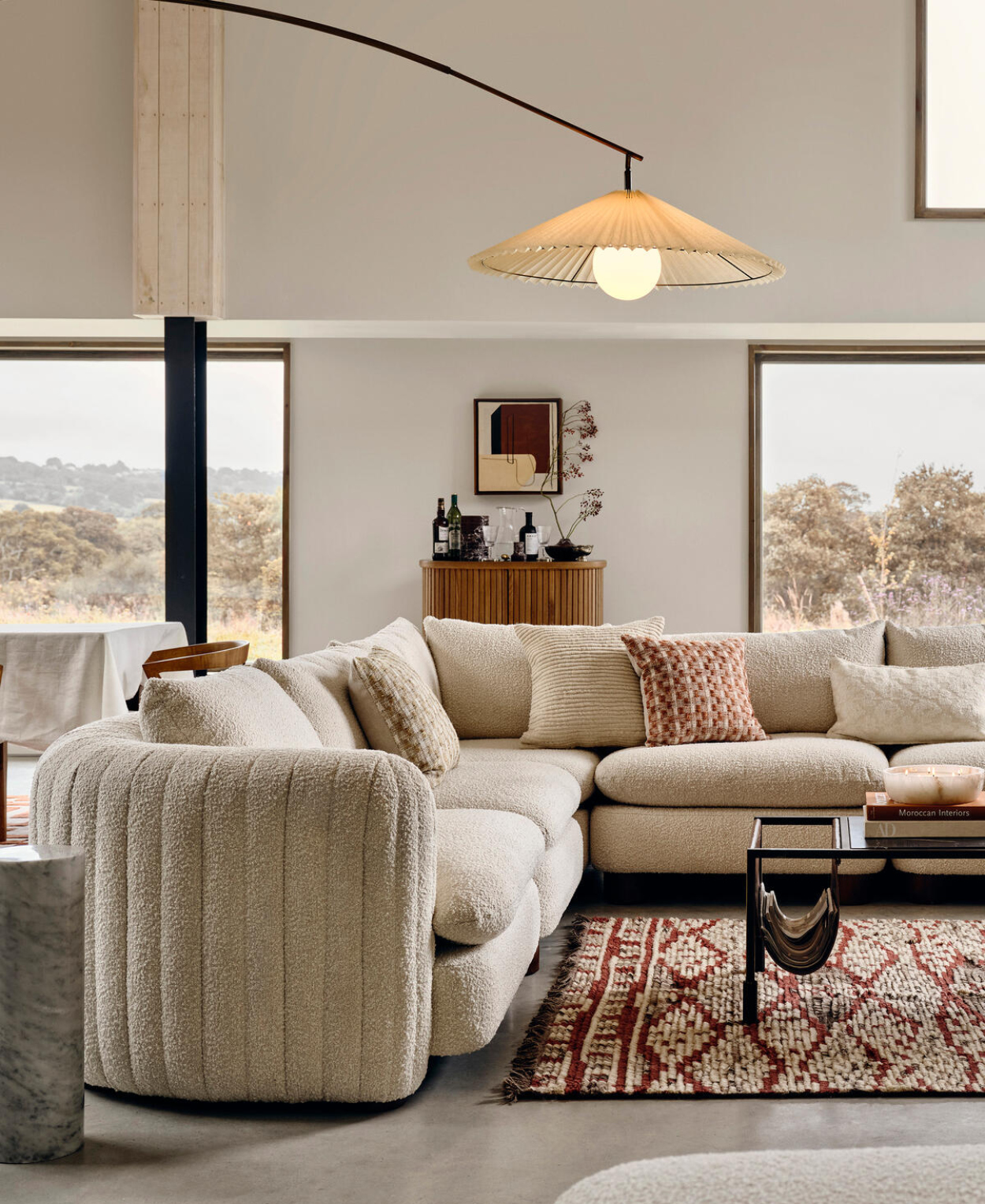
The global, members-only phenomenon that is Soho House comprises a number of exceptional, design-led properties in major cities around the world. It is a brand renowned for the unique environments it creates, offering rest and comfort, as well as meeting, working and entertaining spaces for its community of creatives. And although we might not have our own Soho House here, tapping into the vibe has never been easier with the recent arrival of Soho Home in New Zealand.
Available to order exclusively from local interior-design authority Design Central, Soho Home aptly mirrors the look and feel of Soho Houses worldwide, allowing you to infuse your spaces with sophisticated savoir-faire. Design Central’s masterful experts are well versed in the heritage brand, able to guide you through the luxurious array of furniture, lighting, textiles and dining accessories that Soho Home has to offer.
Certainly a sophisticated, noteworthy offering to consider, whether you’re looking to refresh your existing decor or source a one-off piece to elevate the ambience of any room, we highly recommend you experience the intangible magic of Soho Home for yourself.
Come Friday afternoon, the conversation inevitably turns to weekend plans. In the Denizen office, this means discussing which restaurants we plan on visiting, and which dishes we intend to order. With social media providing all manner of temptation throughout the week, a curated shortlist is vital for weekend dining success. So without further ado, here are the delicious dishes from around Auckland that you need to try over the weekend ahead.
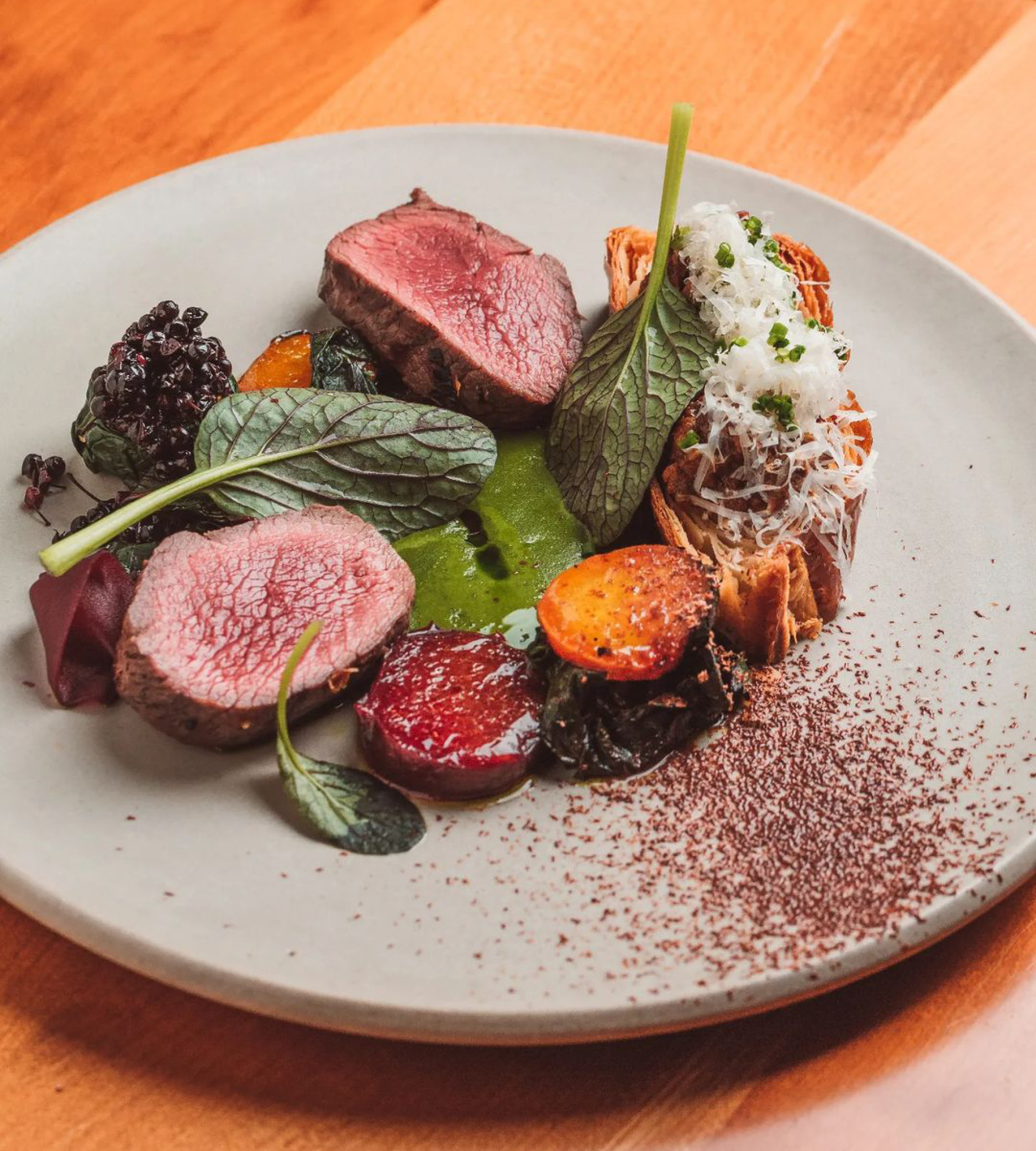
1. Wild Red Deer Sirloin from Ahi While the days of wintry dishes are almost numbered, we plan on returning to Ahi for a final taste of a seasonal favourite. The Wild Red Deer Sirloin is simply unparalleled, with tender, juicy meat that is premium quality and cooked to perfection. Served with equally-tender coal-baked beetroot, creamed horseradish, activated walnuts and a cheese savoury, it is a dish we would happily order all year round.
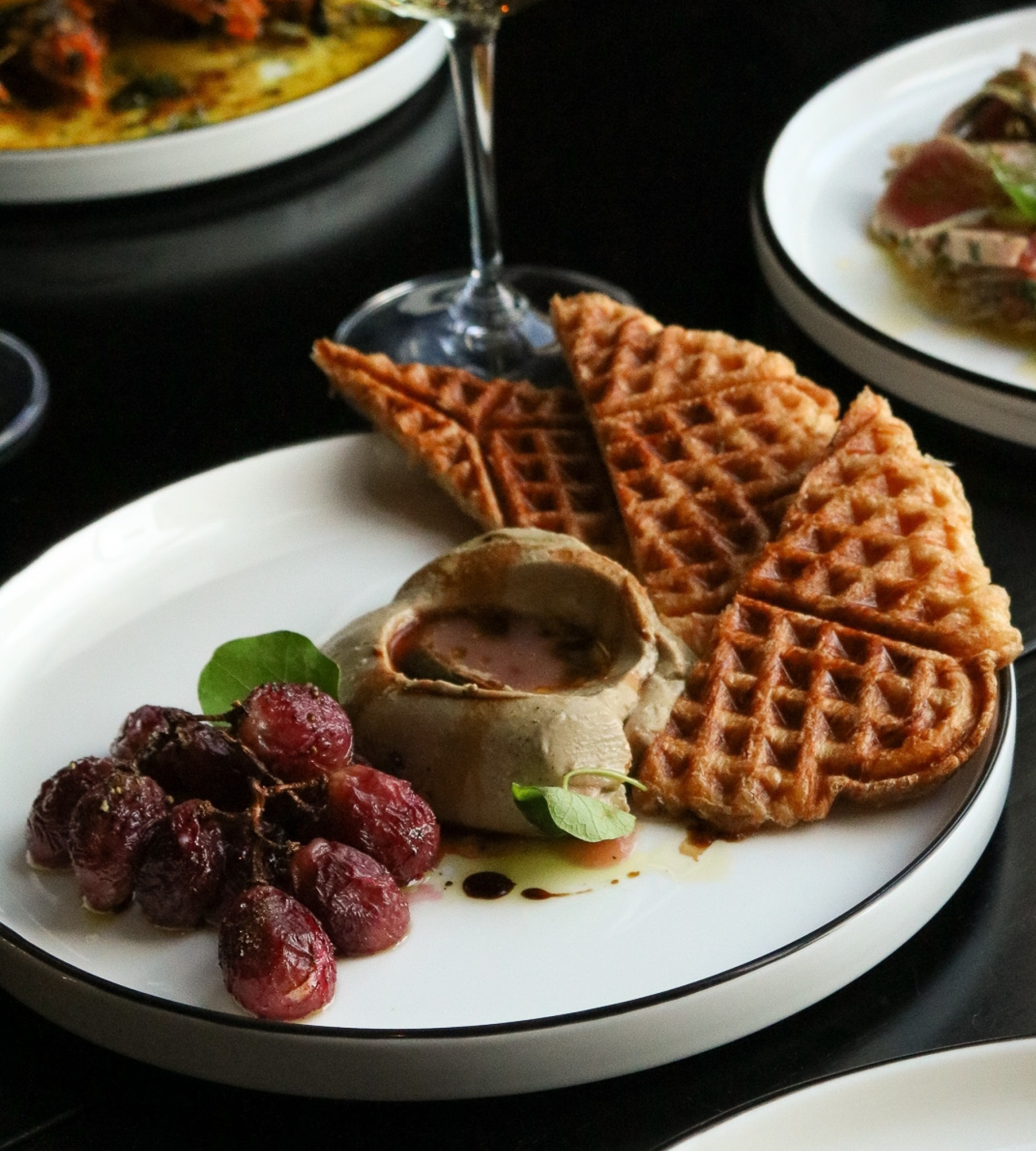
2. Duck & Waffles from Jervois Steak House We have it on good authority that this dish is set to be our new favourite — and while we haven’t had a chance to try it yet, it’s one we’ve been hanging out for. Here, the kitchen has paired duck liver parfait with croissant waffles, roasted grapes and vin coyto, giving us the elevated take on the ‘croffle’ we’ve long been craving.
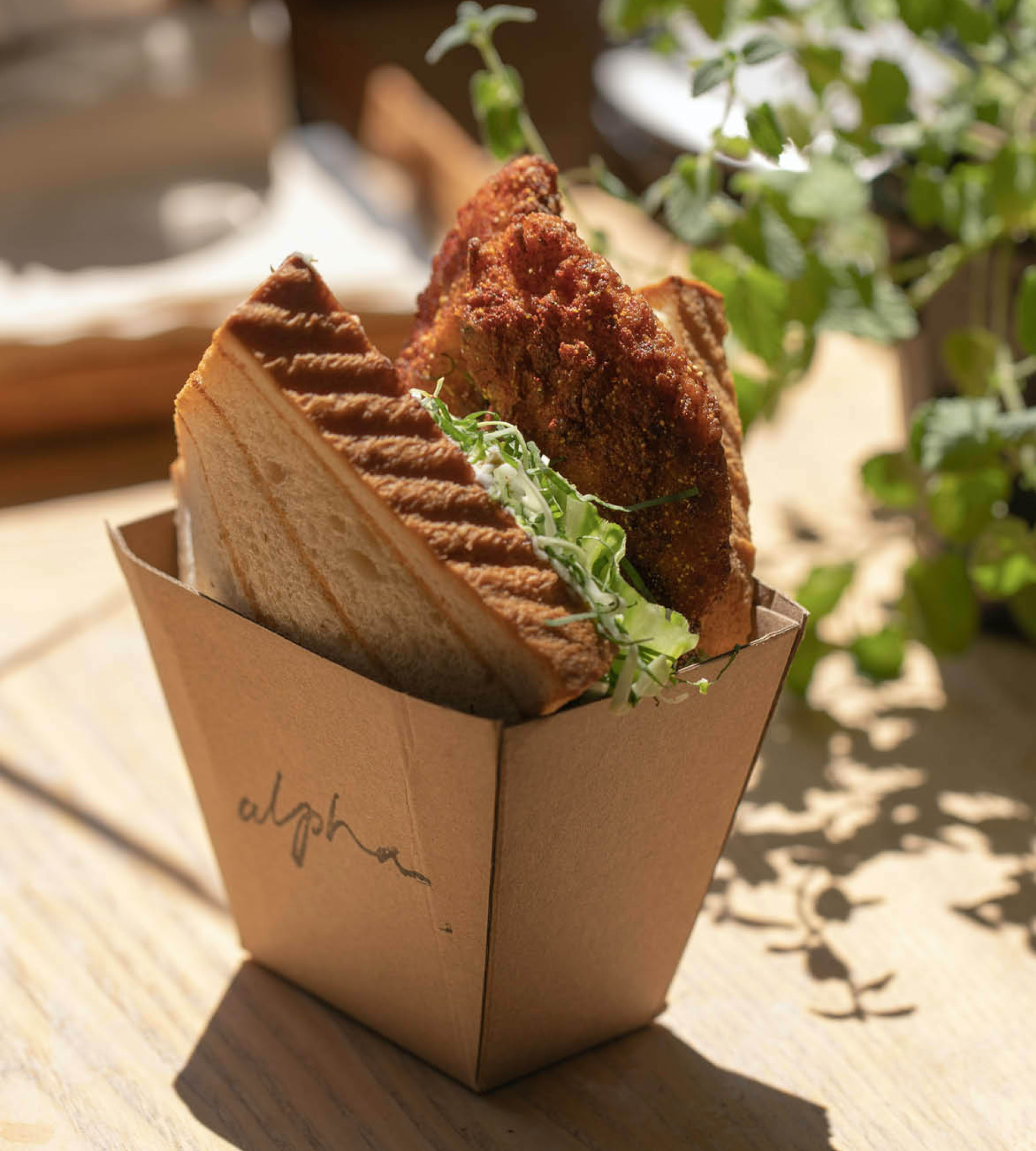
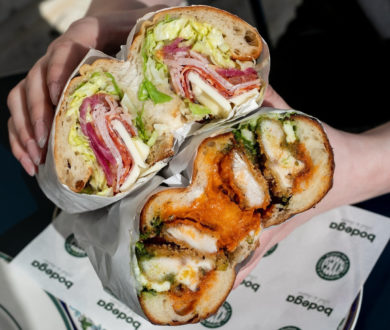
3. Hot Fish Sando from Alpha Despite its small, intimate nature, there is no shortage of dining inspiration at Alpha. Set up as Pasture’s ‘test kitchen’, this cafe (which has recently expanded into night-time service, too) showcases how creative the culinary process can be. The absolute must-try dish is a simple sandwich that might just be the best iteration of this classic staple we have ever tried. Hot market fish (both in temperature and spice) is placed between fluffy shokupan bread, with homemade tartare and crunchy lettuce. It’s perfectly spiced, outrageously flaky and completely, utterly delicious.
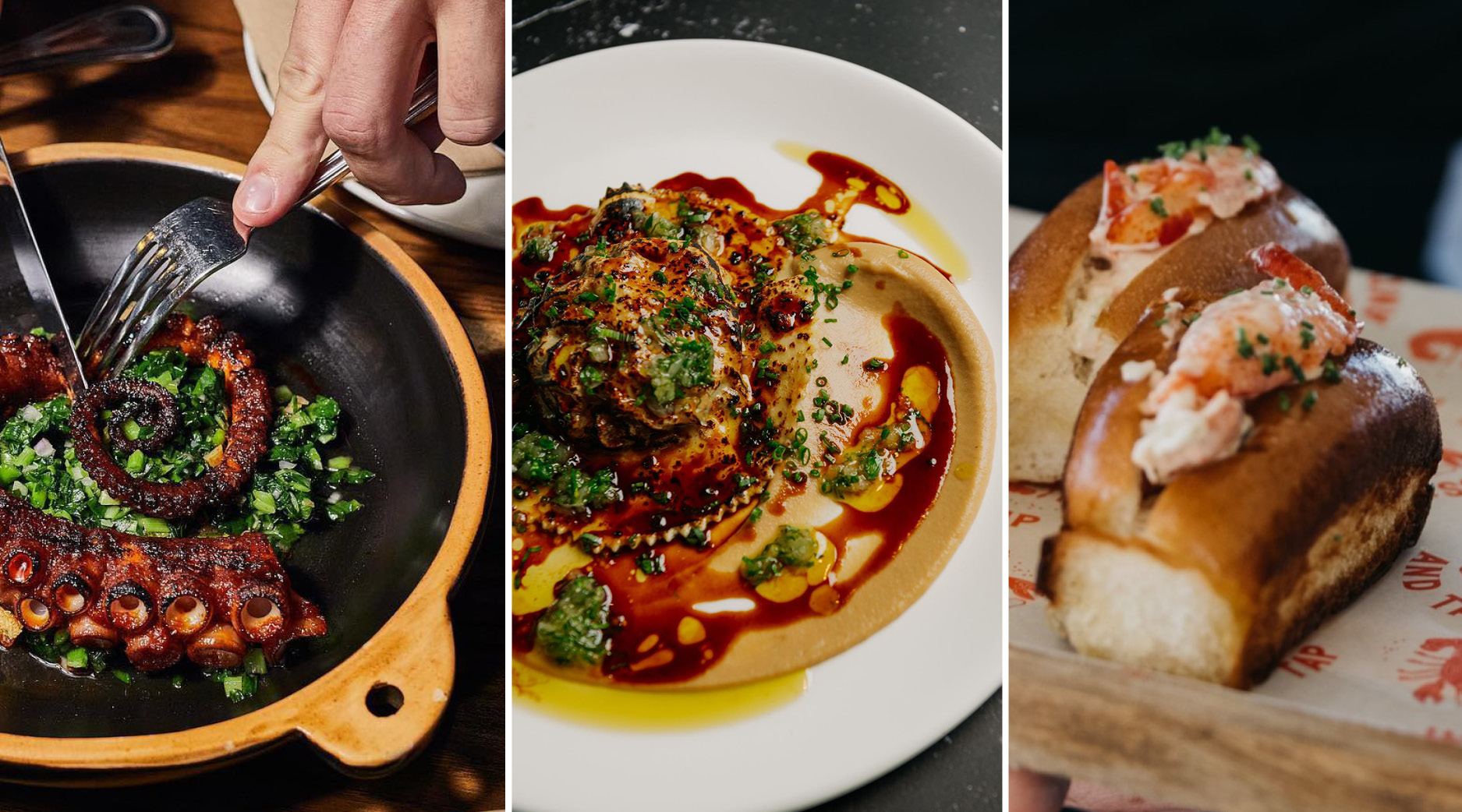
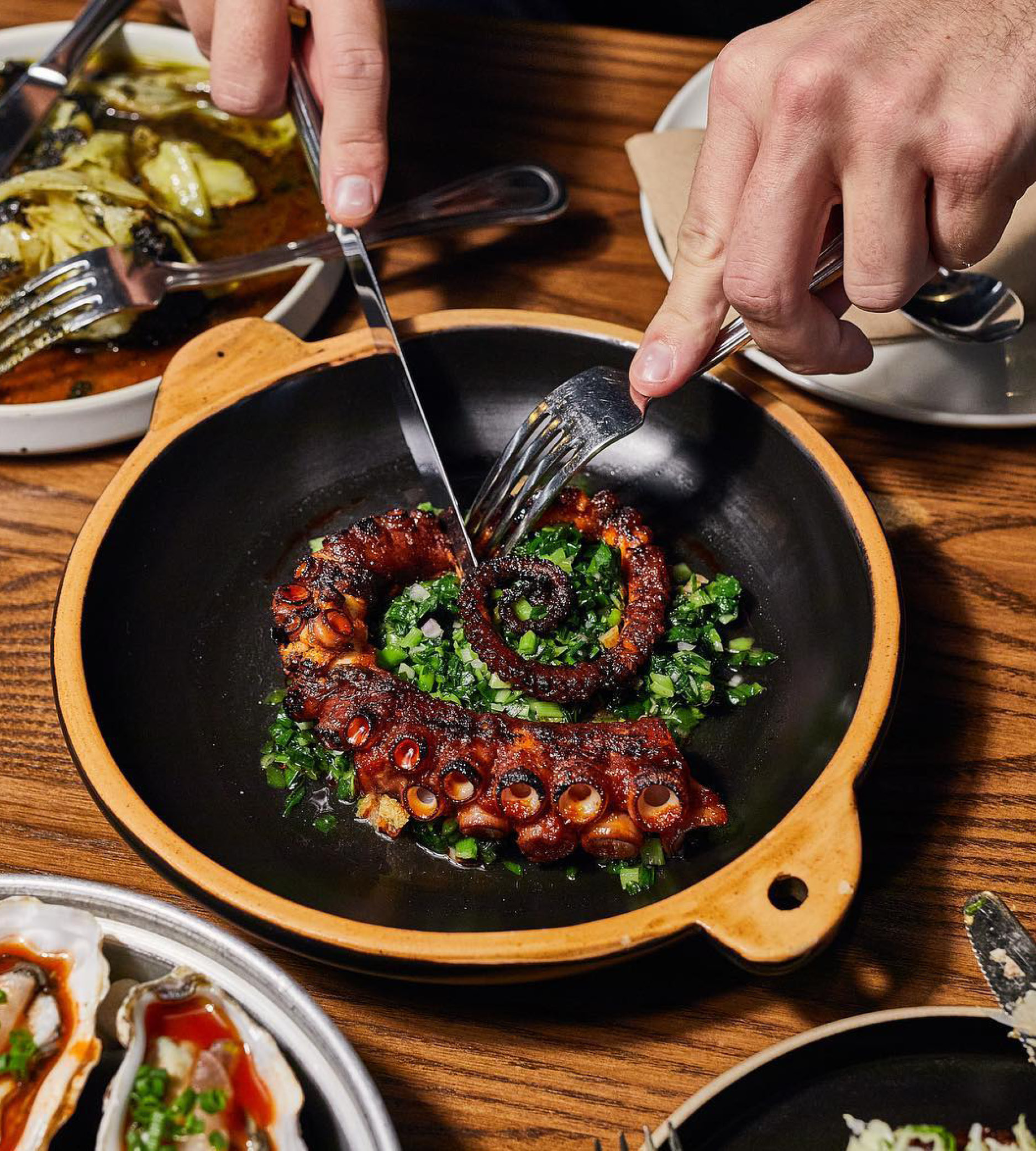
4. Gochujang Charred Octopus from Gochu The popularity of Gochu head chef’s latest venture, Tokki, has us looking back to his Commercial Bay roots (conveniently easier to find a booking for). And while diners often come for the milk buns, they always stay for the unassuming favourites — the gochujang charred octopus being one. Resting on a bed of garlic chives, shallot namul and cashews, one could almost call this healthy, if it wasn’t so damned delicious.
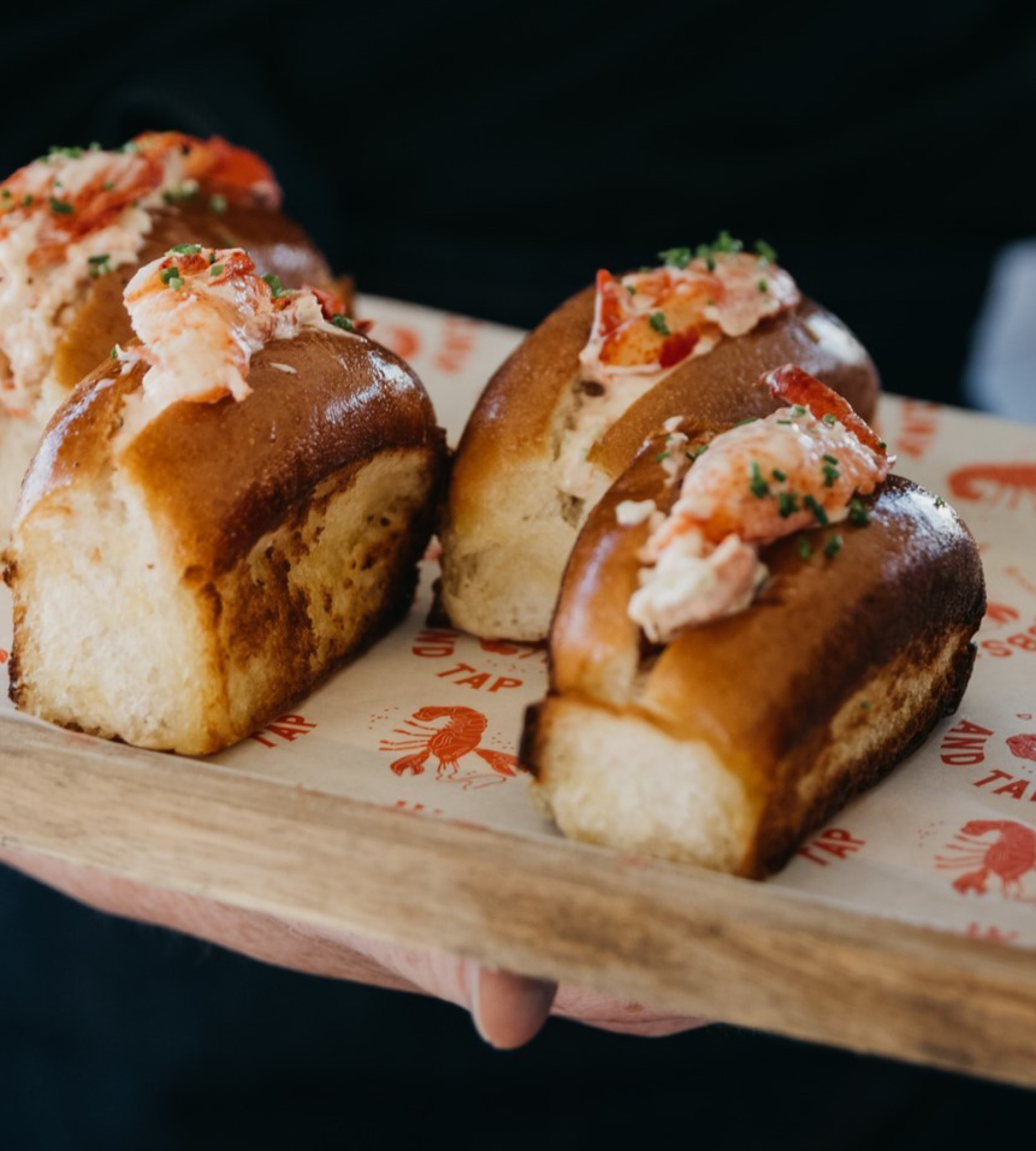
5. Hot Buttered Lobster Roll Combo from Lobster & Tap Sweet, divine, and always best served with lashings of butter, lobster is something we often crave. Leave it to Lobster & Tap, purveyors of the most elevated humble lobster in the city, to hit the spot just right. We’re quite grateful for the Hot Buttered Lobster Roll, with chopped lobster meat, clarified butter, lemon and chives, served warm on a hot toasted bun. Paired with chips (or crisps), coleslaw and pickles, it’s the most delightful addition to a weekend of dining.
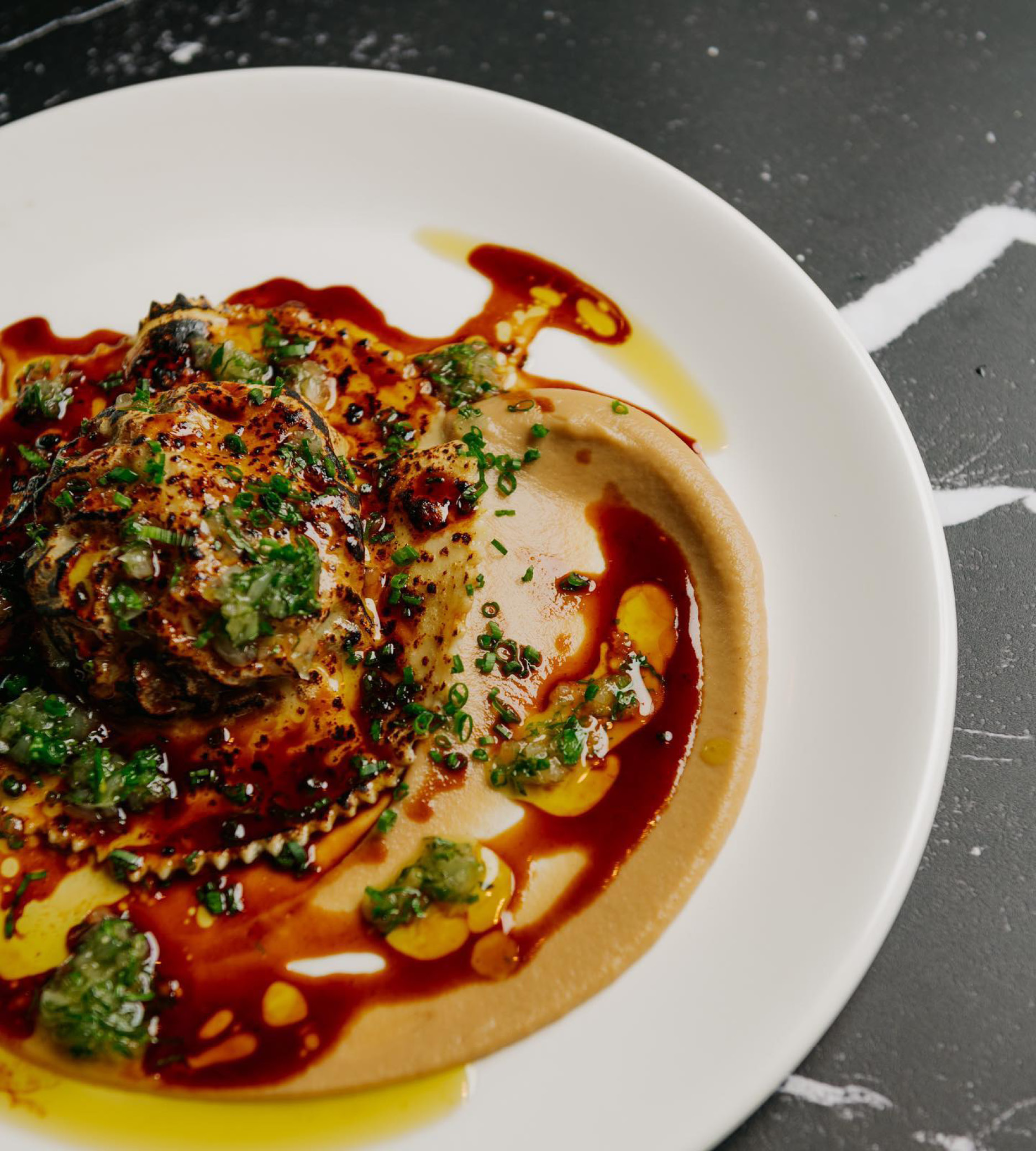
6. Wagyu Oxtail Raviolo from Soul Bar & Bistro It’s a big call but this just might be Soul Bar & Bistro’s greatest pasta to date. Never a venue to shy away from bold new flavours, Soul’s heavenly raviolo is the crown jewel of its current menu. Served with celeriac and pickled onion gremolata, this satiating dish is packed with rich, warming flavours that complement a perfectly-filled piece of al dente pasta.
The future of haircare is sustainable — proven by the impressive measures many world-class salons are taking to use products that are as good for the environment as they are for our tresses. Here, we sit down with Servilles’ Newmarket Salon Manager, Olivia Davies, to talk about her recent trip to the Davines Village in Palma, and what she learned about the latest innovations in haircare.
Why is there a big shift to sustainability in haircare? I believe clients are so much more interested in and knowledgeable about the actions and environmental impacts of cosmetic companies these days. Our individual and daily consumer choices can really impact the bigger picture and we don’t have to look too far to see the effects global warming is having on our earth. Sustainability is becoming more important in our lifestyles than ever before and the hair industry is no different. Davines is a pioneer of sustainable hair care and the driver of innovation for the rest of the industry, with it’s priority to not only be the best in the world, but the best for the world.
Why should someone switch to sustainable products? My favourite benefits would include knowing there’s no animal testing and that the products are all vegan friendly with fewer chemicals and more naturally derived ingredients. Renewable energy production is used to make the products and packaging — contributing to the reforestation and organic farming projects that help take care of our planet during production. Last but not least, these products often lead to much healthier hair.
Davines scientific garden.
Davines is known for the scientific garden, which informs the beautiful formulas. What happens there? Davines uses this place to study and find inspiration through its organic farming techniques and biodiversity. When I was there it was used to host guests with cocktails, canapés and live music. It is used for a range of purposes, but it was by far the most beautiful and memorable part of the village for me.
What philosophies do Davines and Servilles share? Although hair care is our main business we like to focus on the bigger picture. Creating an environment both our teams and clients can be proud of and in which they enjoy spending time — delivering expert advice, experiences and services that help educate and inspire our people.
If you could only pick three products from the Davines range, what would they be and why? Davines’ Oi all-in-one milk is my number one favourite and I use it on almost every single client. It is a beautiful, lightweight, leave-in treatment that nourishes, repairs and protects the hair from daily life and excess heat. Invisible No-Gas spray is my close second. It’s a non-aerosol hairspray that also has high heat protection, perfect to use pre and post-curling your hair. The Natural Tech Renewing conditioning treatment I could not personally live without. I have incredibly sensitive skin and have never found a range I can continually use that deeply nourishes without weighing my long, fine hair down.
As a hairdresser, what difference do you notice when working with sustainable products? Since Servilles converted to a Davines salon six years ago I haven’t suffered from dermatitis or an inflamed scalp post-colour service since. Not only are the products very sustainable, but they also have the highest concentration of naturally-derived ingredients of any brand we have used. We have far fewer client reactions and are able to dispose of over 96 percent of our waste created in the salon sustainably.
What impact do you hope this will have on the world? That it will inspire our clients to make the best choices for their hair and our environment simultaneously; that it will hold other companies accountable for their carbon footprint and environmental transparency; and that more companies follow suit, so our earth can really start to repair.
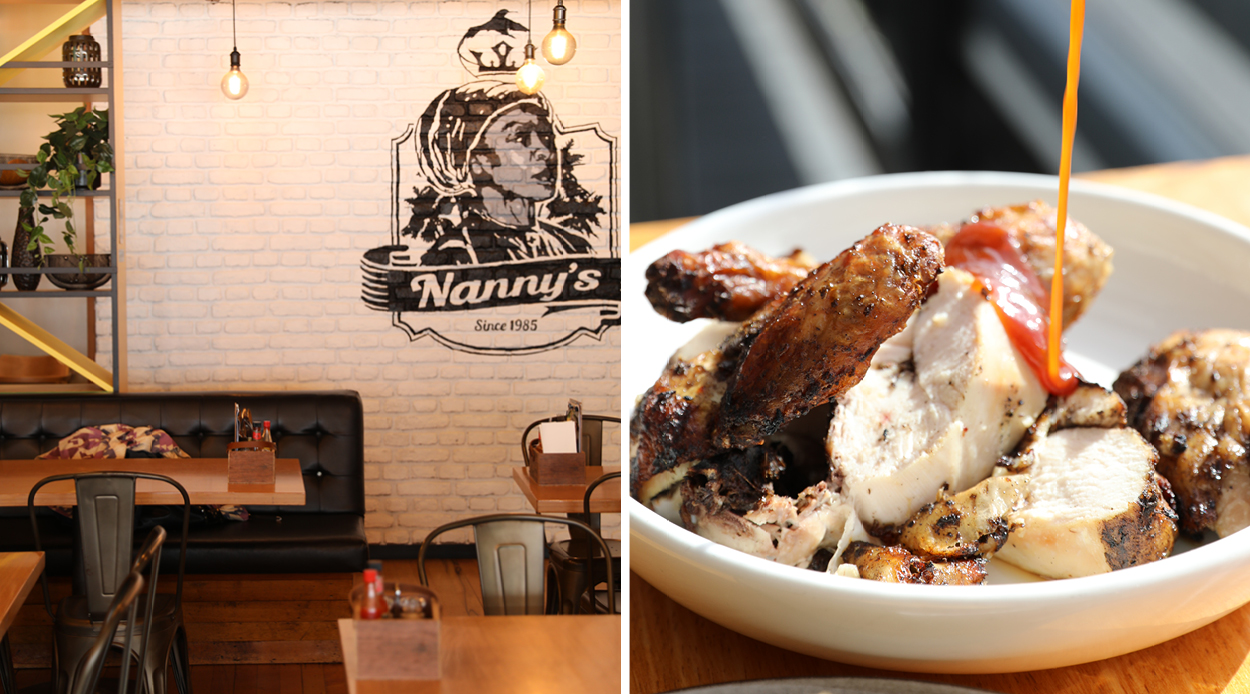
On Kingsland’s main drag lies Nanny’s Eatery, its happy-go-lucky ambience propelling co-owner JP’s vision of stepping into a place that feels like home. “It’s no different than going to your cousin’s house and having a laugh”, he tells me, a twinkle in his eye.
This laissez-faire vibe (with a side of JP’s banter) provides a taste of what’s to come — hearty, belly-warming dishes with bountiful flavour, best shared with family and friends. After all, JP intended Nanny’s Eatery to be a place that satiates your appetite and nourishes your soul.
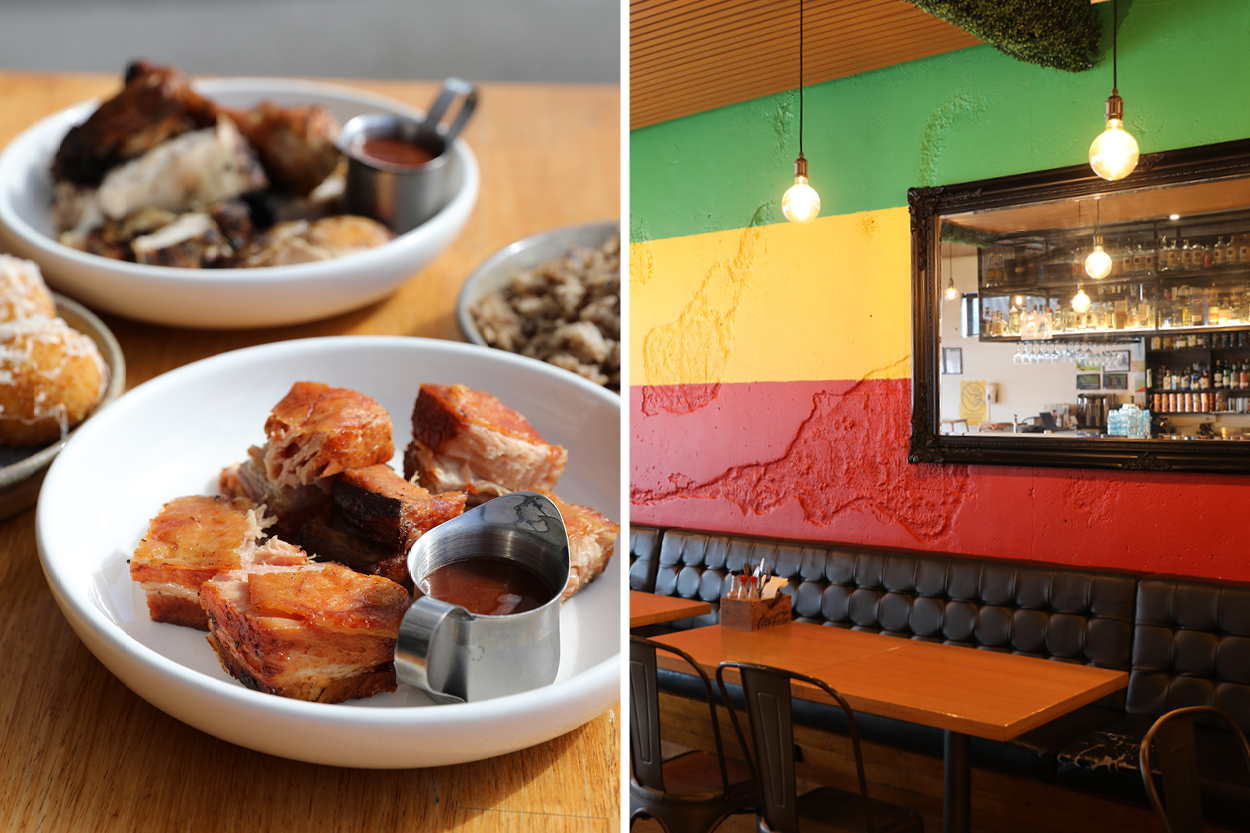
Left: Nanny’s Eatery. Right: Jamaican Jerk Chicken with Rum Barbecue Sauce.
Migrating from Kingston (Jamaica’s capital) to Wellington at the age of fifteen, JP quickly realised that his homeland’s cuisine would fare exceptionally well in Aotearoa. “I knew it would work because when my friends came over and had my parents cooking, they’d rave about it, and the next day at school, they’d be like, ‘dude, can you bring me some [more]?'”.
His love for food ingrained in his DNA, JP recalls fond memories of his childhood in Jamaica, where his mother and grandmother taught him how to cook (and bestowed him with a few trade secrets along the way). After completing high school, he moved overseas to hone his culinary craft, holding an impressive two-year post at a two-Michelin-starred restaurant in Denmark. His ambition to found his own operation led him back to our shores, where his well-received Wellington-based food truck paved the way for his present bricks-and-mortar space, which has been open since the end of last year and we are told is the only Jamaican eatery in the Auckland region.
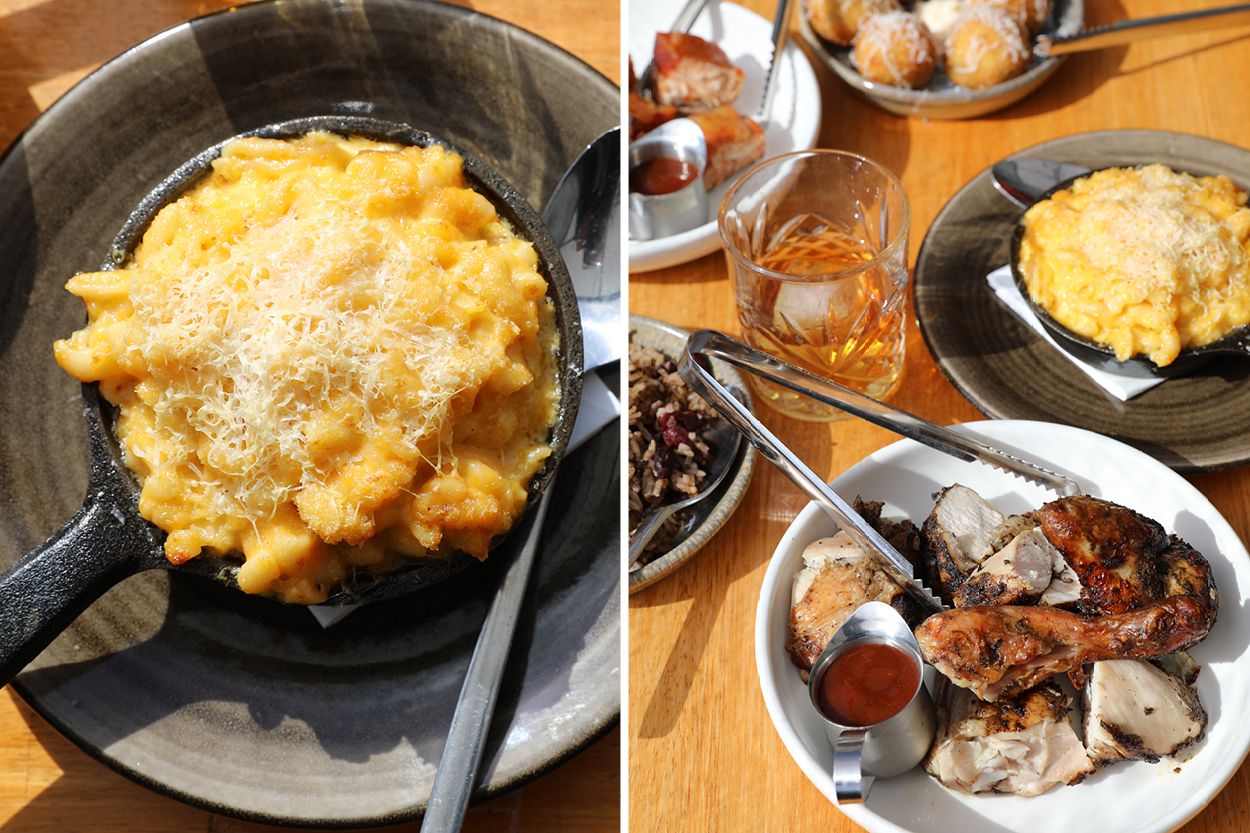
Left: Five Cheese Mac N’ Cheese. Right: Jamaican Jerk Chicken.
As JP puts it, what makes Jamaican cuisine so palatable is that it is “spicy and full of flavour” — but not too fiery — as “not a lot of Kiwis can handle heat”. The infusion of two key ingredients, scotch bonnet pepper and pimento (allspice), produces a full-bodied heat that’s not overly intense, meaning you can still appreciate the meal’s flavours without setting your taste buds on fire.
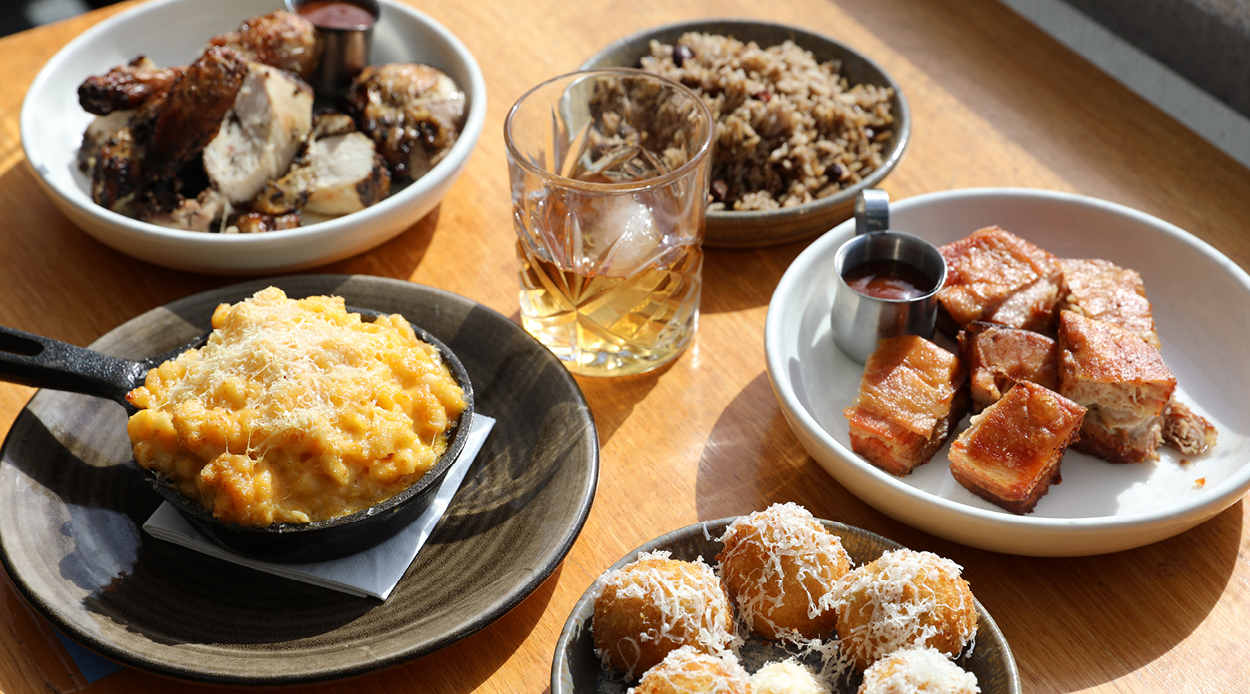
When it comes to ordering your aromatic soul food at Nanny’s Eatery, it’s a given that newcomers should try both the Jerk Chicken and Jerk Pork Belly, served with a lashing of JP’s rum barbeque sauce. Or, if you’re feeling adventurous, we have it on good authority to try the Pork Fried Ribs or BBQ Wings. For those partial to plant-based morsels, the ‘I can’t believe it’s not chicken’ Cauli Bites and vegan Ital Coconut Curry will satisfy your cravings like never before. Our favourites included the moreish Jalapeño Poppers (a true test of my self-control) and the creamy Five Cheese Mac N’ Cheese, the exact formulation of which JP guards closely — believe us when we say we tried to get it out of him.
Jalapeño Poppers.
For a comforting accompaniment to any dish on the menu, try the Rice and Peas, its succulent taste enhanced by Scotch bonnet peppers, although, do take note, no green peas are used in the making. While in Jamaica, pigeon peas are utilised for this traditional dish, at Nanny’s Eatery, the nutty-tasting legume is substituted for good old red kidney beans.
Inviting food isn’t all Nanny’s Eatery has on offer either. JP has a few more tricks up his sleeve, including the City’s most extensive array of rums (76 and counting) should you wish to sip on a Caribbean-inspired cocktail alongside your meal. We recommend a taste of the house rum, which hails from Jamaica, for its exceptionally smooth texture and rich notes of toffee. It goes down a treat served neat or on the rocks, but if you’re lucky JP might offer you a shot.
Left: Jamaican Jerk Pork Belly. Right: Nanny’s Eatery & Rum Bar.
So, for a mouth-watering taste of the Caribbean that’s closer to home, Nanny’s Eatery is the place to be. With its unassuming atmosphere and humble fare elevated with just the right amount of heat, pull up a seat, indulge in the flavours, and see for yourself why Nanny’s Eatery has become a mainstay on the Kingsland food scene.
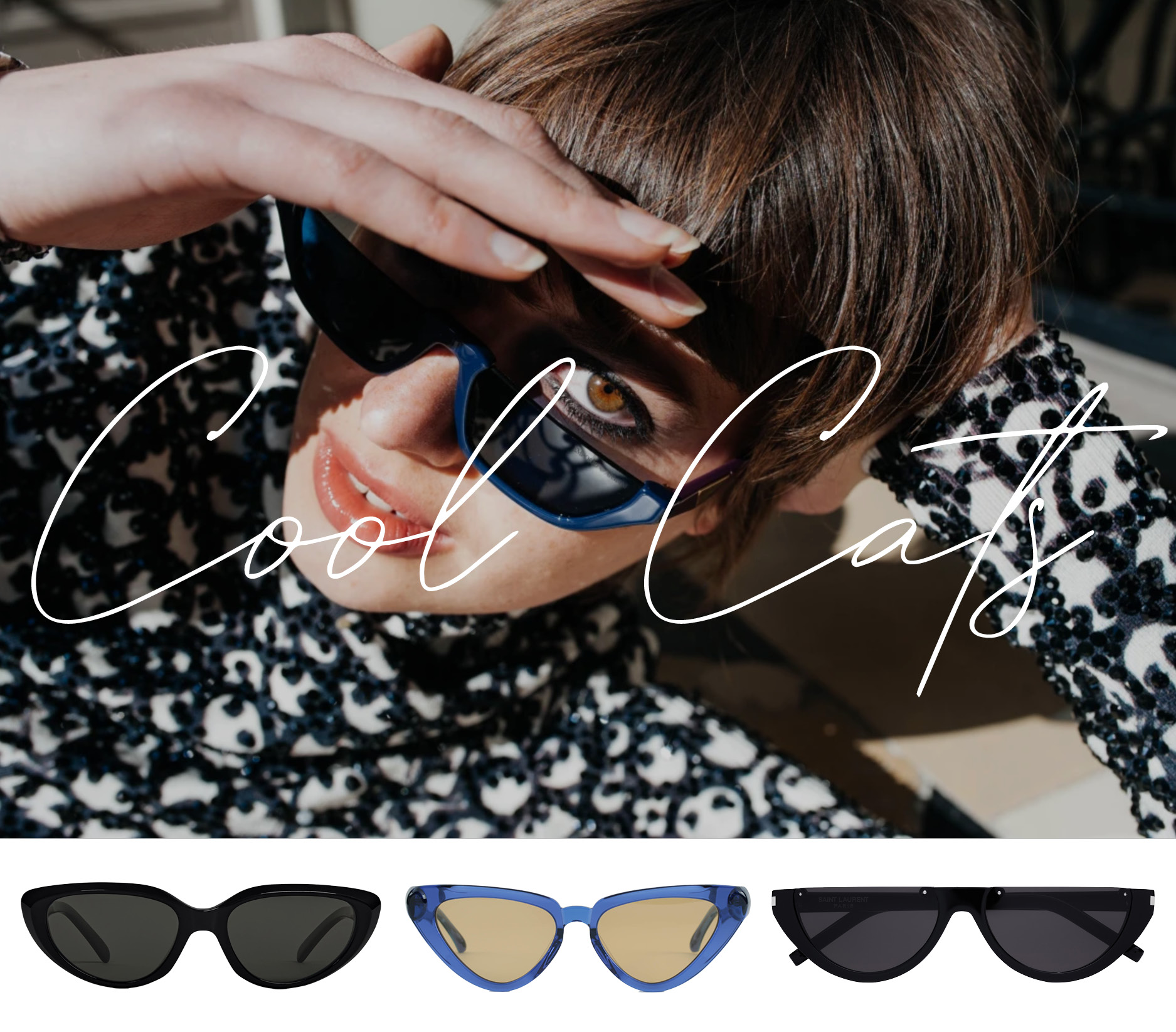
The power of a pair of sunglasses should never be underestimated. In fact, picking the right shades for your face can enhance your natural features like nothing else. Consider shape, colour and lens style carefully — alongside flattering your visage, sunglasses can be made to pull an outfit together as the perfect finishing touch.
Here we present a curated edit of our favourite styles right now. From uber-cool cat-eyes to colourful lenses and sporty shapes, these are the slick new sunglasses to add to your collection.
From left: Celine Cat Eye S220 sunglasses from Parker&Co. Projekt Produkt RS2 C06 sunglasses from Parker&Co. SL 563 sunglasses from Saint Laurent.
From left: LV Charm Cat Eye Sunglasses from Louis Vuitton. ValentinoXVI Pilot Sunglasses from Faradays. Christian Dior Missdior B2u Sunglasses from Parker&Co.
From left: Wrap D-frame Sunglasses from Balenciaga. Moscot MESHUG SUN sunglasses from Parker&Co. Moscot Shtarker Gold Sunglasses from Parker&Co.
From left: Wire Cat Sunglasses from Balenciaga. Christian DiorBobby Sport sunglasses from Parker&Co. Bottega Venetahue sunglasses from Sunglassbar.
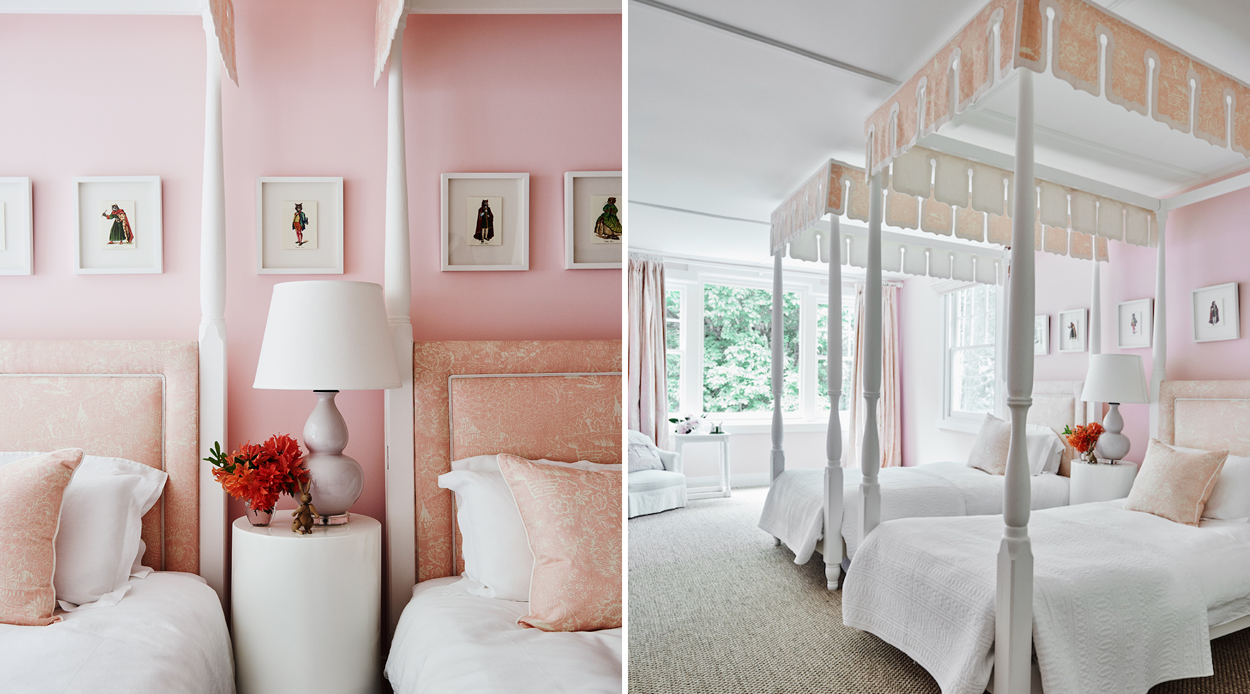
When Australian interior designer Charlotte Coote reimagined her own home, there was a raft of inspiration on which she could draw, having created countless spaces for clients across the country. That said, she ended up finding it a little closer to home, in the gardens surrounding her Mt Macedon residence in the Victorian countryside.
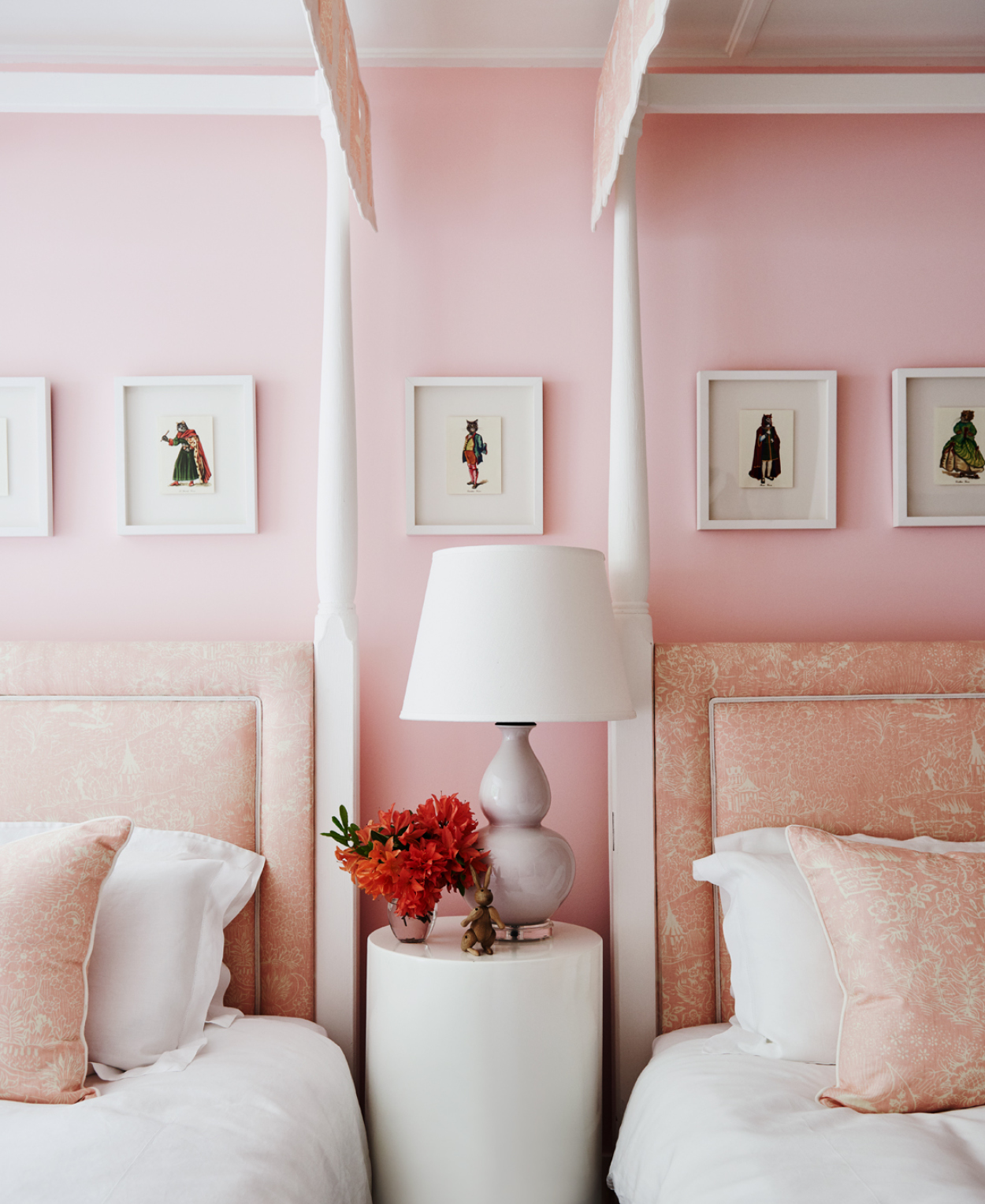
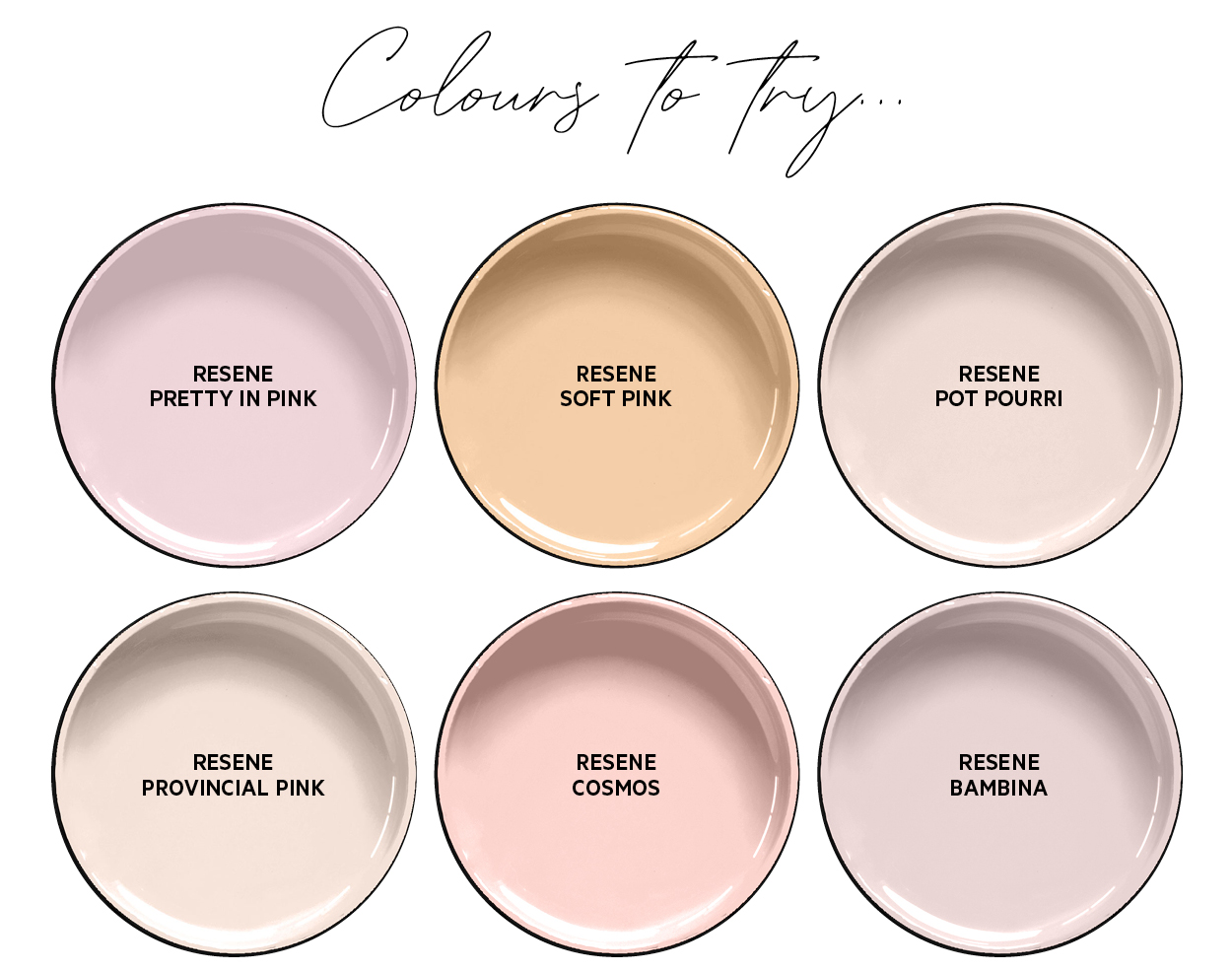
When designing her daughters’ rooms, rhododendron was the immediate inspiration, and liberal use of Resene pink paints was employed. Far from the Barbie or millennial shades of the moment, these dusty hues with peachy undertones were used to create a space that was timeless, sophisticated and chic. In fact, their effect proves that pink need not be reserved for the kids’ rooms alone, promising to bring soft femininity to any space.
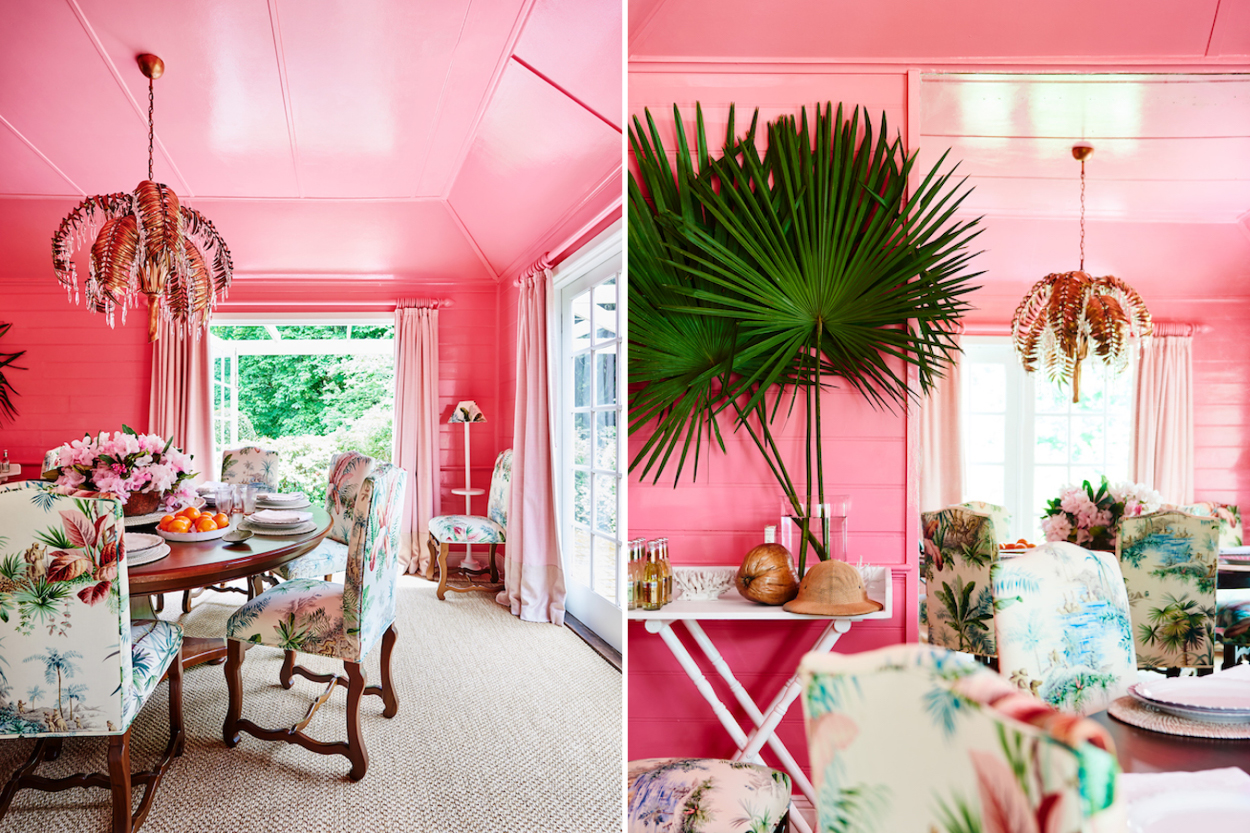
Extending the pink theme to the living room, Coote opted for a touch of brilliance with a sherbet pink (a tone that simultaneously feels of-the-moment and utterly timeless), the bold approach imbuing the common area with a sense of confident, contemporary elegance.
Ultimately, Coote’s masterful handiwork reveals how a touch of pink can completely transform a room into something magnificent. And with the right furnishings, you too can harness the power of this colour to create a captivating ambience for your home. And in order to ensure you select the perfect pink palette, we recommend starting with Resene’s vast and varied options.
‘Punching above our weight’ is a phrase so entrenched in the Kiwi vernacular that it should be written on our passports. We like to think of ourselves as a country that exceeds expectations and excels beyond what our resources might suggest is possible — going so far as to entangle our sense of national pride with that very idea. But the promise of celebrating success and the act of doing so (particularly when one of our own really does go off and succeed on an international scale) are two very different things. And while it’s true that we have a number of hugely-talented entrepreneurs in New Zealand, there is a lot more to be done to support the global aspirations of those with bright ideas — especially if we want to celebrate success for real (and not just with glib one-liners). Having experienced this first-hand, Anna Mowbray is an entrepreneur who wants to shift the paradigm, and encourage others in the process.
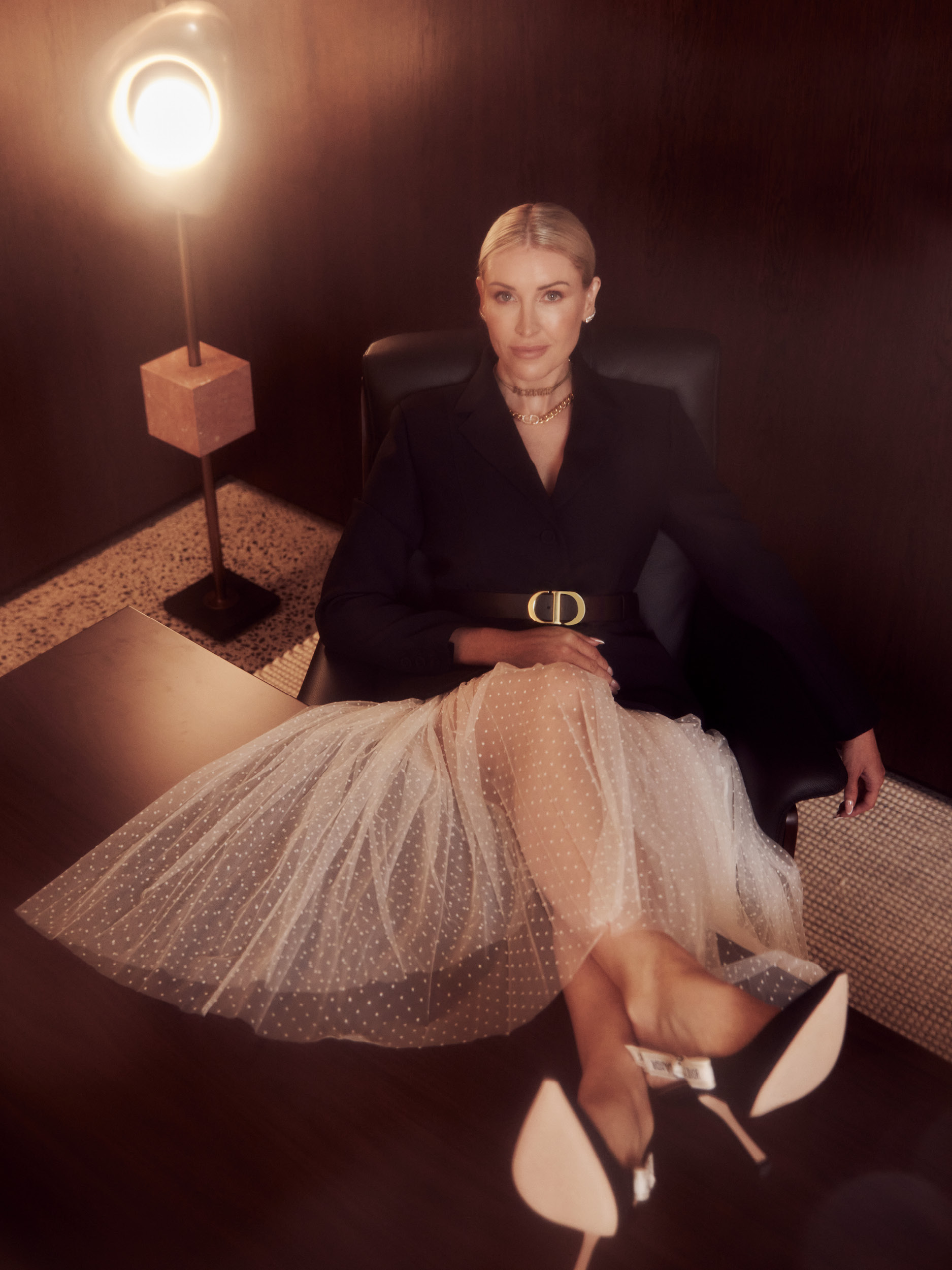
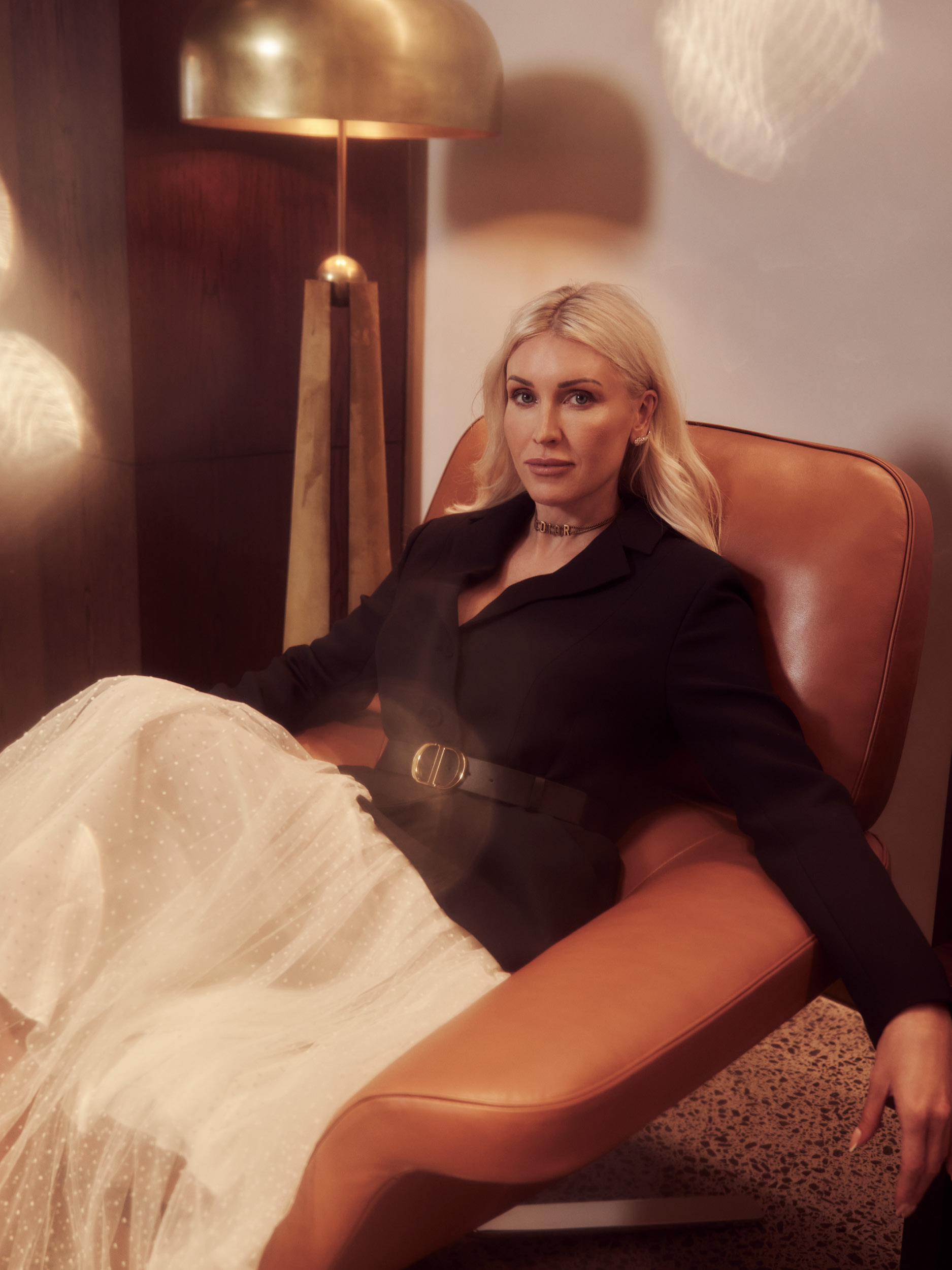
Anna wears necklace, jacket, belt, skirt and heels all from Christian Dior.
You’ll no doubt be familiar with the story of Zuru. Started by Kiwi siblings Anna, Mat and Nick Mowbray almost 20 years ago, the company has, thanks to the immense determination of its founders, grown from humble beginnings in the shed of a Waikato farm to one of the most prolific toy companies on the planet — headquartered in Hong Kong but with operations spanning the globe. Its products are iconic (from Mini Brands to Bunch O Balloons to X-SHOT) and its reach is immense (one of the top 10 toy companies globally, Zuru now has an annual revenue in the billions, sells its products in over 120 countries and has recently branched into fast-moving consumer goods with considerable success). But perhaps most significantly, its founders stand apart from their competitors for their Kiwi ingenuity, single-minded perseverance and never-say-die attitude — a potent, propulsive mix.
That is the first thing that strikes me about Anna Mowbray. The director and co-founder of Zuru carries herself with the kind of confidence and sure-footedness that could only have come from years of self-belief and a mindset anchored in the idea that nothing is outside the realm of possibility (if you’re willing to put in the hours).
“We had a very idyllic, very humble upbringing, and my parents sacrificed a lot,” Mowbray tells me, describing a childhood of bare feet, Vegemite sandwiches, friendly competition with brothers and seminal lessons around the importance of education, independence and grit. “My dad worked so hard, and he was really entrepreneurial,” she continues, “he always encouraged us to be self-motivated and self-employed, and to take risks and build our own futures, which was empowering to us as children.” It proved a crucial example for Mowbray, that instilled in her an insatiable hunger for success, and an outlook that left no room for complacency, laying the foundations for her future as a business leader. It was this drive that kept her moving forward, even in the face of daily challenges. After all, the path to success is rarely smooth.
“I think the biggest misconception people have about me is that success came overnight,” Mowbray reveals, laughing. “They don’t know that it has taken 17 years of determination, tenacity, huge hours and massive sacrifice,” she explains, “I spent most of my twenties in a small town in China, not knowing the language or the culture, sleeping on factory floors, living hand-to-mouth with no outside investment, and setting up this business with nothing more than a vision for creating the largest toy company in the world.”
That Mowbray and her brothers built their business from throwing caution to the wind, relocating to rural China, diving into a space of which they knew very little, cleverly setting up their own vertically-integrated manufacturing facility and creating products to compete with the likes of Hasbro and Fisher Price, is a testament to their incredible dedication. Failure, as Mowbray tells me, was not an option. “In many ways, our naivety was our greatest blessing because it gave us this fresh perspective and positive mindset to be innovative and build something totally different,” she says. “From the outset we wanted to be as close to the problems and solutions as possible, so we established a supply chain that we owned completely — from ordering raw materials to creating the final products to marketing campaigns and strategy — and we quickly became the most knowledgeable company in the industry.”
Indeed, despite some early cashflow challenges, Zuru’s unapologetic approach of betting big and winning big paid off, resulting in products like Robo Fish (which sold 30 million units in 24 months), Bunch O Balloons and Mini Brands (both of which went straight to number one across all toy categories, globally). And while Zuru’s commercial success is undeniable (and much-discussed), what you probably don’t know is just how involved its founders still are in the day-to-day.
For Mowbray (inherently a problem-solver) this deep engagement with her company’s operations is something she loves. “I am always in the weeds, trying to understand where the problems lie and solving them efficiently,” she reveals. “I find I often spend less time in huge macro head spaces and more time focused on finding high-level solutions to everyday problems.” It’s a lesson in the value of simple, honest hard work and never being above the small stuff. Mowbray’s willingness to dedicate herself to finding solutions where others might not, and the voracious optimism that allows her to see any challenge as an opportunity, really is the secret sauce to her success. It also makes her a better leader.
“Anna has always led by example,” says Aneisha Viera, Global Brand Director at Zuru Toys. “She manages a huge cross-section of teams and departments including factories, sourcing, operations, sales, marketing, finance, demand, capacity planning, branding and more, and not only skims the top of these areas but engages deeply with their work, never missing a beat.” For Viera, Mowbray’s influence has been pivotal. “Even when I didn’t have confidence in myself, she saw something in me, and bestowed so much trust in me,” Viera continues, “she taught me what it means to be a leader, to get in the trenches with your team and the value of real, gritty, hard work… she also instilled in me the importance of balancing work with a meaningful life outside the office, for which I am so grateful.”
Indeed, what sets Mowbray very much apart as a leader, is the time she dedicates to ensuring that the people around her feel listened to and empowered. And, having spoken with those in her orbit, it is these qualities (well beyond any of her quantifiable accolades) that have earned the deep respect and admiration of her team.
“I am always thinking about how I can be doing things better or differently,” Mowbray explains, “and recently, I’ve come to learn the importance of being vulnerable, both in business and in my personal life.” As a businesswoman and a mother, Mowbray is no stranger to that neverending search for balance that is so familiar to many working women, telling me how, in the early days of Zuru, she would keep a cot in her office and change nappies on her desk during meetings. It’s an image that Viera also recalls in our conversation, telling me of one particular day in which Mowbray was into the office early and broke for a lunchtime workout before proceeding to breastfeed her youngest child while leading one of the most important licensing meetings of the year (finalising a deal that was crucial to one of Zuru’s biggest brands). “That day and every moment since,” Viera says, “whenever I have wondered or doubted if I ‘could do it,’ it’s that image of a workout-clothes-clad, breastfeeding, boss, CEO, nailing a multimillion dollar deal, that reminds me that I can do anything.”
To me, Mowbray is something of an enigma. She is bold, unapologetic and a powerful force in business. But she is also warm, relatable and incredibly generous with her time; as focused on helping others tap into their potential as she is on her own personal growth. “I get so invigorated by the idea of being able to grow people on our team,” she explains, “under my leadership across our toy business at Zuru, we now have a 70 percent female workforce, with women in over half of our director and upper-management roles.” It is Mowbray’s influence that people like Aneisha Viera and others who work for Zuru, like Head of Global Content Strategy Bec Hunter, describe as transformative, both for their careers and on how they carry themselves through life. “Anna is an empathetic leader who empowers and motivates her teams” Hunter says, “I have learned a tremendous amount from her, her genuine enthusiasm for success, her global perspective and adaptive style.”
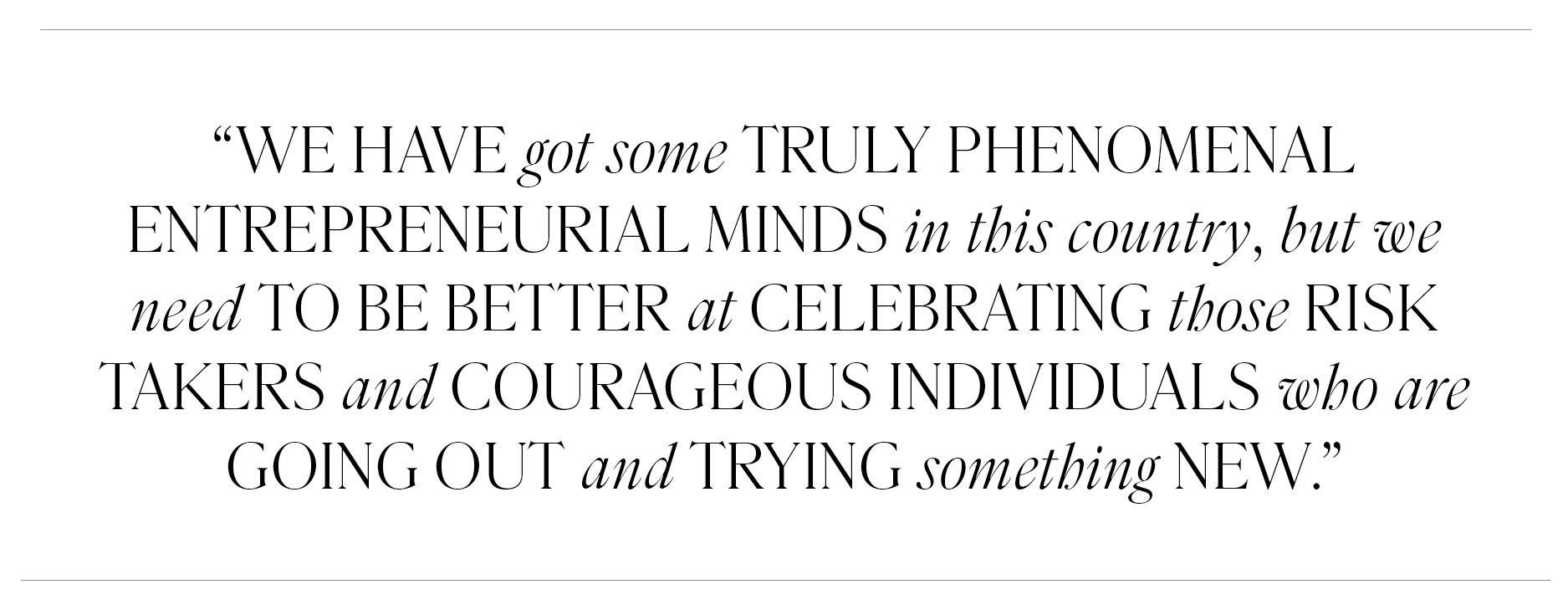
But as much as Mowbray dedicates time to facilitating growth internally, she also wants to encourage a shift in the wider attitude towards entrepreneurialism in New Zealand. “We have got some truly phenomenal entrepreneurial minds in this country,” Mowbray says, “but we need to be better at celebrating those risk takers and courageous individuals who are going out and trying something new. We need to create an environment here that encourages people to dream big and supports them to act on their ideas.”
So what does that actually look like? As Mowbray puts it, “fostering entrepreneurialism is about local connectedness and leaders, investors and entrepreneurs being more selfless with their journeys.” It is also, she tells me, about mentoring young talent, and encouraging successful businesspeople to take others under their wings. This month, Mowbray will judge the Rise Up awards, which sees globally ambitious female founders vying for a grant that will help take their businesses to the next level. “We’ve got ingenuity in spades,” says Mowbray, “but often, we are too reserved or scared to put ourselves out there for fear of judgement… if we celebrate and support those who aren’t afraid to dream big, we will build more homegrown models that can be looked up to and replicated.”
It’s also, of course, about how far the New Zealand government is willing to help, not only by growing the talent density here, but by making this country an appealing place to build a business. Or, at least, as somewhere to which expat entrepreneurs might want to return. “As a country”, Mowbray articulates, “we need to look at how we can support business at a higher level, in order to unlock New Zealand’s huge potential… whether that is policy change to allow for sustainable and profitable growth, or what tax breaks look like for businesses bringing hundreds or thousands of jobs here, or visa and immigration laws… it’s so important for the future of this country.”
For Mowbray’s part, she explains how, since relocating her family back to New Zealand from Hong Kong (an unexpected, Covid-driven move) she has been involved in helping a number of start-ups here — some in an advisory role (such as healthcare accessibility platform, Health Now) and one as a founder (an HR-focused tech business — watch this space). And as much as she is still focused on growing Zuru’s already-considerable reach, she speaks to me as though she is just at the start of her journey. “I set this goal at the top of last year to get to a billion dollars of revenue across our toy business, and we smashed that,” Mowbray says, matter-of-factly, “so now, I have this desire to find new opportunities, new categories and new industries to conquer.” She continues, “I also want to figure out how we can solve different and more pressing problems in the world; we’ve brought a lot of joy and fun but now I’m thinking more about how I can make a difference in other ways.”
It is refreshing to talk to someone with such a relentlessly positive outlook; someone who looks at the challenges being served us by the world and sees only opportunities. When I ask Mowbray the advice she would give budding entrepreneurs who might feel discouraged by the last few years, she is practical and clear. “Create products with purpose,” she says. “Be a sponge for knowledge, learn as much as you can, shake as many hands as possible and be interested in people, learn what drives them to achieve greatness.” She pauses, before adding, “but above all, it comes back to the idea of vulnerability… seek out criticism and constantly challenge yourself by asking ‘how can I be better? How do I evolve?’”
Practising what she preaches, Mowbray is not naturally inclined to speak about herself (“this is not my happy place,” she jokes with me when we first sit down) but she puts this aside in the hope that sharing her story might inspire someone else to aim for the same kinds of lofty goals. After all, she and her brothers are living proof of the eye-watering success that can organically grow from hard work, good timing and unwavering self-belief.
To me, what is most impressive (beyond her obvious career accomplishments) is Mowbray’s inherent generosity — made all the more impactful when paired with her unique ability to make things happen. When Covid-19 hit New Zealand, for example, she set up a task force in China to procure and manufacture PPE for New Zealand hospitals, not letting the fact that it was in very high demand and in very short supply stop her. And after spending hours on FaceTime and Zoom calls (“I spent a month working 18-hour days,” she tells me) to understand the criteria of manufacturing high-quality and stable PPE, she funded and chartered five Air New Zealand planes packed with essential supplies to ensure our national stockpile would be okay in the case of an outbreak.
“She cares deeply,” Aneisha Viera says, “and I don’t mean about the business (that’s a given — built into her DNA), she cares deeply about her team and about people.” Mowbray is a rare example of someone for whom success on an astronomical level has not eroded their ability to be grounded, practical and empathetic. And now, the entrepreneur is looking to the future. “I want to make sure that I am giving back and helping others to unlock their potential,” Mowbray reveals, “but I also want to see what I can do by applying my skills to new spaces. I want to be useful and to make a real difference.”
That said, Mowbray also plans on dedicating a large part of the next 10 years to raising her children, explaining to me how she and her fiance (former All Black, Ali Williams) are focused on bringing up good, humble citizens who pave their own paths and grow to be passionate and compassionate people. Because despite everything she has achieved, when asked what she wants her legacy to be, Mowbray doesn’t hesitate. “It’s such a big question,” she says, “but the answer is actually really simple… my greatest legacy is my kids.”
Whatever Mowbray chooses to do next, I have no doubt that she will continue to punch well above her weight. “I don’t want Zuru to be the greatest mountain I’ve ever climbed,” she tells me, a twinkle in her eye. And incredibly, I don’t think it will be.
Image credit: Styled by Claire Sullivan-Kraus. Hair and makeup by Alexandra Stanworth. Shot on location at ECC Minotti showroom.
For more exclusive access to what the city has to offer, engaging content, excellent imagery and thought provoking commentary on the life that surrounds you, subscribe to Denizen magazine now.