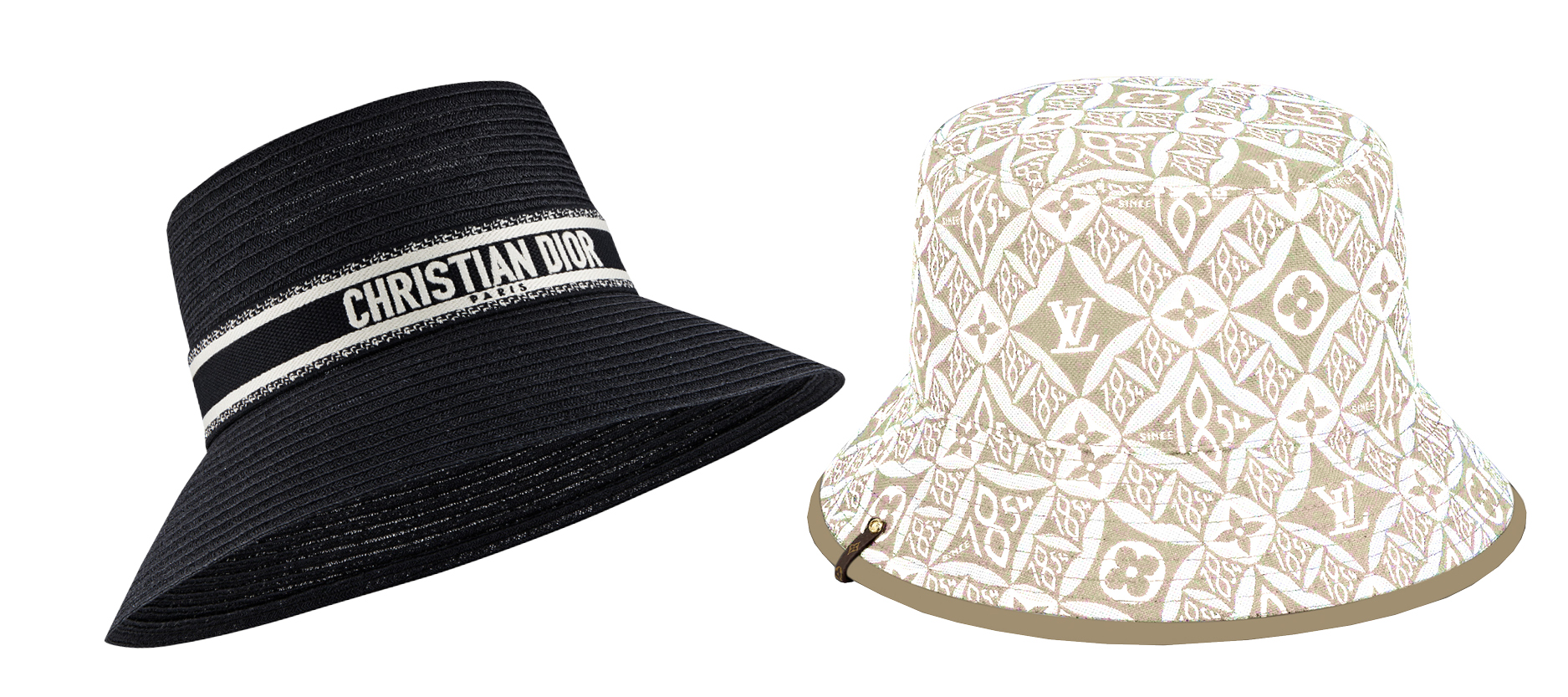
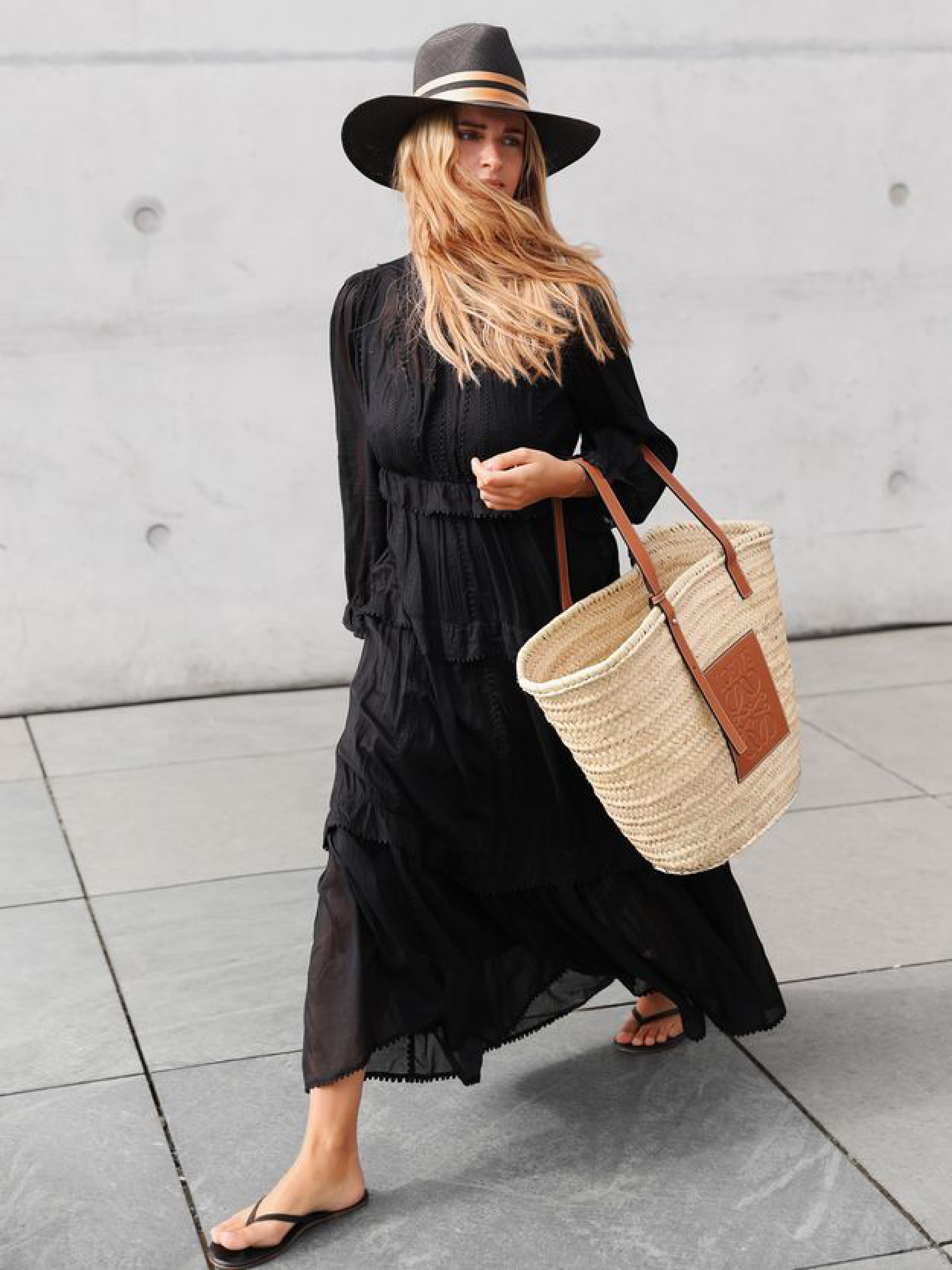
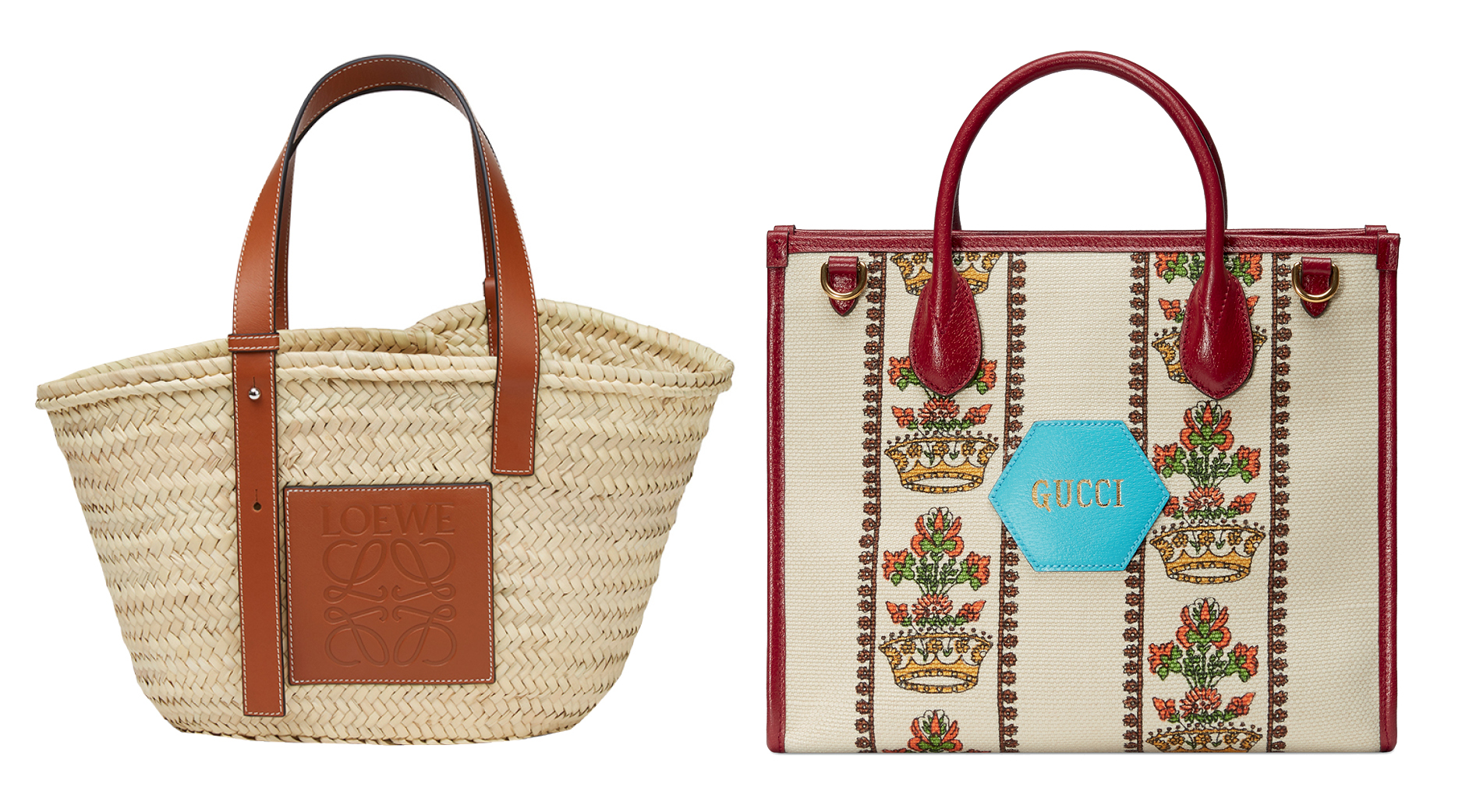
Now’s the time to feel the wind in our hair and sand between our toes. Get set for beach season with a sun-shielding bucket hat and a designer hold-all tote bag that fits all your summer essentials. These accessories are given the chic treatment with woven textures, leather accents and eye-catching motifs for an unforgettable holiday look.
GG canvas wide brim hat from Gucci; Bucket hat from Prada.
Summer is the time to truly relax and unwind. For the ultimate in cultural escapism, we recommend these moving memoirs. From the style and strife of the life of Christian Dior’s war-hero sister to the personal tales of beloved late chef Anthony Bourdain, these tomes will stay with you long after the last page.
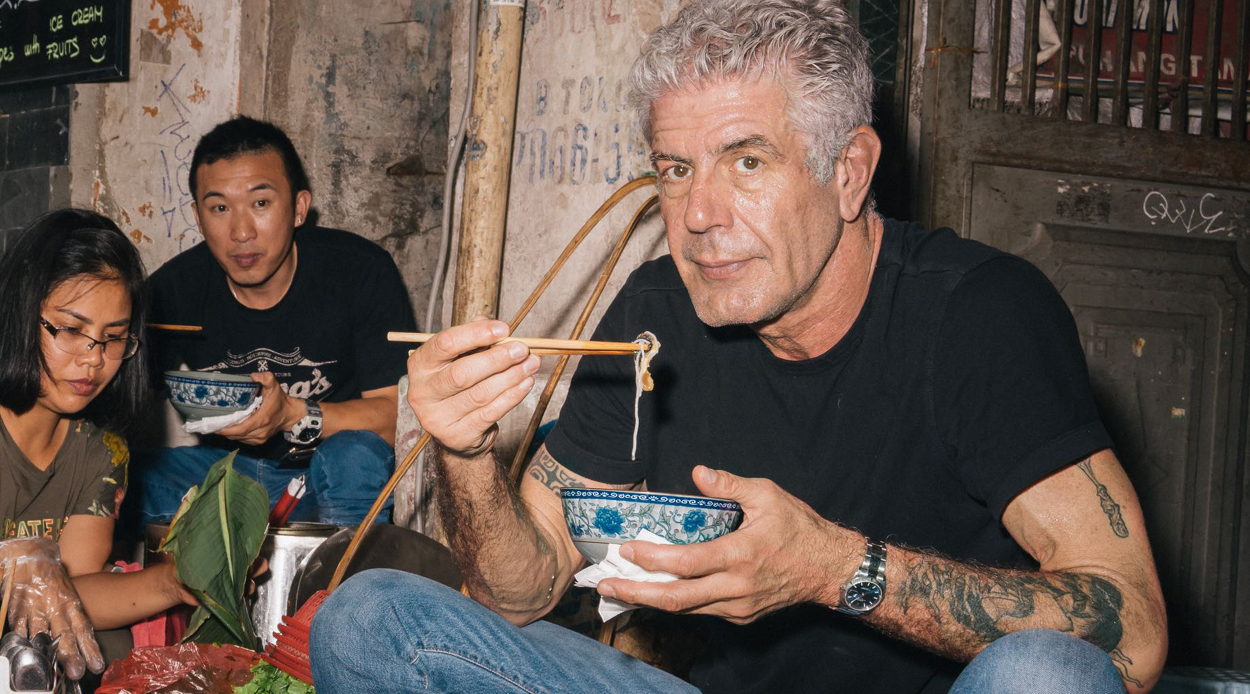
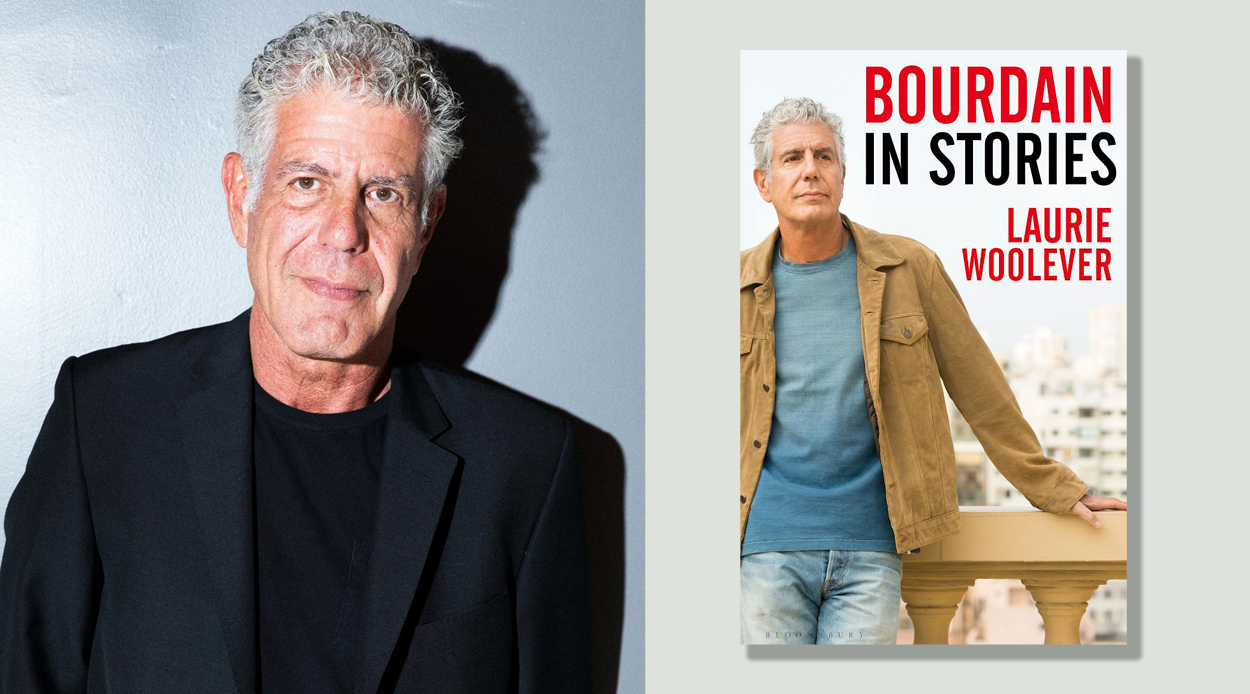
Bourdain in Storiesby Laurie Woolever After the passing of Anthony Bourdain in 2018, those he influenced came together to celebrate his life of travelling nearly everywhere (and eating almost everything), while telling the stories of those he met along the way. His legacy has only grown since, and now his own story is told by his friends and colleagues. Bourdain’s long- time assistant and confidante interviewed nearly 100 people to put together this remarkably full and nuanced view of his life and work.
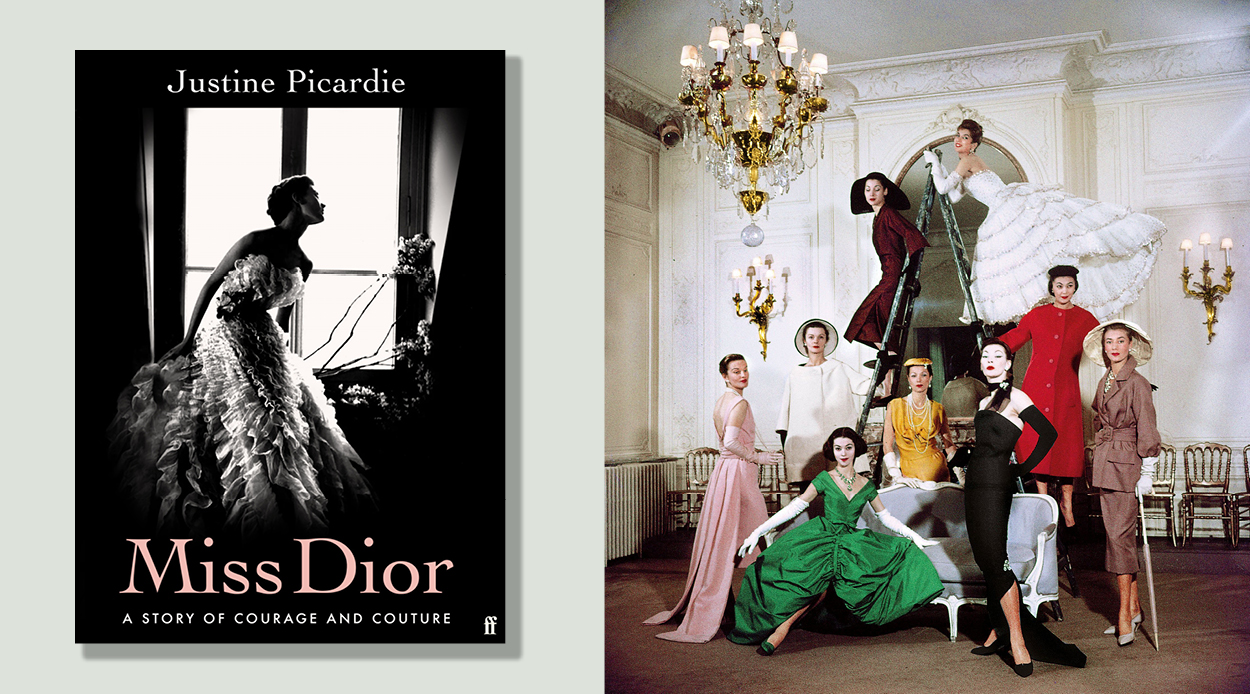
Miss Diorby Justine Picardie The life and style of Christian Dior have been documented in tomes over time, but what about his original muse, his sister Catherine Dior? Tulle- light traces of her can be found in the House of Dior’s archives but Justine Picardie’s research for Miss Dior took her back to Occupied France, where Christian mastered the art of couture and Catherine dedicated herself to the French Resistance. After being captured by the Gestapo and eventually escaping a ‘death march’, she sought a quiet life tending to her roses, as her strength and femininity continued to inspire Christian, who created the Miss Dior scent in her honour.
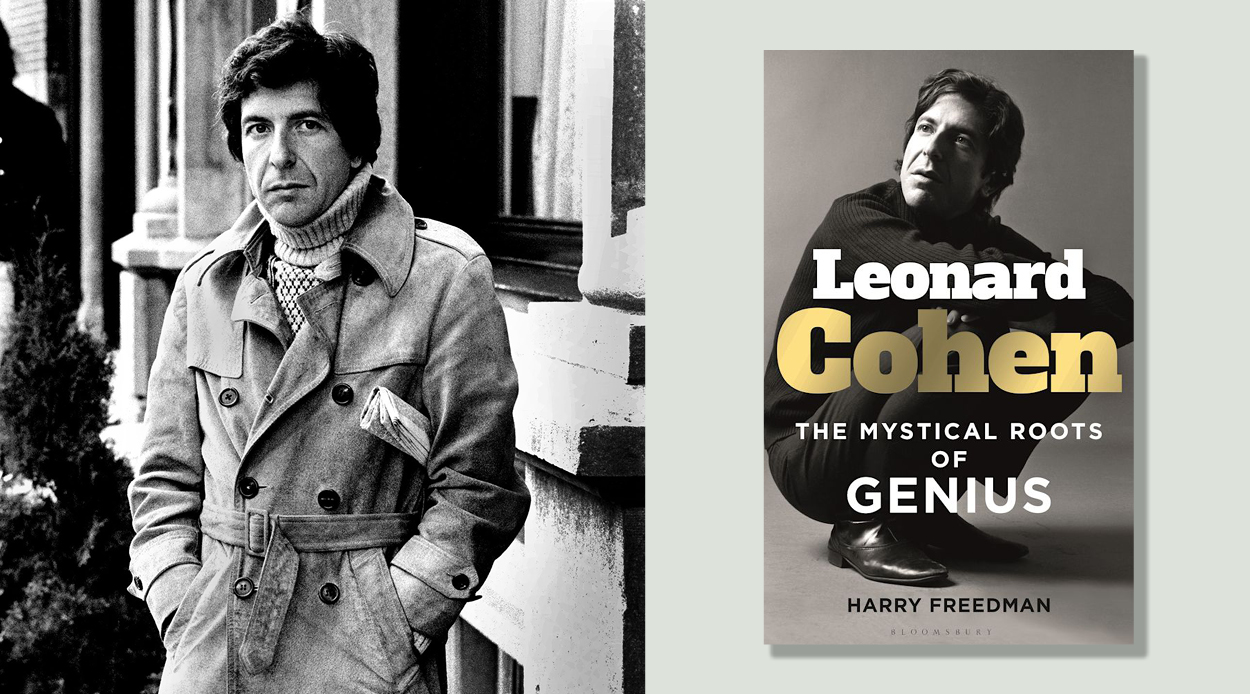
Leonard Cohen: The Mystical Roots of Geniusby Harry Freedman Born into a prominent and scholarly Jewish family in Canada, Leonard Cohen aspired to become a poet, before turning to songwriting and eventually recording his own compositions, — the rest is melodic history. Harry Freedman, a leading author of cultural and religious history, uncovers the myriad spiritual dimensions behind the lyrical legend. From ‘Suzanne’ and ‘Hallelujah’, which drew on his learnings in Judaism and Christianity, to his later life immersed in Zen Buddhism, this song-by-song memoir offers insight into Cohen’s inspirations as well as his soul’s imaginations.
My Bodyby Emily Ratajkowski In this refreshingly revelatory group of essays, model and actor Emily Ratajkowski shares her strikingly personal experiences while negotiating her own beauty, and the boundaries of power. After appearing in the infamous Blurred Lines music video in 2013, Ratajkowski shot to fame and purported a new take on feminism alongside bikini shots on her Instagram. Now, in this honest exploration of empowerment, Ratajkowski deftly discusses such complex topics and dares the reader to draw their own conclusions.
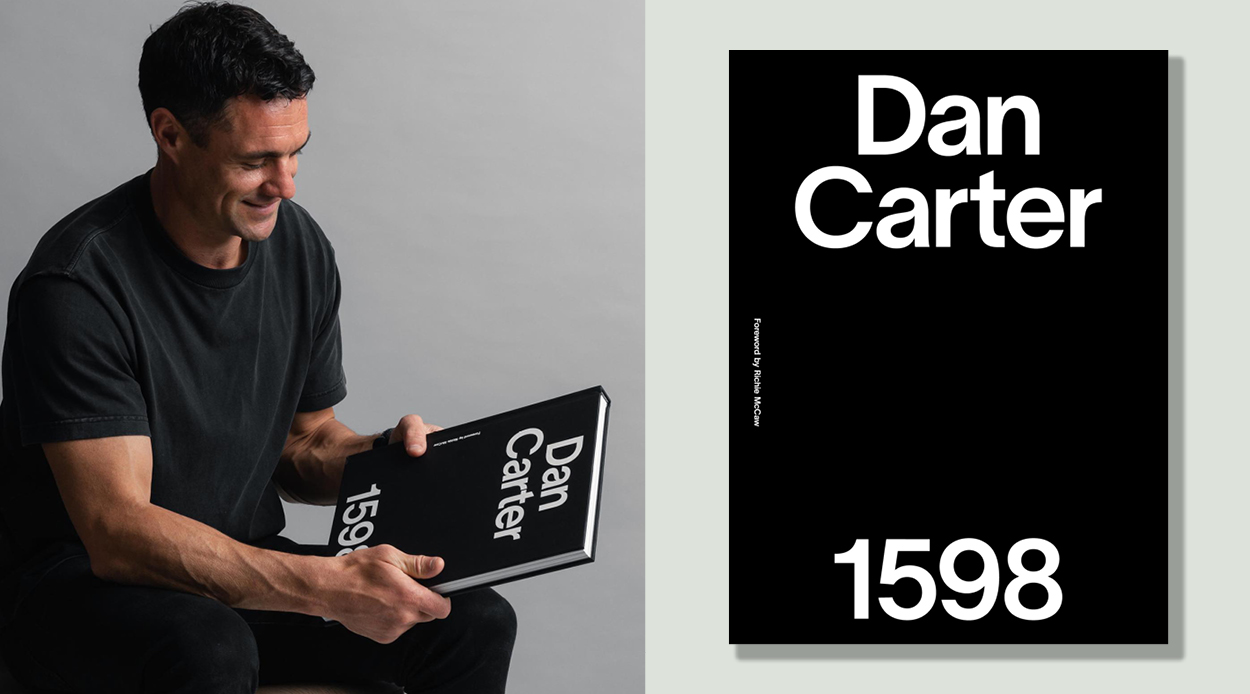
Dan Carter 1598by Dan Carter This coffee table tome by Dan Carter is for rugby fans young and old. A celebration of a world-record test career — named 1598 after the number of points Carter won as an All Black. Rendered in a beautiful large format hardback, and with a foreword written by Richie McCaw, the test-by-test tale is paced with magnificent imagery. Get in quick to score one of a 1000 limited-edition signed copies that come aptly complete with boot laces as a bookmark.
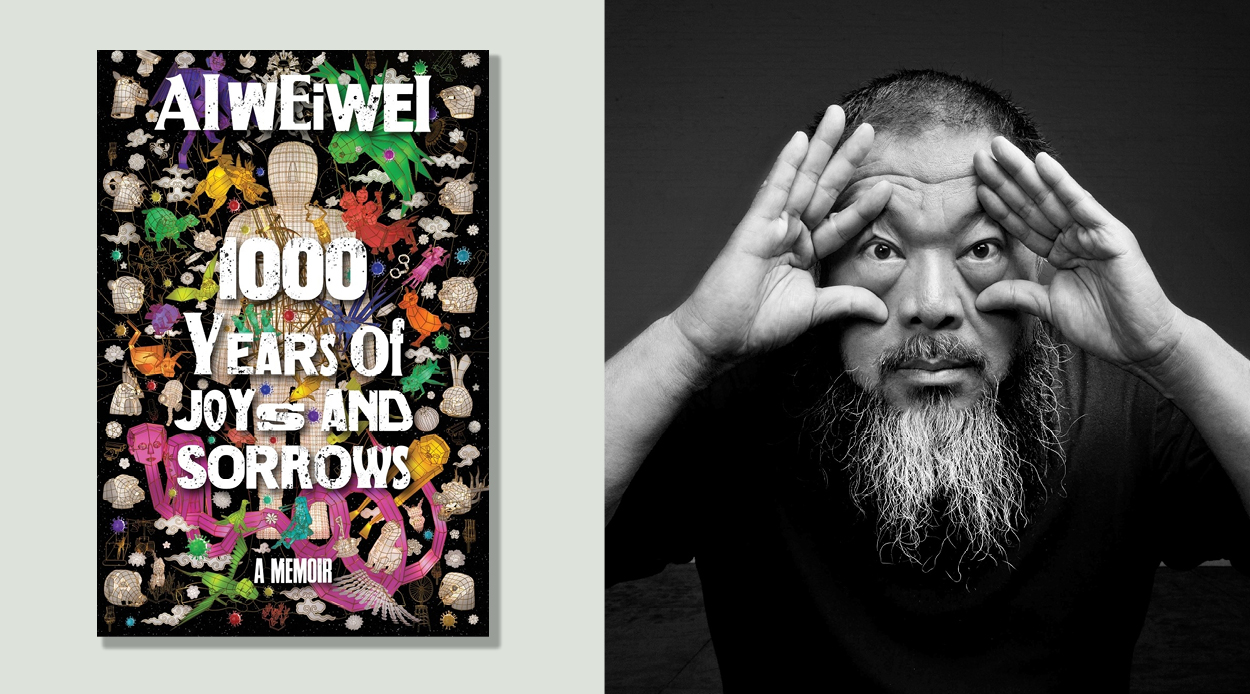
1000 Years of Joys and Sorrowsby Ai Weiwei This is a century- long tale of China seen through artist Ai Weiwei’s own extraordinary life and the legacy of his father — the nation’s most celebrated, yet exiled, poet Ai Qing. A testament to the enduring power of art and the voice of freedom, it is a moving memoir.
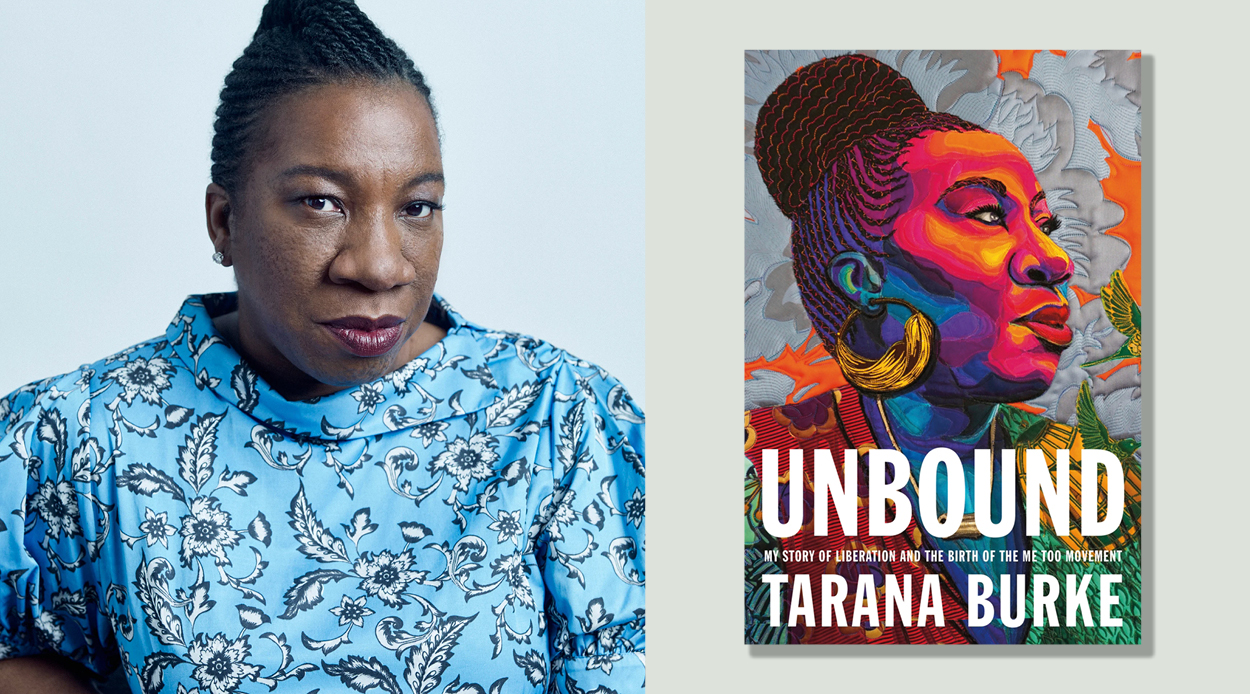
Unboundby Tarana Burke The founder and activist behind the Me Too movement, Tarana Burke, debuts a powerful memoir about how she came to say those two simple yet transformative words. While empowering those who had experienced sexual assault, she learnt to confront her own with empathy, a power she has now shared with the world.
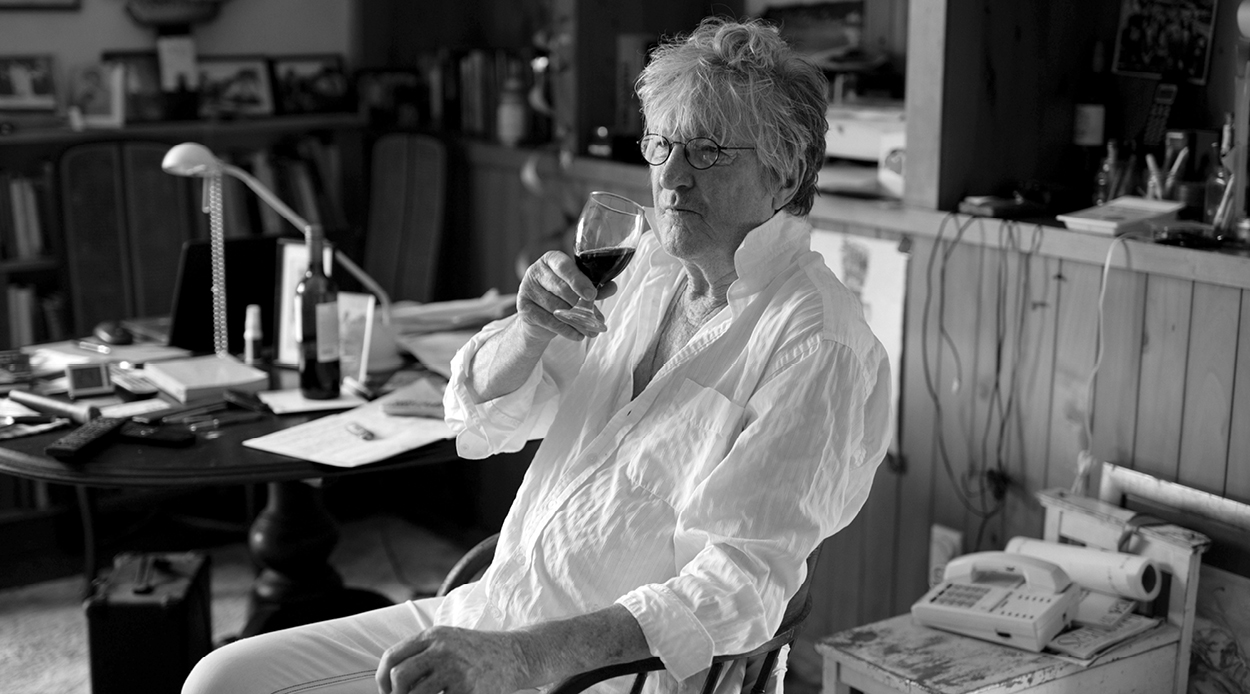
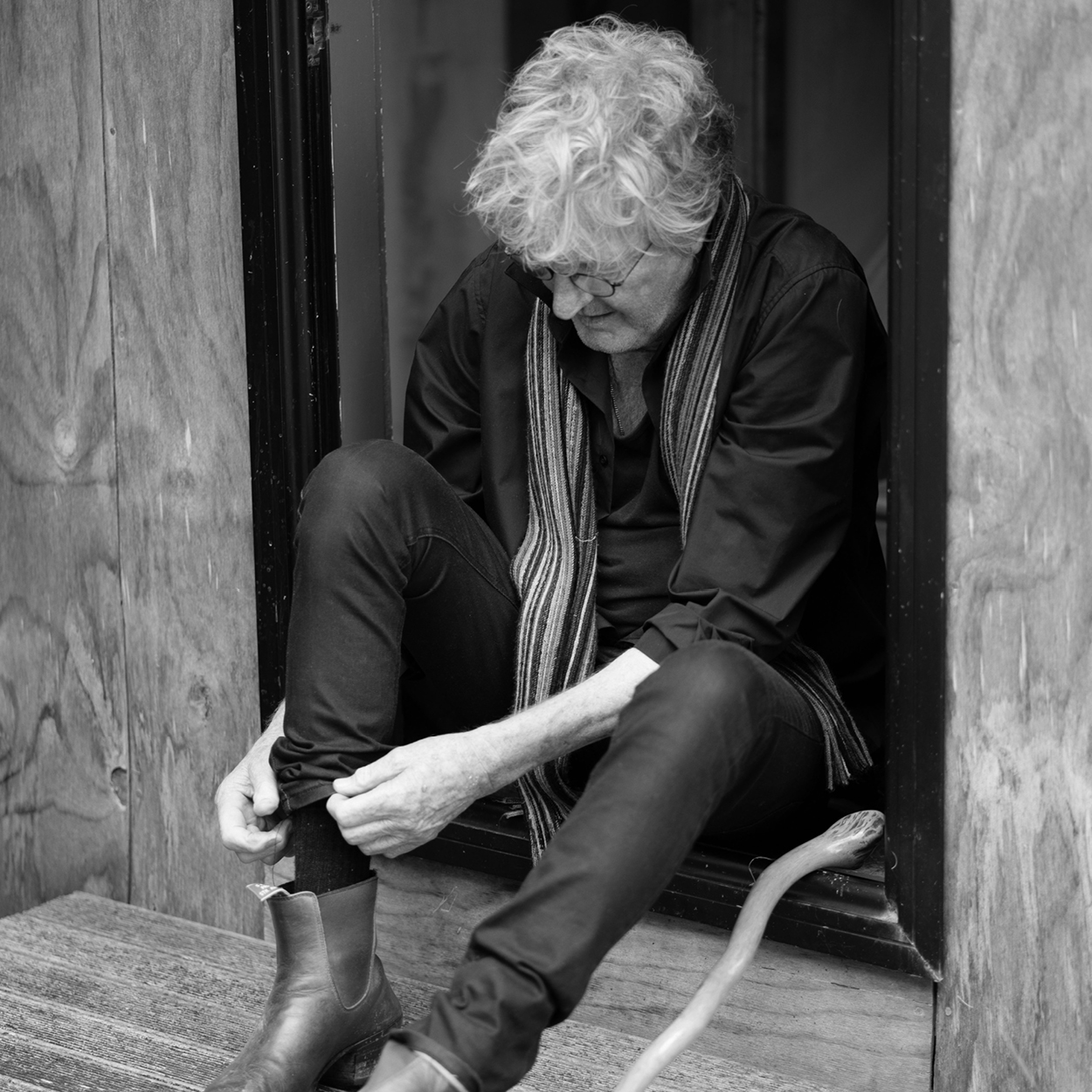
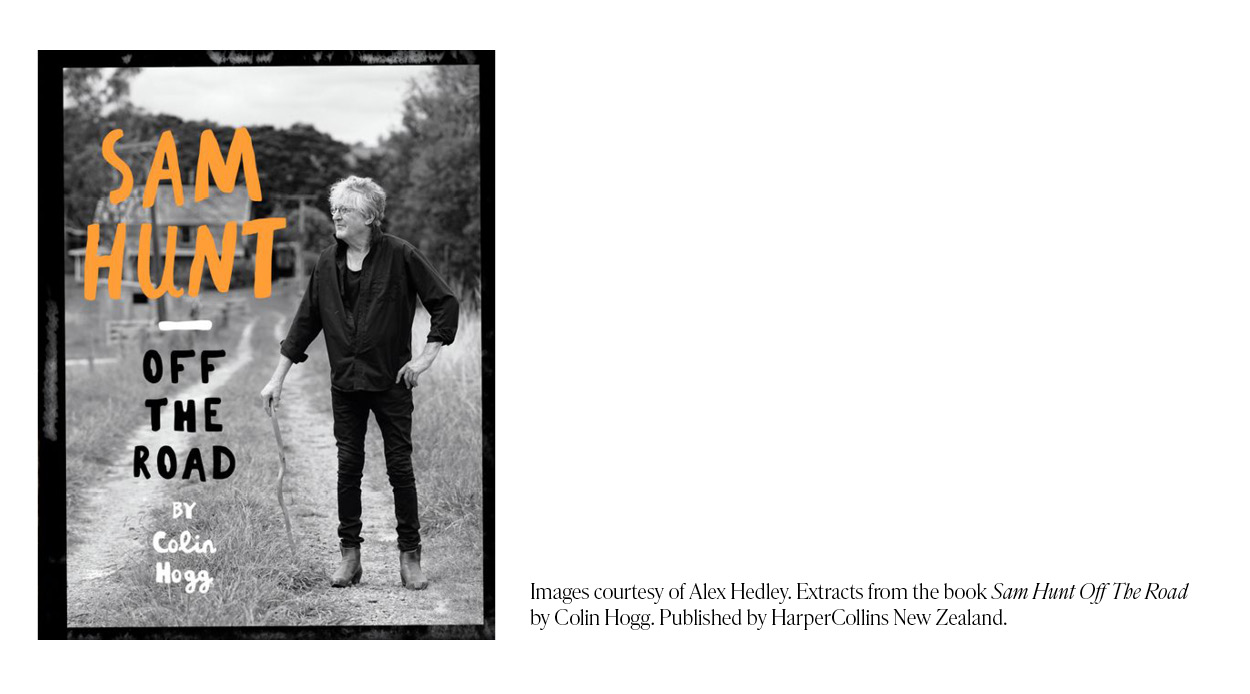
He is one of New Zealand’s most iconic figures, but don’t expect Sam Hunt to take up that lofty mantle readily. While over 50 years of writing and performing poetry has seen Hunt’s work come to hold an incredibly important place in our wider literary landscape, he is not interested in waxing lyrical about his legacy or acknowledging the influence his distinctive voice holds. For him, the idea of a ‘career’ sits at odds with his work, which he would tell you is something that has just been in his blood since childhood.
Impressively, poetry has been the way that Hunt has made his living since he started touring the country in his early 20s, frequenting pubs and venues up and down New Zealand to enthral audiences with his spoken-word performances, and making a name for himself with his shaggy-haired, lovable-rogue presence. (He officially retired from performing five years ago.)
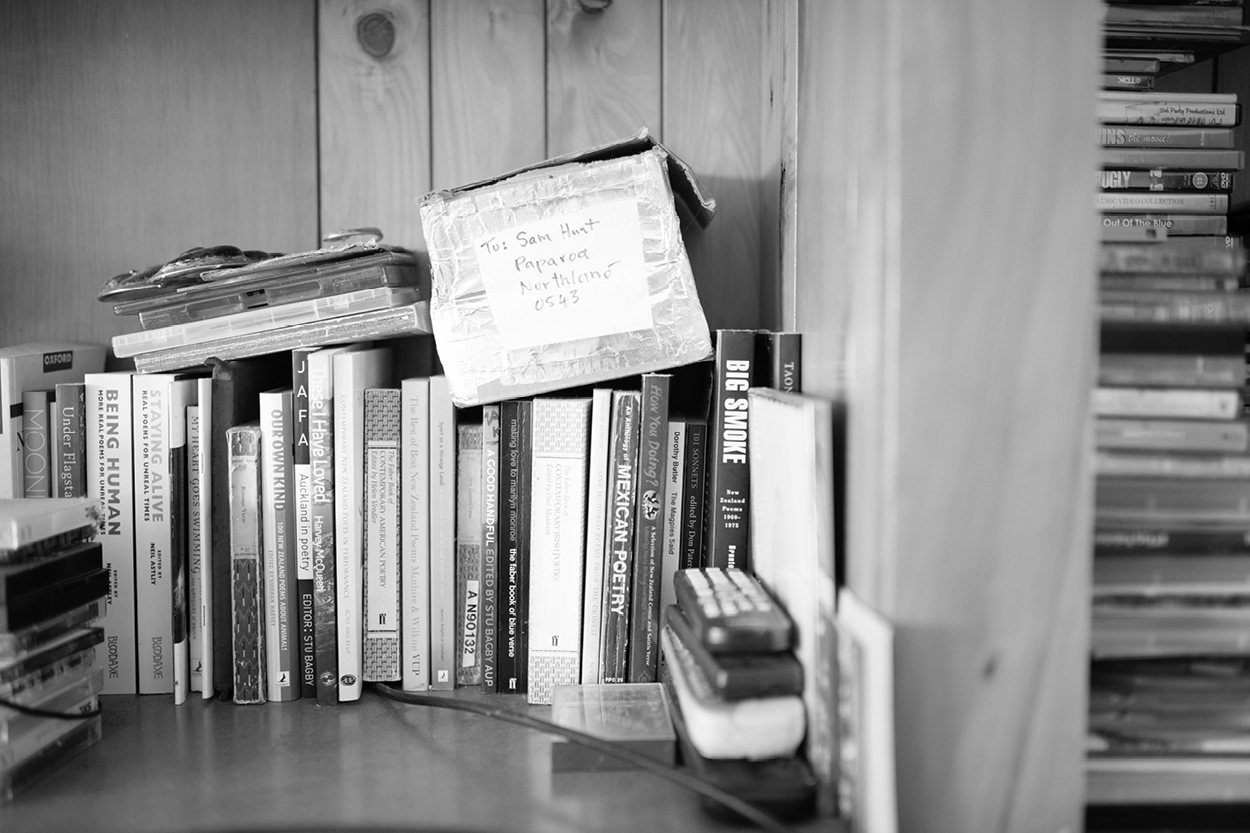
Over the years, he has published numerous books and anthologies, his work has inspired a documentary film and he has had a number of articles penned about him in which he has been painted as a rakish character and a true bard — both true. But more than all that, poetry is something from which Hunt just cannot escape (and he doesn’t want to either). It is more than just a way for him to express his experiences; it is a lens through which he looks at the world, where a conversation with Hunt will see him recite cantos and lines from a mind-boggling number of other writers’ work — all of which (and thousands more) sit comfortably in his memory.
Here, we sat down with the man himself to discuss his fascinating poetic process, the lyrical voices that run through his head, the beautiful stillness of his home on the Kaipara Harbour and the crucial importance of listening.
As long as I can remember, poems were part of the scene at home. My parents both loved poems, but different sorts of poems in different sorts of ways. If I could put it plainly, my mother’s favourite tipple was the lyrical poems, whereas my father’s great love was for the ballads. He used to tell me ballads like Lord Ullin’s Daughter:
A chieftain, to the Highlands bound
Cries, “Boatman, do not tarry!
And I’ll give thee a silver pound,
To row us o’er the ferry!
“Now, who be ye, would cross Lochgyle
This dark and stormy water?”
“O, I’m the chief of Ulva’s Isle,
And this Lord Ullin’s daughter.
And so on and so on. Wonderful. So I grew up with all of that.
When I was seven my mother converted to Catholicism and I became an altar boy. I had never been sure about the religious side but I think it was Bach who said something along the lines of “the only good thing about religion is the music”, and I quite agree. Johann Sebastian and I are at one on that.
My mother’s father, Harry Bosworth, was another influence. He had a great memory. He would know entire Shakespeare plays by heart. Years ago, when Allen Curnow was a youngish man on the ferry between Devonport and Auckland, he said he had seen the most amazing thing — a drunk man standing on top of the ferry quoting canto after canto of Don Juan — that was Harry Bosworth. Some years ago a film was made about me called The Purple Balloon, and my poem, Purple Balloon, is about Harry Bosworth. It’s got lines in it like:
When Gangrene set in
my grandfather’s feet on a rack,
laid in the hospital bed,
he watched them slowly turn black…
And on it goes.
There are poets that became huge influences on me. Like Alistair Te Ariki Campbell and James K. Baxter, who wrote the famous letter to me… it starts off:
Dear Sam, I thank you for your letter
And for the poem too, much better
To look at than the dreary words
I day by day excrete like turds
To help to Catholic bourgeoisie
To bear their own insanity;
But the most beautiful verse I was trying to get to (that’s another thing, I’m not very good at quoting verses from a poem, I have to remember the whole thing):
Dear Sam, this day as I came down
The steps that take me into town,
Rehearsing in my head these rhymes
That hold a mirror to the times,
A perfect omen crossed my track,
Pugnacious, paranoid and sly,
A tomcat with a boxer’s eye
Dripping a gum of yellow pus;
I thought that he resembled us
Who may write poems well, with luck,
About the dolls we do not fuck,
And hear the dark creek water flow
From a rock gate we do not know,
Till we ourselves become that breach
And silence is our only speech.
As a 22-year-old I received that in the mail. What a poet. What a poem. It’s quite funny, I heard somewhere that it’s been published in a big smart anthology somewhere. When Baxter wrote that, it was banned. The magazines that had published it had to destroy all copies. It’s since been published by Oxford University Press.
My mum loved a poem by E.E. Cummings called No Time Ago. One day, one of the Sisters of Mercy at the convent said to my Standard 2 class, ‘Does anyone know a poem by heart?’ So I put up my hand and I said this poem, which is a beautiful 12-liner. I don’t know where it came from but I loved it then and I love it now, it goes:
no time ago
or else a life
walking in the dark
i met christ
jesus)my heart
flopped over
and lay still
while he passed(as
close as i’m to you
yes closer
made of nothing
except loneliness.
There’s a whole chapter in a psychology book dedicated to my memory. It was written by a Professor of Psychology at Auckland University. According to that, I do know a few thousand poems.
The reason I can remember so many poems is just because I can’t forget them. I don’t really know where some of them came from and what often happens is that I don’t have a bloody clue who wrote something. I’m not really interested in poets or poetry when it all comes down to it. But I love great ones. That’s the guts of it. The ones that won’t leave me. A good poem can keep me awake all night.
Some of the poems in my head I’ve never seen written down. A friend of mine Paul Firth recently died and years ago, when his older brother Mark died, their father Clifton wrote this poem about him, and I remember when I was about 15 or so Clifton saying this:
There is no question that a star was born
a supernova flared and died
as supernovae do from time to time
yet what is this conflagration but a fission
confusion of atoms at a critical moment
nothing, nothing, nothing at all
but surely it’s enough
that now and again
a supernova flares
and a star is born.
And I had not until recently, when a friend of the family came across a copy, ever seen it written down. But I’ve known that poem, I’ve had it in my head, for 60 years.
I came across a piece the other day by a North American poet (he shot himself I think, most good poets do) Theodore Roethke, Wish for A Young Wife… this is how it goes:
My lizard, my lively writher,
May your limbs never wither,
May the eyes in your face
Survive the green ice
Of envy’s mean gaze;
May you live out your life
Without hate, without grief,
May your hair ever blaze,
In the sun, in the sun,
When I am undone,
When I am no one.
That could change your life, that poem. You might go home to your husband and say, “sorry mate, I’m off”.
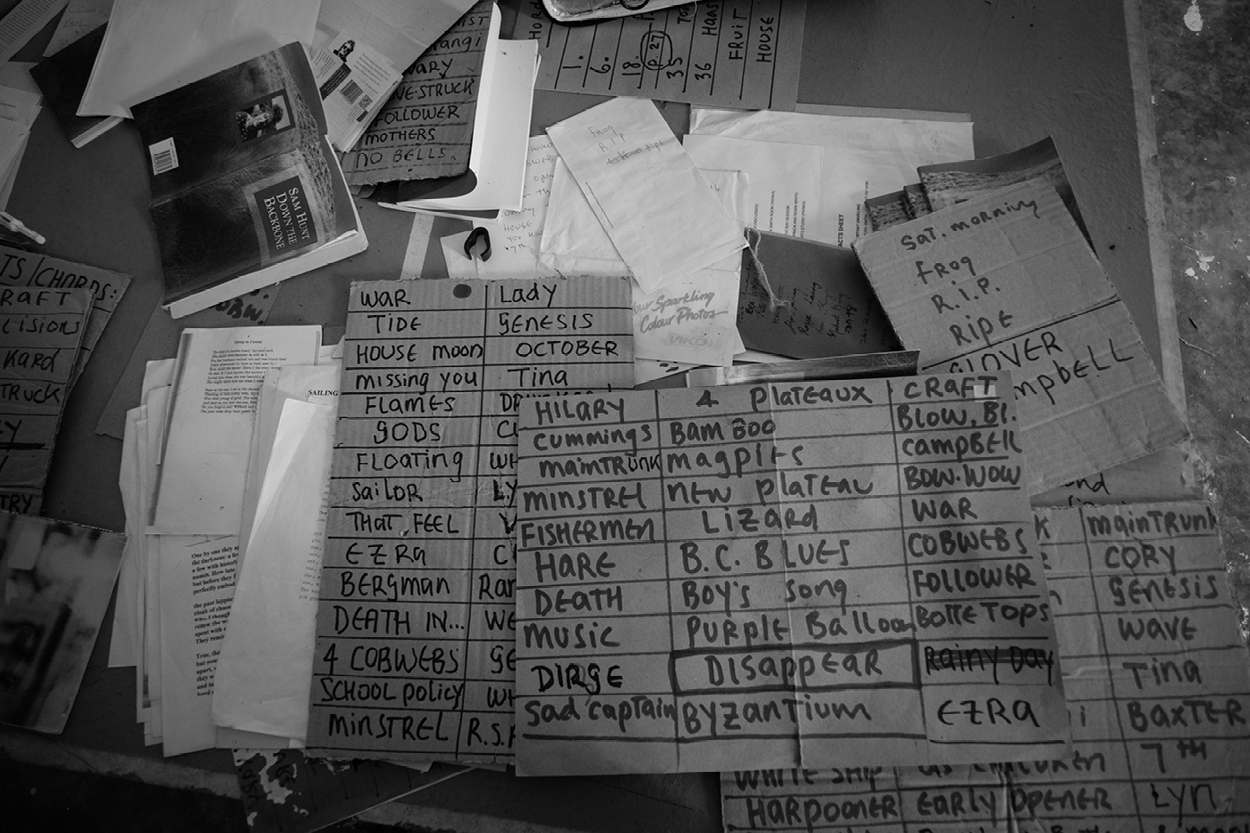
I think of the poem not as written down, that’s just the score. And you can get to the poem by way of the score. But I hear poems. I know the voice of the poem. If a new poem is coming along, it’s like a pregnancy, different things happen at different times. For me, it doesn’t happen the same way every time by any means but a poem starts with a sound. It’s almost like I’ve recognised a voice from somewhere. Sometimes the poems land on the roof and I’m not sure whether it’s a possum or a poem! Something thumping across the corrugated iron on top of my house, and I think, what is that?
I’ve worked out (it’s just a theory of mine) that I’ve got five voices. Two of them are female and the other three are male. And if I wanted to, I could divide my poems up into those five voices as far as where they’ve come from. There’s a line of Ezra Pound’s (a wild old bugger — he was a contemporary and good friend of T.S. Eliot’s, who dedicated The Waste Land to him — ‘to Ezra Pound, the greater master’) that ends up talking about the five voices, and this is what he says:
Oh world my poems are written for five people
Oh world I pity you, you do not know these five people.
Isn’t that great? Long before I would come to know those lines I worked out that I basically had five lyrical voices in my heart and head.
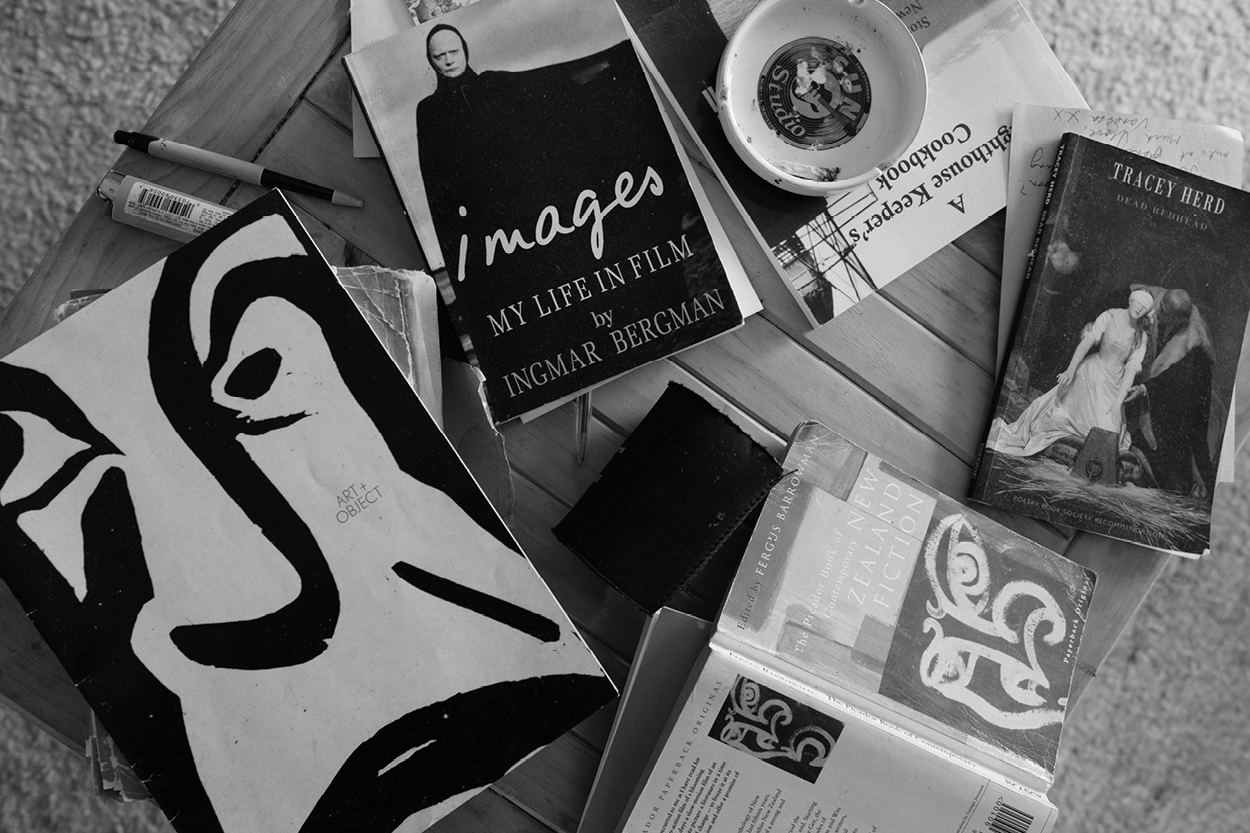
Sometimes I can make the mistake of trying to scribble a poem down too quickly in my Warwick 1B8 exercise book. But then again, if I don’t scribble something down, particularly if I wake up in the night with a line or a phrase or a word, it will be gone in the morning. So that part I recognise. But equally I recognise going the other way. It can’t be rushed. It’s a strange process and I still find myself astonished by it. It must be like the people who see birth all the time, like midwives. Most of them would agree with Ted Hughes in a poem he wrote about a birth, and in the last line, it’s a wonderful, throwaway line, he says:
Just another ten-toed, ten-fingered miracle.
The empty page is a good workbench. But I’m listening more than writing. For me it’s a sound process, which is probably part of the reason why I have often ended up working with musicians. People like Barry Saunders and David Kilgour and other people.
I didn’t have to go to a vocational guidance person to ask what I wanted to do. If somebody had stopped me in the street when I was young and said, ‘well, what are you going to do with your life?’ I don’t know, I’d have probably said I was going to go to jail or something. Do a life sentence and get it over with. I didn’t really know what I was going to do but I knew that poems were going to be at the heart of it.
When I was quite young, everyone was taking what they used to call OEs (overseas experiences) and honestly, what wankers. They came back more boring than they were before they left. And around about the same time I was discovering poets like William Blake with his lines like, ‘to see a world in a grain of sand’. You don’t have to travel all around the world. I mean it’s wonderful if it helps you make something of it all, but so many people just take selfies. That happened to me recently, someone tried to take a selfie with me and I just grabbed the camera and threw it on the ground. What an insult to humanity that is?!
I hate the word career. Career is a six-letter word starting with ‘C’ like cancer. I never had a career, and I never want a career.
Experiences had more to do with my poetry than any sort of marks I got for School Certificate. I remember once, my father and I were going to see French cellist Pierre Fournier at the Auckland Town Hall (who was playing, among other things, the Dvorak cello concerto which I fell in love with that night and love to this day) and I discovered a passage from my father’s chambers on Queen Street directly to the Auckland Town Hall backstage, and I ended up in the number one backstage room where Pierre Fournier was tuning up his cello for the show.
Later that night we were walking down Queen Street to catch the ferry, and an old friend of my father’s, Lewis Eady, was closing up his music shop, but he let us go in to see if he had a copy of the Dvorak cello concerto, which we found on double vinyl. We went home and stayed up all night playing the vinyl over and over. I’d describe those kinds of moments as spiritual experiences. They’re certainly the ones that have stayed close to my heart and consciousness, and subconsciousness.
I was very fortunate to be able to earn a living on the road. Often I’d do shows, one of my regular ones was the Gluepot in Auckland, and I’d do a one-man show where I’d get around 1000 people which was the maximum upstairs there, and it would be $10 a head. The pub would take the bar and we’d take the door. And so driving home the next day, or the day after, or the day after, I’d maybe have made, over a couple of nights, around $20,000 in cash. In the end I did get caught by the tax department. I was living outside the law. But what did Bob Dylan say? “To live outside the law, you must be honest”.
I retired on my birthday, on the 4th of July, five years ago. I do miss performing but I don’t miss the in-between bits of getting there and getting home. I miss the energy of doing shows and, although I don’t want to get sentimental about audiences, I’ve had some bloody lovely audiences. If I didn’t do a good job I didn’t expect a good reaction from the audience, and there were times that I bombed out (drunk and stoned and a long way from home) but that didn’t happen very often. And for all the times when the magic was taking place which involved not just me but every member of that audience, the relationship was almost electric. I miss that.
Now that I’ve stopped performing I’ll go downstairs in the house where I’ve got my own PA system and I turn the microphone on and I speak my poems into that. I don’t know what the cattle and the sheep think about hearing my voice booming out in the paddocks but the microphone gives me just a bit more objectivity. Again, it comes back to listening. When you go and do a show you’re putting your voice out there and it gives you that distance. I think, I wonder what this poem’s like and I wonder what it sounds like, and it’s different from sitting here and reading what I’ve scribbled down in my 1B8 Warwick. I wonder who Warwick was? I think I’d like to have met him.
Some poems are stillborn, or die young. And there are many more that maybe should have. But there are certain poems that I feel blessed to have written. There’s been a guiding hand there somewhere, or an ear that has listened and has taken it in. And it still amazes me. The poem that my mother always said meant a lot to her was one of mine called Wave Song. It’s sort of a carnal poem, a lot of them are anyway. But that makes it special.
I hope I’m not being curmudgeonly when I say that some of the biggest threats to poetry come from the writing schools. I know some of them have produced great stuff but there is great stuff that I believe would have happened anyway. Trying to learn poetry is a bit like learning how to dream. “And professor, what do I do when I close my eyes?” There are a lot of so-called poets who are being published who really haven’t done a hell of a lot more than go to a computer and start playing around with rhymes and things, and I’m thinking well, where is it coming from? I don’t need to know what a poem is about per se, I’ve never had that urge. But I want to feel that it’s going somewhere.
There’s a lot of talent among young people, but if I look for what’s happening in poetry now, I’m more inclined to listen to people like Benee and other ones like her. They’re the poets as far as I’m concerned because they’re doing it and they’re not bullshitting. There’s a lot of bullshit out there.
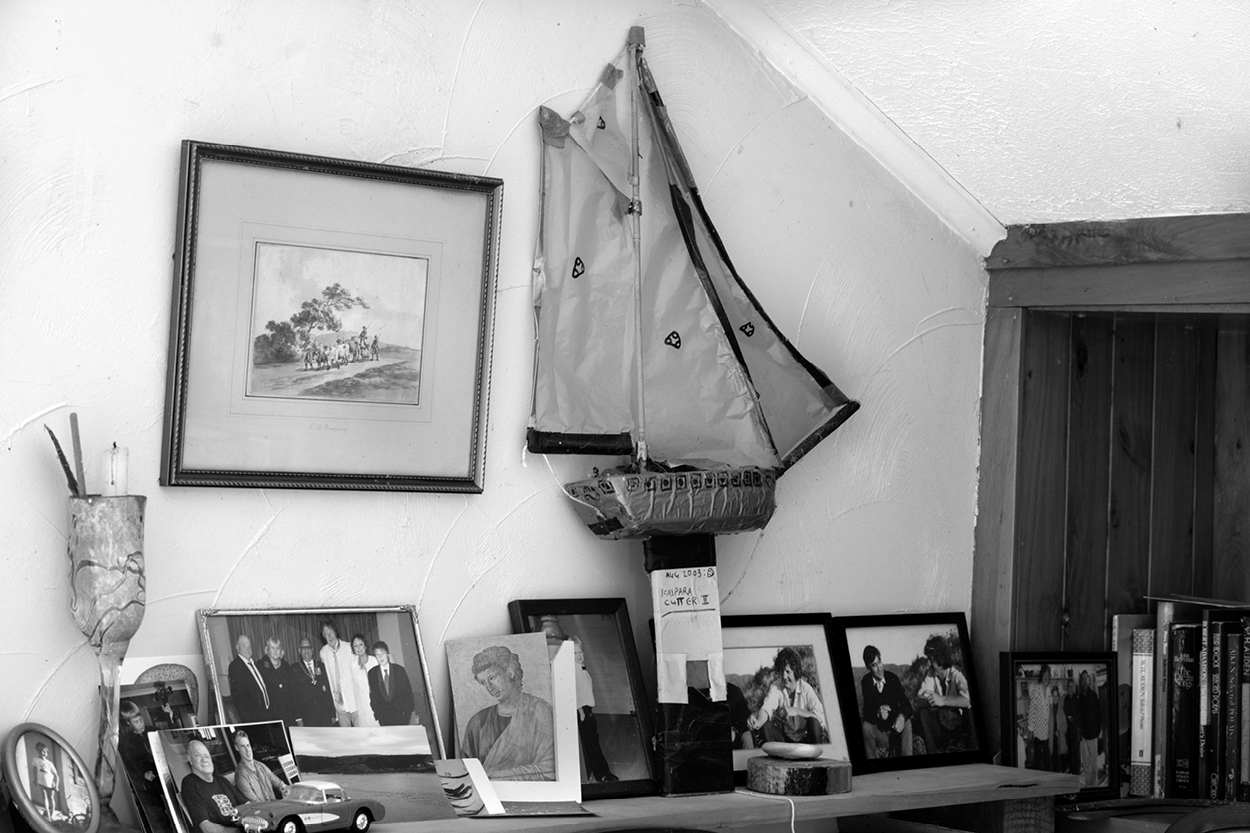
I love my home in the Kaipara. I live in a treehouse. I love this place. When I retired I couldn’t have been happier. And often, apart from when I go out with a couple of friends and get lost on the back roads (there are some beautiful backroads up here and sometimes there’s a pub at the end of them too) I don’t really see too many people. A lot of people like to visit people… they’re forever visiting… and I can’t work it out why anyone would visit somebody. I like the sign that apparently Bob Dylan has on his property in California that reads: ‘If you haven’t rung, you’re trespassing.’
When my youngest son Alf turned 11, I wrote 11 runes for him, and one of the little four-liners goes:
Alive Alf to live
clear of any city
live as we do
five gunshots from humanity.
And that’s where we live, five gunshots from humanity.
Alf recently gave me, for a present, six months of Spotify, which was very sweet of him except that I discovered the first six months were free anyway. I rang him and we laughed. He’s good. I thought, what a beautiful gift for a son to give his father and then I realised that it was all for free! Well, so is love, so is love.
You’ve got to fight for the ability to be still and sit in one place and listen. People will trespass on that territory easily and that’s why I do live five gunshots from humanity and not just physically and geographically but mentally. I’m not saying that I’m better than anyone, I’m just saying that I’m on my own. Jim Baxter, when he was 17 years old, wrote in High Country Weather:
Alone we are born
and die alone
Yet see the red-gold cirrus
over snow-mountain shine.
Upon the upland road
Ride easy, stranger
Surrender to the sky
Your heart of anger.
Poems are always there if you listen long enough. I had to renew my licence the other day and I overheard a phrase at the AA in Dargaville, I won’t repeat it now because I want to keep it echoing in my head, but it started me on something new. I think it was James K. Baxter who said in a poem dedicated to Maurice Shadbolt in the Pig Island Letters… ‘Whoever can listen long enough will write again.’
I’ve never worried about the dryness of the mind. At one stage I didn’t write a poem for quite a few years because I was just taken up doing other things and I wasn’t able to take the time to listen long enough… and then one day they all returned.
I stuttered quite badly from my adolescence, something I developed in puberty. And then in my later teens and early 20s I found myself out doing shows (as I did for the next 50 years), and the stutter went away completely. But in the five years that I’ve been retired from performing, I’m stuttering again and I don’t mind it. I think it had been outrun by the performances where I couldn’t stutter. And now it’s back.
I’m sort of working on a new collection. I recently wrote a poem called Mum and Mary about my mum, Betty and Mary, Mother of Jesus, out sharing a joint. It will be in this new book which I was going to call Last Poems but my publisher asked what would happen if I decided to write a few more?
I enjoy life but I’m looking forward to death. I’m three-quarters of a century now and it’s all happened really fast. I’m looking forward to having a look around the corner. ‘Hey around the corner, behind the bush, looking for Henry Lee’ (line from a 1955 song by The Weavers). That’s where I’ll be.
I don’t want to be remembered for anything. I was recently, very kindly offered an award and I just had to turn it down because it didn’t represent anything that I was about. It was a corporate thing. And they wanted to make me their poet. And I thought, if I get short of money I can stop in at a pub and play somebody on the pool table for $1000 and then move on to more dangerous places.
There’s no one really that I’ve ever fantasised about conversing with. Sitting down and talking to you is what it’s all about as far as I’m concerned. There’s a beautiful line in one of Bob Dylan’s many great songs where he says:
I have dined with kings
I’ve been offered wings
And I’ve never been too impressed.
I wonder if someone these days would be able to have a similar run to me. I hope that they would be able to, but looking back on it, it’s got to be in your blood. It’s not something you can pick out of a line-up of vocations or a booklet of possible professions. It must be very hard now. I’m recently 75 but I would find it very very tough being a 15-year-old now. It’s all so confusing.
I’m not a man for giving advice because all the advice I’ve given myself has got me into ditches. But again, I quote Bob Dylan, with the title of one of his well-known songs, ‘I Believe In You’. Believe in yourself. I know that you can’t just turn on a button and believe in yourself but make sure you get the poems down that will make you personally believe in yourself. If you’re listening to the voice, or voices and if you can tune in to your own one as it’s transmitting stuff from your conscious mind by way of your subconscious… if it’s working, it’s like love. It’s wonderful.
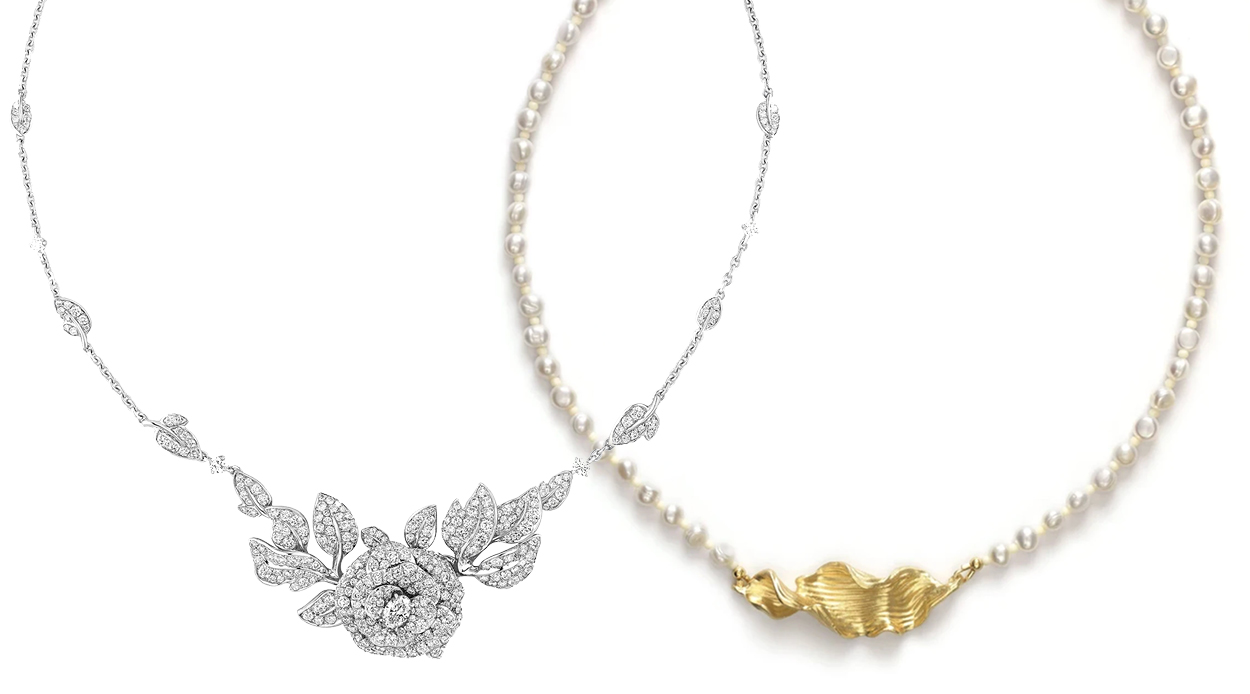
Is that a sapphire flower carefully closing its moonstone petals for the evening, and do we spy Neptune’s green tourmaline ring emerging from a sea of diamonds? Let your imagination run a little wild with these exquisite creations that draw sparkling inspiration from the bounty that is found in the beauty of the natural world.
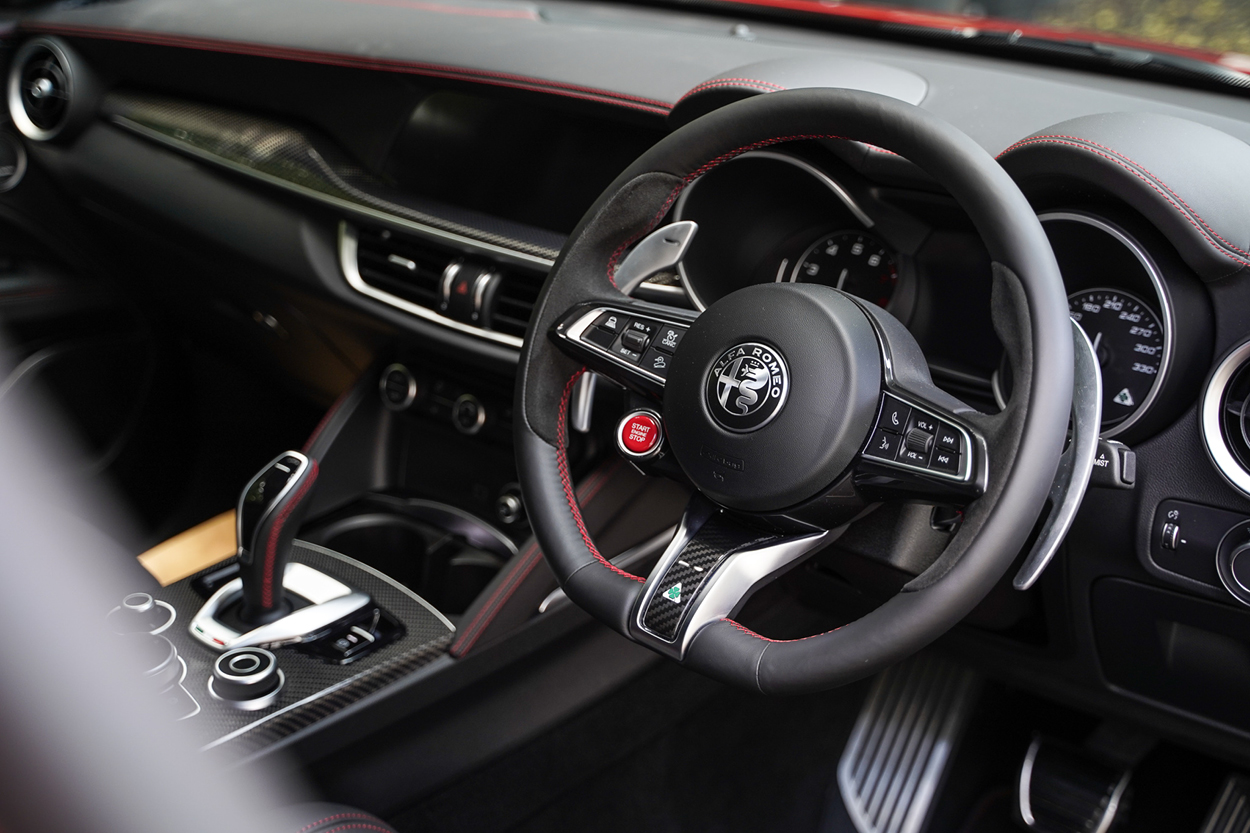
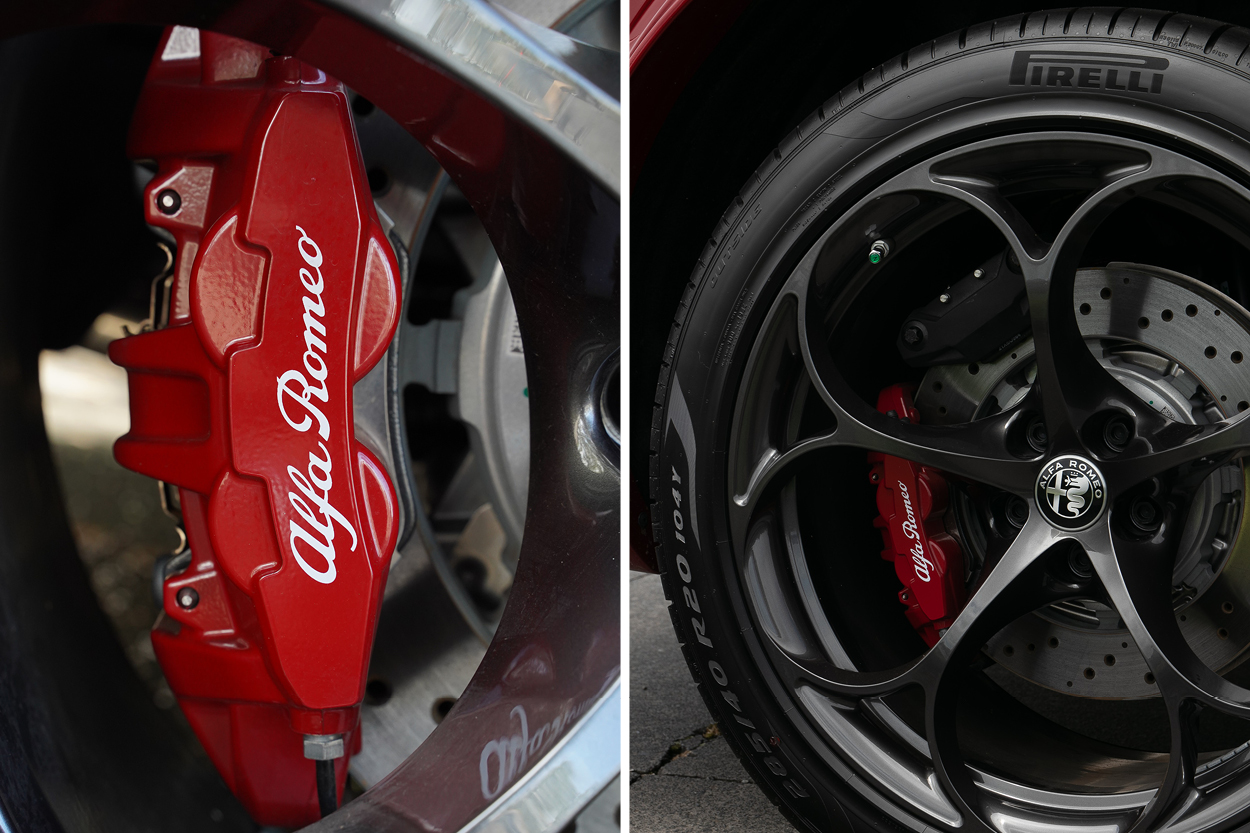
Few cars elicit the same passion in their fans as the Alfa Romeo. While simultaneously boasting exceptional performance, attention to detail and Italian design pedigree, there’s an instinctive, intangible quality to the automobiles from this storied maker that make the heart skip a beat — although, in the case of Alfa Romeo’s 2021 Stelvio Quadrifoglio, it’s likely to be the Ferrari engineered 505-horse V6 engine that’s responsible for that.
A modern performance SUV, this car melds the power of Alfa Romeo’s most powerful sports sedan (the Giulia Quadrifoglio) with a safe, comfortable and easy-driving vehicle — and has twice won the award for SUV of the year. So, those looking for practicality that also responds like a champion racehorse when you put your foot down — you won’t be disappointed.
The 2021 Stelvio Quadrifoglio boasts a wide range of technological, connectivity, safety and aesthetic upgrades that have been key to its evolution since it was first launched in 2017.
The first thing onlookers will notice as you pull up are its signature unique, ergonomically sculptural exterior lines. Both eye-catching and sophisticated, the contemporary style of the Stelvio embraces a simplicity that belies its creative and technical complexity, all revolving around enveloping the driver in comfort.
Inside, the centre console has a tactile new design that imparts plenty of visual impact, and more storage space for the flotsam and jetsam we all tend to carry with us in this life. Also new are the steering wheel and leather-trimmed gear stick. Operationally, the new touchscreen infotainment system features a slickly updated interface design and specific screens to communicate vehicle performance.
Engine-wise, Alfa Romeo’s Stelvio Quadrifoglio is equipped with a 2.9 V6 Bi-Turbo powerhouse, capable of letting rip 375kW and up to 600nm torque. In other words, enough to set a record lap time for a production SUV at Germany’s legendary Nürburgring race track.
The Stelvio’s 8-speed automatic transition prioritises fluid movement, allowing it to be driven comfortably on all terrains whether you’re heading out for a summer trip and encounter some back-country roads or are simply pulling in at the supermarket.
For those who are after a reliable commuting carryall, there’s no reason to be intimidated by the prospect of handling such power. One of the most comprehensive updates in the newest Stelvio model is what it calls its ‘Level 2 Advanced Driver Assistance Systems’ — or ADAs. These are designed to bridge the delicate balance between pure, unadulterated driving enjoyment, and increased support during heavier traffic or long trips.
Should you opt to switch it on, you’ll give the car control of certain operations like the accelerator, brakes and steering (while keeping your hands on the steering wheel, of course). From there, enjoy features like Lane Keeping Assist (which detects whether you’re veering off from your lane and actively intervenes to steer you back into your lane), Active Blind Spot Assist, Active Cruise Control, Traffic Jam Assist (keeping the car in the middle of the lane in heavy traffic) and more. No more jerking back-and-forth as you navigate already-irritating congestion, the Stelvio will enhance your experience without being intrusive.
With its Stelvio Quadrifoglio, Alfa Romeo effortlessly balances innovation and heritage, power and control, to offer a comfortable, well-built SUV with plenty of nimble spark — making even just going from A to B a thoroughly enjoyable journey.
The Christmas rush leave you with no time to catch up on newly released seasons of your favourite shows? Now that a bit more downtime is on the agenda, we suggest adding these fresh seasonal releases to your cultural calendar.
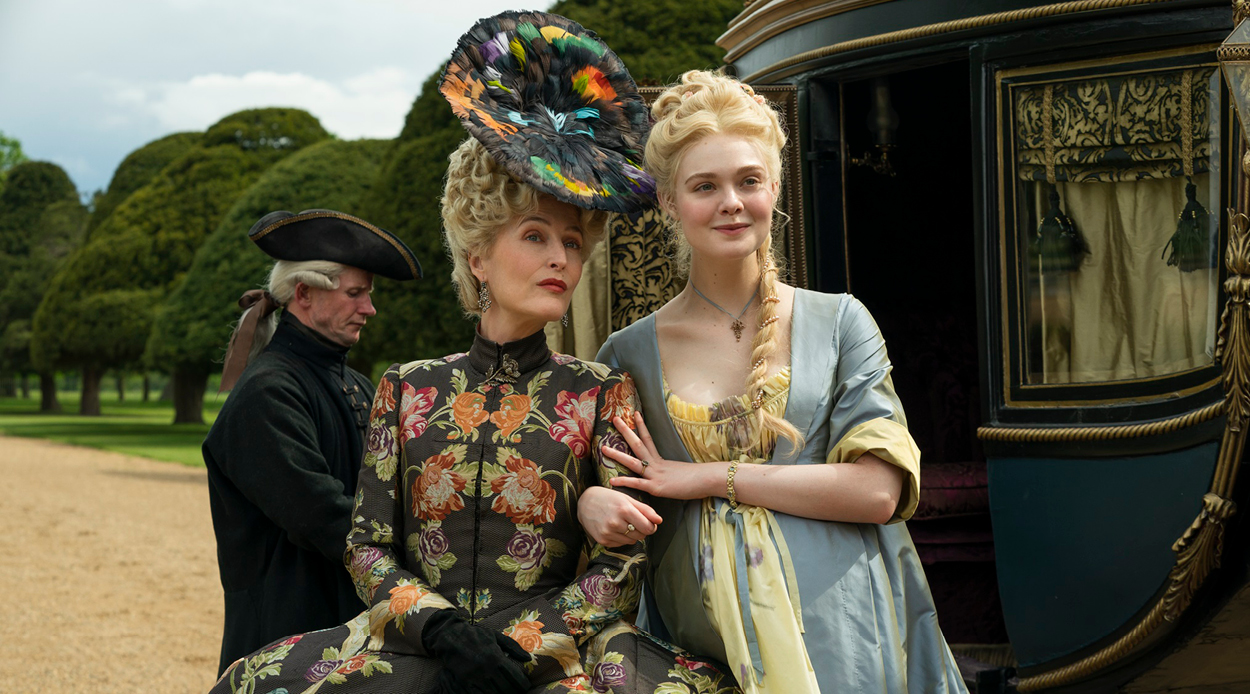
The Great Re-writing the possibilities of a period drama series, The Great premiered to widespread acclaim last year with its “occasionally true story” of Catherine The Great. Far from fusty, Catherine (Elle Fanning) and her husband Emperor Peter (Nicholas Hoult) swig, swear and slight each other, as they charge towards a coup d’état. Now, as Catherine tries in earnest to bring the Enlightenment to Russia, she is met by her mother (played by the inimitable Gillian Anderson), as well as unconventional power plays. With an artful irreverence, the first season’s costumes were inspired as much by the House of Dior as 1700s style, and we can expect to see more swoon-worthy yet witty costumes as the historic characters give each other a dressing down this season. With one executive producer proclaiming that Catherine’s life as the longest-serving female sovereign in Russia is enough creative fodder for at least six seasons of its 10-episode format, The Great could well become a TV show for the ages. Watch on Neon.
Curb Your Enthusiasm After the year we’ve all had, we’re in dire need of some levity. Larry David more than delivers with season 11 of his addictively awkward show Curb Your Enthusiasm. The prickly protagonist remains comfortingly unchanged as he navigates life’s ups and downs in his own, distinctly Larry David-type of way. Watch on Neon.
This Way Up At times both hilarious and heart-wrenching, the compulsive comedy-drama returns for a much-anticipated second season. Luminous Irish actors Aisling Bea and Sharon Horgan reprise their roles as sisters Áine and Shona. In season one, we met Áine after she got out of rehab for “a teeny little nervous breakdown” and followed as she attempted to rebuild her life. Now, things are going pretty well — but there are inevitable hiccups for both sisters, with every twist and turn portrayed with deftness, intimacy and characteristically sharp comedic timing. Watch on Neon.
https://www.youtube.com/watch?v=TJFVV2L8GKs
The Witcher Nothing like a pulpy fantasy drama for a bit of light escapism. The Witcher returns, and with it, gruff monster-hunter for hire Geralt of Rivia (played by Henry Cavill) and his friends and enemies, as they grapple for existence in their tumultuous Continent. Based on the wildly popular books by Polish author Andrzej Sapkowski, and a trilogy of video games inspired by it, this adaption introduces new complex characters as the epic continues. Watch on Netflix.
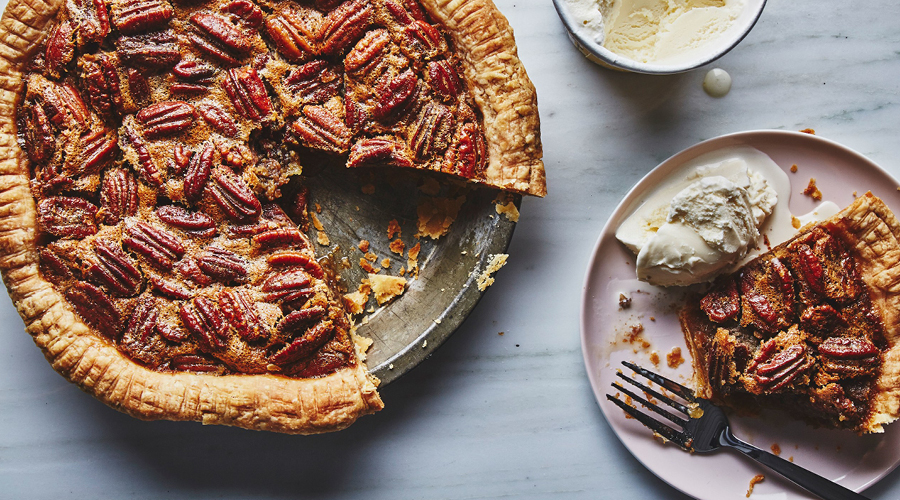
Although sweet pies during the festive season aren’t as ingrained in Kiwiana culture as in the United States, we can all still come to a mutual agreement that pies are absolutely delicious. With Christmas knocking on our door, why not consider a pie as part of your dessert spread? Without further ado, here’s our recipe for a buttery and decadent pecan pie that can sit pretty alongside the pavlova this holiday season.
Cinnamon-Spiced Pecan Pie Recipe (Feeds 10-12 people)
Ingredients:
For the crust 2 cups of plain flour Pinch of salt 170 grams of butter — cut into cubes and chilled 2 egg yolks 4 Tbsp of ice-cold water
For the filling 2 cups of pecan nuts ¾ cup of dark corn syrup 3 eggs 1 cup of white sugar ¼ cup of brown sugar 1 tsp of vanilla extract 2 tbsp of unsalted butter, melted 2 tsp of ground cinnamon 1 tsp of salt
Equipment Rolling pin 22cm pie dish Bag of rice, pie weights or beans
Method:
Crust 1. In a large bowl, sift the flour and salt together. 2. With your fingertips, pinch the cubes of butter into the flour and break up the butter until there are no more big lumps. 3. In a separate small bowl, mix the egg yolks and ice water until combined and add ¾ of it to the dry mixture. This helps avoid your pastry from becoming too wet, which is irreversible and you would need to start all over again. 4. Be quick when mixing the eggs and flour together with a fork until the dough just starts to come together. Take your hands and if the dough holds together in a ball when squeezed in your palms, it’s ready to knead. If the dough doesn’t come together, add the rest of the egg mixture. 5. The dough should be quite dry and crumbly as everything hasn’t been fully mixed together yet. Once it’s transferred on a flat and clean surface, bring together in a disc and wrap the dough disc in cling wrap and chill in the refrigerator for at least 30 minutes, or up to four days.
Assembly and filling 1. Preheat the oven to 180°C, fan-baked. 2. Dust flour onto a clean surface and unwrap the disc of chilled dough. Flour the top of the dough and roll it out, turning every few rolls. Don’t be discouraged by any cracks that form and just simply smush them back together. Roll out the dough to a circle about 3mm thick and place into a 22cm pie dish. Trim any excess dough around the sides, then crimp the edges for that traditional pie crust aesthetic. 3. Place a piece of baking paper in the centre of the pie crust and add the pie weights or some uncooked rice. Bake it in the oven for 15 minutes and take it out when golden brown. 4. While your crust is baking, in a large bowl, whisk together 1½ cups of your pecans, corn syrup, eggs, white sugar, brown sugar, vanilla, melted butter, cinnamon and salt. 5. Carefully lift the parchment with the pie weights from the par-baked pie crust, then pour in the filling. Place the remaining ½ cup of pecans in concentric circles on top. 6. Put the pie back into the oven for 20 minutes, then cover with a piece of aluminium foil and bake for another 40 minutes. Unlike other pies, this one is ready when it’s set in the oven, so if it’s still jiggly on top, it’s not ready. 7. Allow the pie to cool completely, slice and serve the pie chilled or at room temperature. Add a scoop of ice cream if you’re feeling extra indulgent (which, we are).
We’re looking forward to taking all things easy this summer, and the signature shoe of the season allows us both to kick back and stay on trend. Rendered in a variety of resolutely fashionable, utterly practical designs — from Gucci’s Original GG slide sandals with a perfected platform to Christian Dior’s gold thread embroidered slides — there is no stopping where these shoes will take you.
Clockwise: Original GG slide sandal from Gucci, Pool Pillow Comfort mule from Louis Vuitton, Gia Borghinicoffee brown puffy thongs from Muse Boutique, Proenza Schoulerslides from Muse Boutique.
Clockwise: Sunset Flat Comfort mule from Louis Vuitton, DWAY Slides from Christian Dior, Chloé Woody Shearling slide from Workshop, Acne Studios Face Pool slides from Workshop.
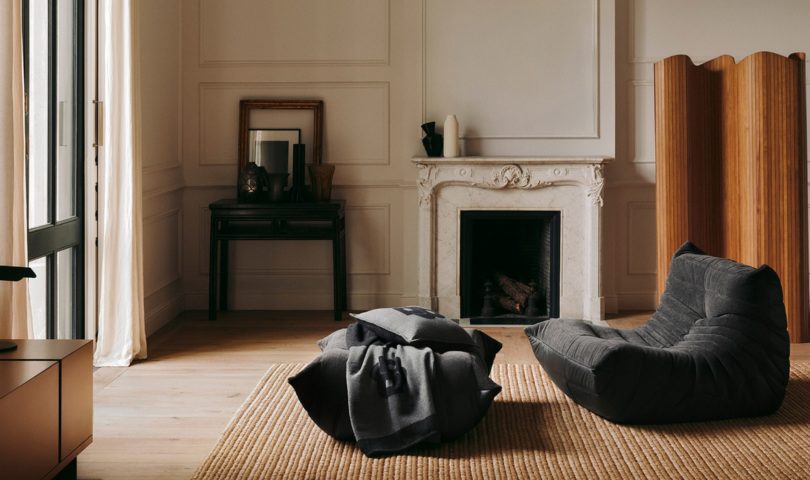
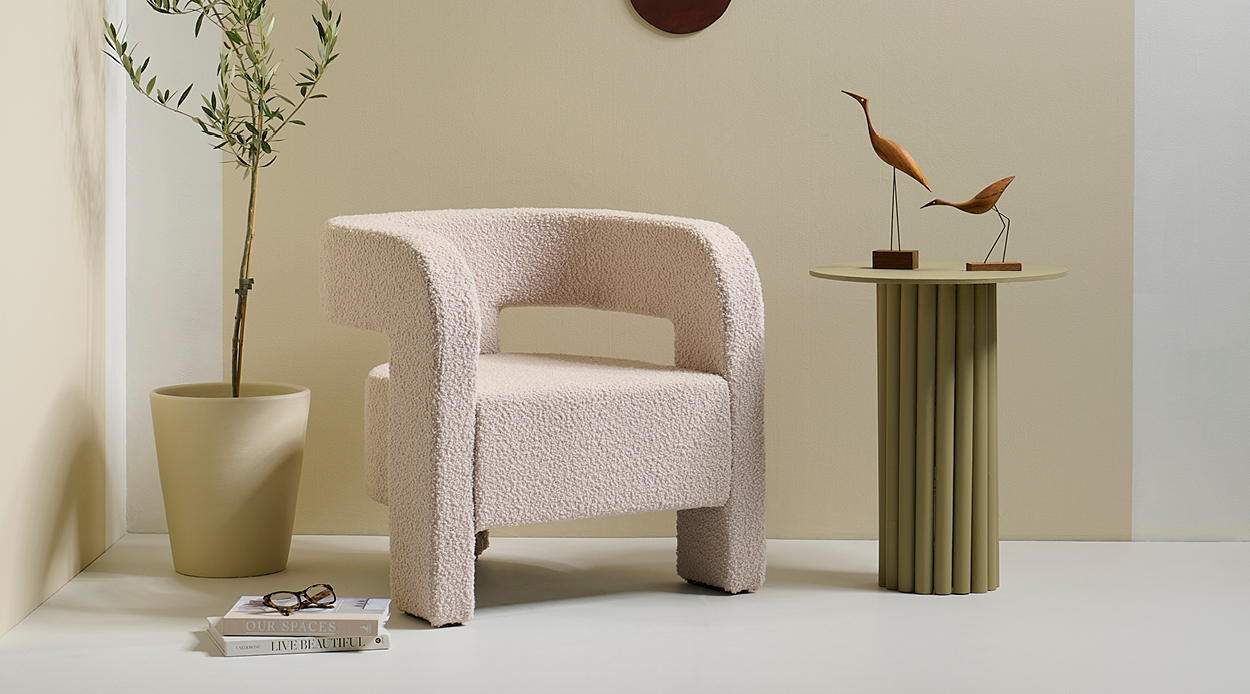
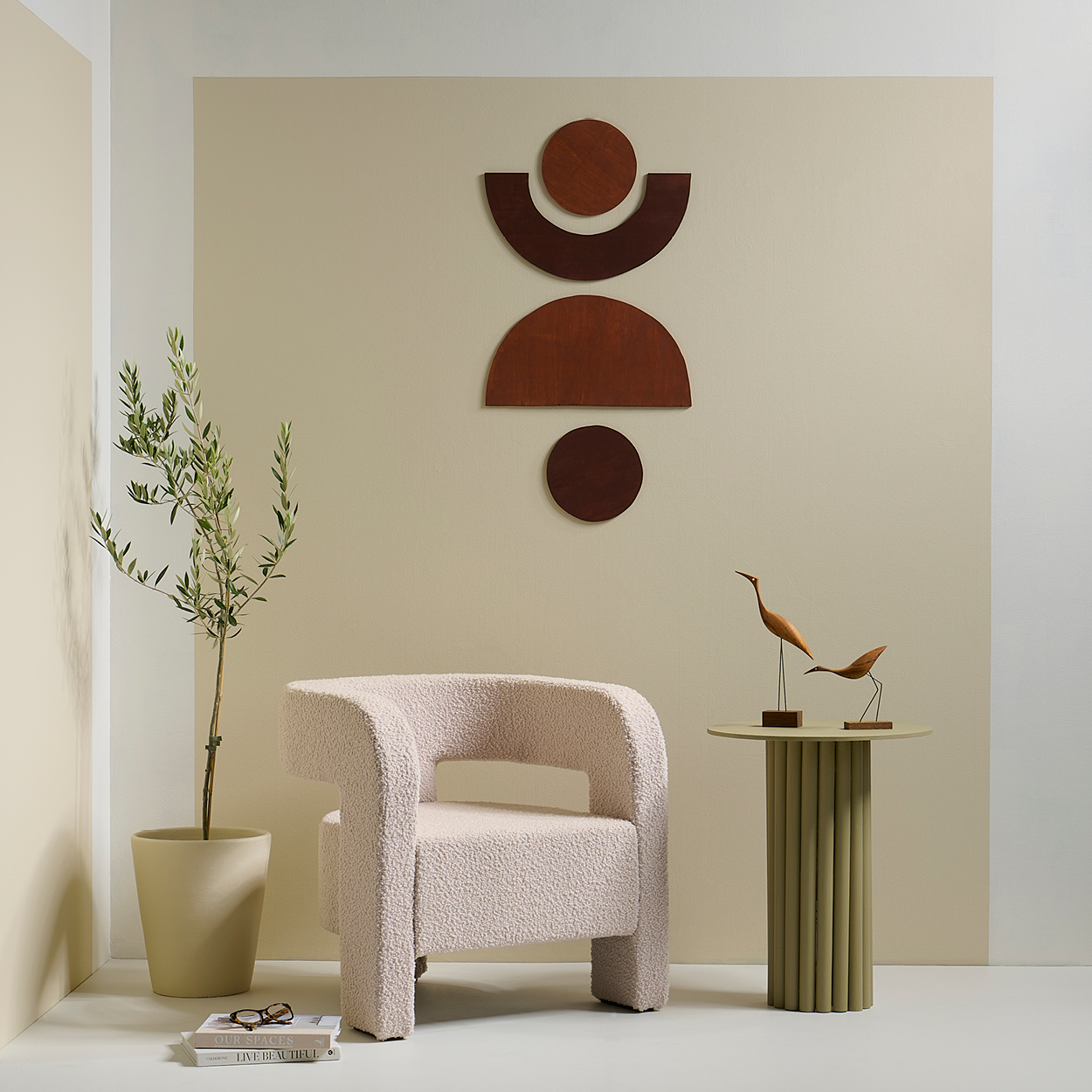
Walls in Resene Double Spanish White with borders in Resene Eighth Spanish White. Floor in Resene Quarter Spanish White, large plant pot in Resene Double Spanish White, art deco table in Resene Clay Creek. Chair from David Shaw and Birds and bowl from Good Form.
A custom-painted wall takes an interior to the next level. For this, the framed wall trend is a creative flourish still in line with a sophisticated scene, presenting just the right amount of interest and intention for a considered conversation piece. In this room, Resene Eighth Spanish White has been layered in spacious borders to frame the focal colour block, Resene Double Spanish White.
The latter, complex creamy white adds warmth, as well as a fixture of flexibility, to the linear design. Both colours have been prepped with two coats of Resene SpaceCote Low Sheen — tinted first to each hue. Unconventional artwork then adds a final, curvaceous flare to the wall space, while the interior piece of the moment, a bouclé armchair, fits right in.
In theory, it should be a designer’s dream come true to have more time than usual to perfect new creations, before they are presented to the world. In the case of the Salone del Mobile, the pandemic-prompted cancellation of last year’s event, and the delay of the 2021 showcase, must have been closer to a nightmare.
Nevertheless, in a true, resourceful style, both the Salone’s organisers and the participating brands used the opportunity to demonstrate the role of reinvention and innovation in their oeuvre.
When the event was able to take place from the 5th until the 10th of September, it was with creativity, sustainability, joyfulness and prestige at the fore — and a brand new title. Dubbed ‘Supersalone’ this year, the seminal showcase was curated by Architect and President of the Triennale Milano, Stefano Boeri.
Milan’s exuberance remained, and the city came alive with celebrations of design throughout, revelling in the groundbreaking nature of the resulting furniture, décor and concept collections.
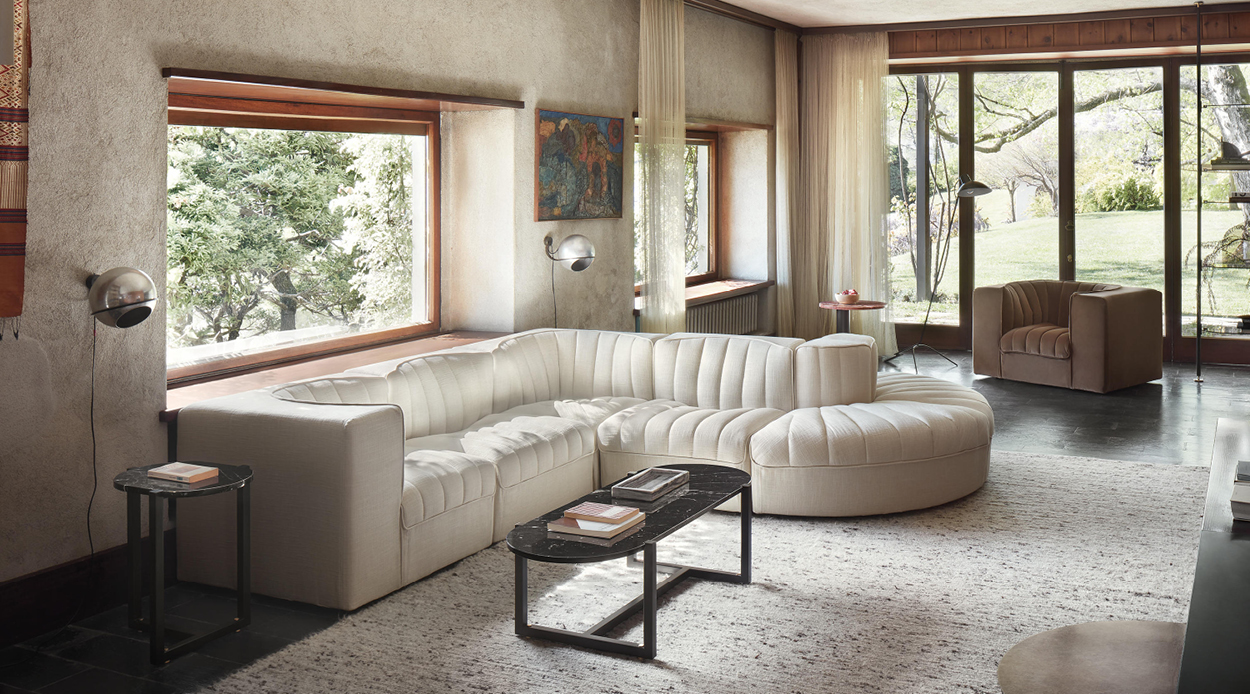
Superior seating pulled up its usual place in the upper echelons of instant classics, this year further highlighted with a dedicated exhibition (Take Your Seat – Solitude and Conviviality of the Chair) celebrating the versatility and essential nature of one of design’s favourite objects. Additionally, Arflex unveiled its organic, curved 9000 sofa — designed by Tito Agnoli to allow multiple configurations.
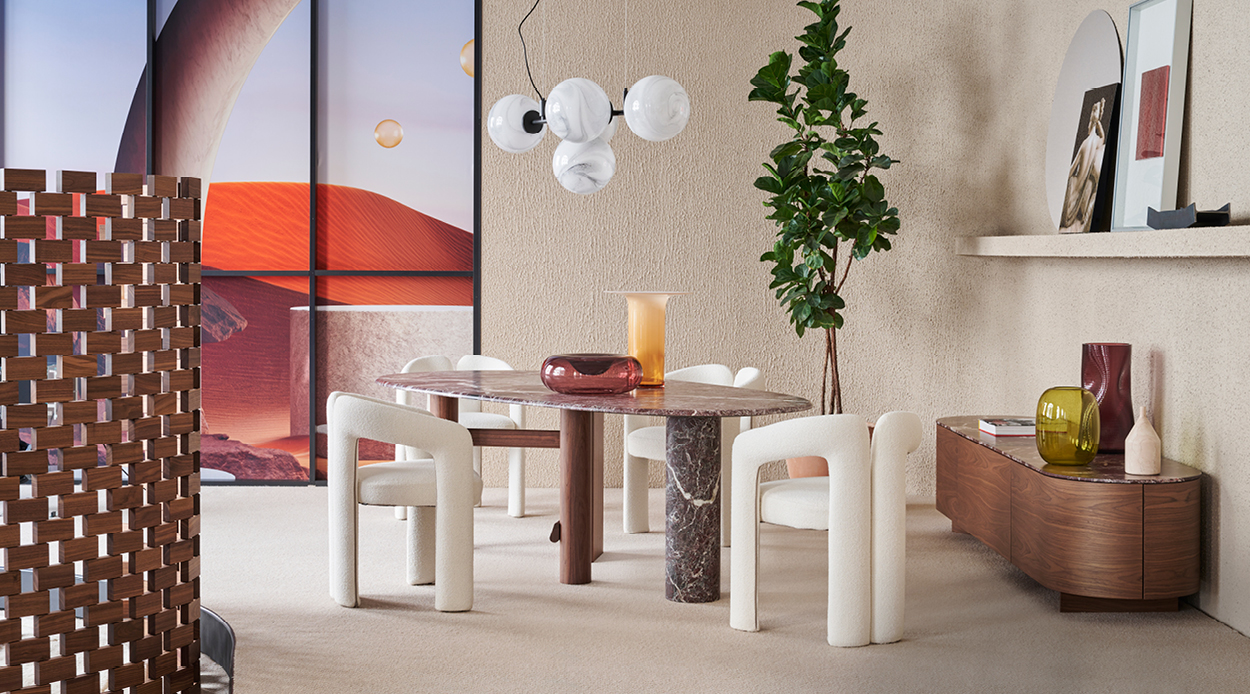
Marco Lavit’s Lemni armchair for Living Divani arrived almost like an abstract line drawing in space, while Patricia Urquiola’s milky new iteration of the Dudet small armchair for Cassina creates a 70s-inspired tableau with the rounded Sengu table.
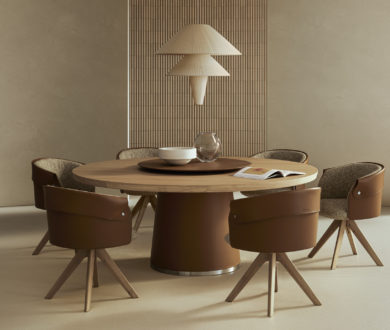
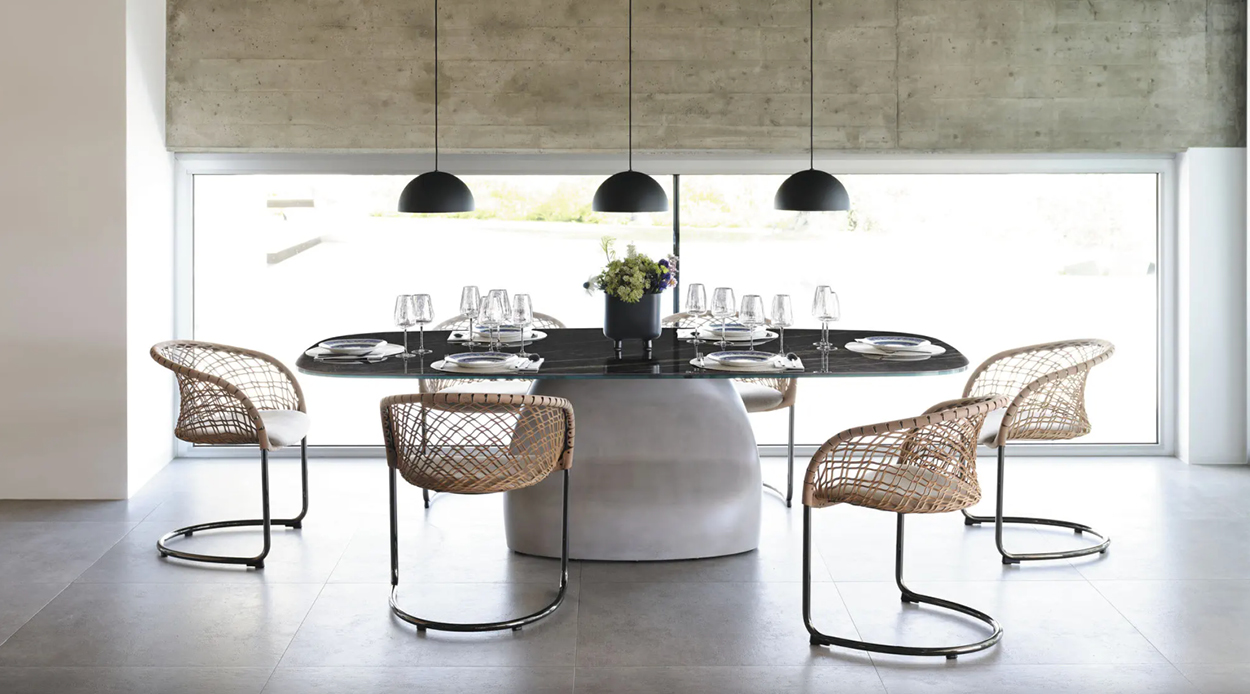
Those wishing for an airy yet cocooning accompaniment for their dining suite need to look no further than the P47 P M TS-CU chair by Franco Poli for MIDJ, while Vincent Van Duysen’s Marteen sofa is a harmonious yet customisable addition to Molteni&C’s repertoire.
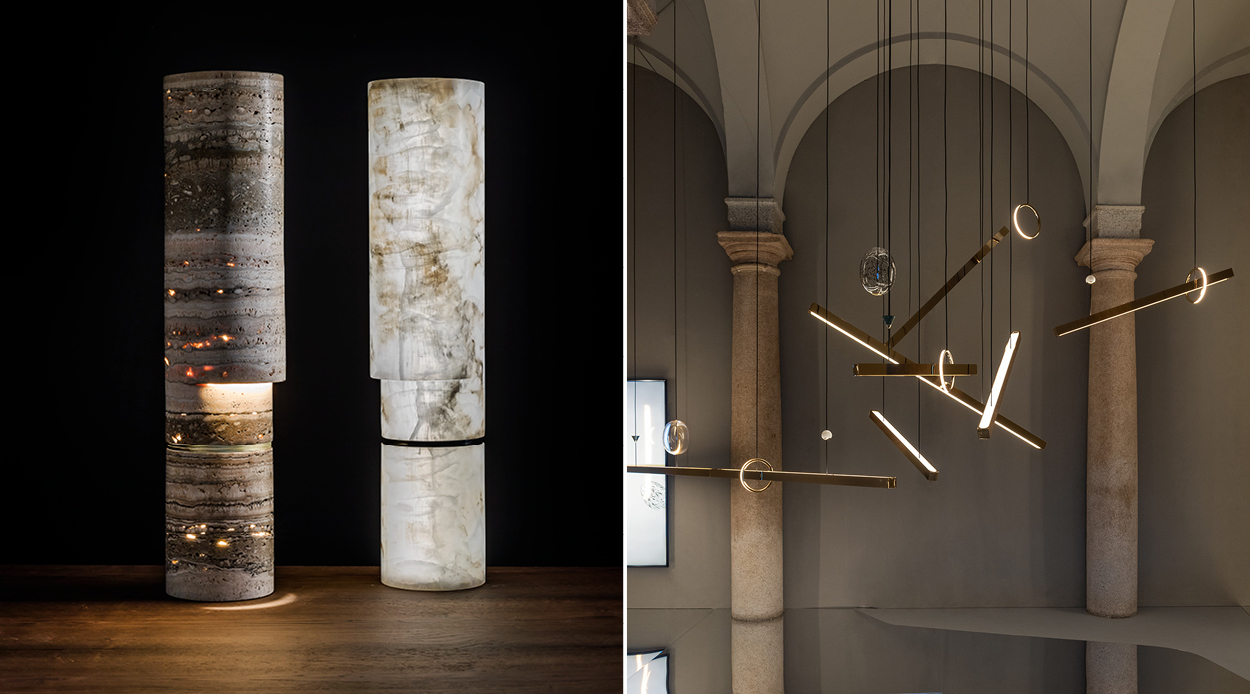
Left: Test-One table lamps by Ugo Cacciatori for Henge. Brand available locally at ECC. Right: Fragments of Infinity by Giopato & Coombes. Brand available locally at ECC.
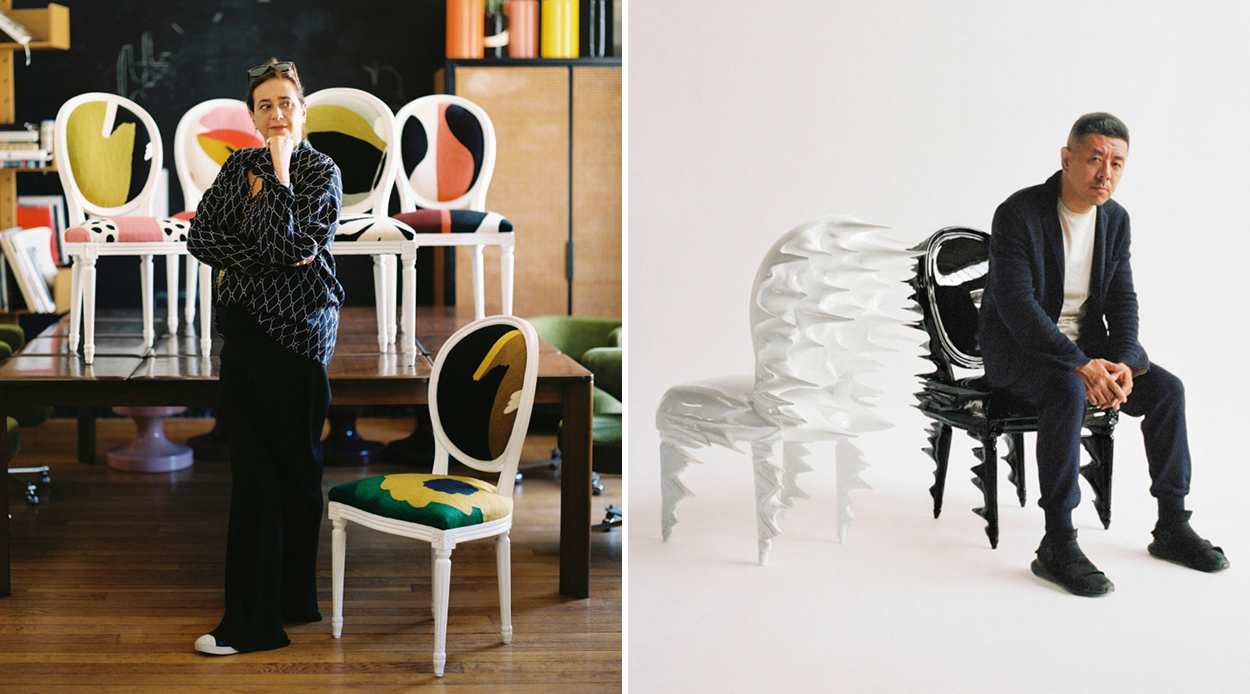
Left: The iconic Dior Medallion chair reimagined by India Mahdavi. Right: The iconic Dior Medallion chair reimagined by Ma Yansong.
Left: Lemni armchair by Marco Lavit for Living Divani. Brand available locally at Studio Italia. Right: Noonu sofa by Antonio Citterio for B&B Italia. Brand available locally at Matisse.
In the lighting realm, Fragments of Infinity by Giopato & Coombes is a boundary-pushing exploration of harmony and geometry. Henge’s Test-One table lamps bridge the natural and the manufactured with sand-polished ice onyx that turns from “sculptural opalescence to bright brutalism” when illuminated.
Joining the Supersalone’s ranks were several luxury fashion houses, with interior pieces that more than held their own among the design luminaries — in fact, collaborations were abundant with Dior asking several renowned artists and designers to reimagine the refined Louis XVI style of its iconic Medallion chair.
Rick Owens also joined forces with emerging Italian designers who created new one-of-a-kind pieces inspired by his clothing for a Galerie Philia exhibit.
Louis Vuitton commissioned several designer pieces for pre-order from its Objets Nomades collection, centring around its artisanal leather. The Campana Brothers’ Aguacate shield, in particular, is supremely eye-catching — with nine colourful panels crafted from saturated leather strips to mimic the interior of an avocado.
The limited-edition Royal bar cabinet from Armani Casa proves that sophistication and conviviality are utterly charming design allies.
These two qualities were seen throughout the 2021 Supersalone, demonstrating the boundless energy and ingenious concepts that result when creativity is given plenty of time to percolate.
For more exclusive access to what the city has to offer, engaging content, excellent imagery and thought provoking commentary on the life that surrounds you, subscribe to Denizen magazine now.