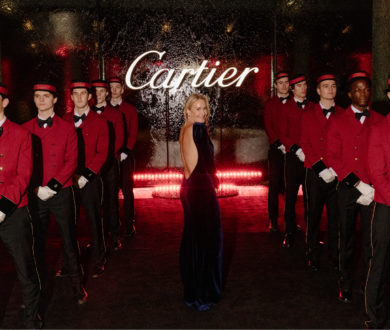




I could think of few settings that would have suited the second chapter of Cartier’s Le Chœur des Pierres as perfectly as Kyoto, a city that treats cultural inheritance as something to interpret rather than merely preserve. Across several days in Japan’s ancient capital, I was lucky enough to be a guest of the Maison for the unveiling of a new suite of High Jewellery creations, an intimate dinner, and the Cartier Cinema Club’s visit to the city for a 20th-anniversary screening of Marie Antoinette.

At the centre of it all was Le Chœur des Pierres, a High Jewellery collection built on one of Cartier’s most fundamental creative principles: everything begins with the stone. Rather than imposing an existing design on an exceptional gem, Cartier lets each precious stone’s colour, proportions, cut, history and character determine the form it takes. From the very beginning, the stone opens a conversation among designers, stone experts, jewellers, lapidaries, gem-setters and polishers; its importance remains central to every aspect of the creative process, and the final result is a piece that remains true to the stone’s beauty.

Among the new creations, Stellara places a 41.01-carat Ceylon sapphire at the centre of a graphic white-gold-and-diamond necklace, its radiating structure engineered to retain both lightness and suppleness despite its complexity.

Panthère Tunya takes one of Cartier’s most recognisable signatures somewhere unexpected, with a 48.12-carat Zambian emerald cabochon anchoring a composition in which the panther gradually shifts from figurative form towards abstraction, its emerald, onyx and diamond markings dissolving into a cascade punctuated by Fancy Yellow diamonds.

Looking back into Cartier’s creative history and revisiting the Tutti Frutti vocabulary the Maison has explored since the 1920s, the Tutti Chaya necklace features emeralds, rubies, sapphires, diamonds, and onyx set into an intricate asymmetrical construction, finished with two ribbed Colombian emeralds totalling 56.97 carats. The necklace, crafted entirely by hand, took nearly 2,000 hours, 1,400 of which were spent on goldsmithing. Understanding how creations this stylistically diverse remain unmistakably Cartier leads inevitably to Pierre Rainero.

Raniero, Cartier’s Image, Style & Heritage Director, has spent 46 years with the Maison, making him both a witness to and a participant in an extraordinary period in its contemporary history.
“What I’m doing now would have been a dream when I started,” Rainero tells me when we sit down together in Kyoto. His career, as he describes it, has been less a calculated ascent than a convergence of opportunity, instinct and a lifelong fascination with art history.
For Rainero, the logic is straightforward. “When you speak about style, the style was not born yesterday.” Heritage, in this sense, is less something to reproduce reverentially than something to understand deeply enough that it can continue to evolve.

When I ask how Cartier’s DNA itself has changed across his decades with the Maison, Raniero’s answer is immediate: “I think you add layers of history.” Cartier’s objective, he explains, is to remain relevant in each era while continuing to search for new expressions of beauty. “We question ourselves: is this design appropriate for today in the way it will be worn? Is it desirable today to be a part of someone’s life?”
Rainero repeatedly returns to that human relationship with jewellery, saying, “jewellery is probably the most symbolic object that a person can wear,” reinforcing jewellery’s capacity to express identity, memory, and emotion, and to acknowledge the important moments of life.

His own aesthetic preferences have evolved too. Rainero once found himself particularly drawn to abstraction and geometry, areas in which Cartier made such a radical contribution during the early 20th century, but today he speaks just as enthusiastically about figurative jewellery and the narrative possibilities of Cartier’s extraordinary menagerie. In Panthère Tunya, for example, the animal does more than lend the historic motif to a new jewel. Its posture serves the composition itself. “The position of the animal, the attitude, the movement is conceived to draw your attention to the stone,” he explains.

For all the extraordinary stones, history and craftsmanship surrounding Le Chœur des Pierres, Rainero brings the collection back to something far more elemental. “The relationship between humans and those marvels from the earth that are stones is incredible,” he says. “We feel a duty to enhance them.”
After 46 years spent helping define Cartier’s image, preserve its heritage and guide the evolution of its style, his philosophy remains remarkably simple: “We are at the service of those stones.”

Later that evening, the collection was brought to life, worn by celebrities and models, as Cartier hosted a grand dinner in Kyoto. Sofia Coppola wore the Polydroma diamond necklace, while Japanese actors Kento Kaku and Ryo Yoshizawa appeared in Panthère brooches. Against Kyoto’s particular sense of ceremony, seeing the pieces worn rather than displayed offered perhaps the clearest demonstration of Rainero’s point: High Jewellery may involve astonishing levels of craftsmanship, engineering and rarity, but its final purpose is to be worn by people.


Sofia Coppola’s presence also foreshadowed the following day’s Cartier Cinema Club, where the Maison screened a restored print of her 2006 film Marie Antoinette to mark its 20th anniversary. Before the film began, Coppola joined Rainero for a conversation, an intriguing pairing of two creatives whose work, in very different fields, explores how history can be revisited without becoming beholden to it.


“I love the Cartier Cinema Club because they support culture and we get to have these screenings,” Coppola said. “I can’t believe it’s been 20 years since Marie Antoinette was first released, and that we’re doing a screening here in Japan, where I also filmed Lost in Translation.” In the restored edition, she revisited the colour treatment, describing the experience of seeing the film’s distinctive visual language refreshed after two decades as particularly exciting. As a long-time fan of the film, I found it spectacular to see it presented as though it were filmed today.

The screening continued Cartier’s creative relationship with Coppola, which recently saw the Maison support an exhibition at the Petit Trianon in Versailles examining the genesis and cultural impact of Marie Antoinette.