



High in Peru’s Sacred Valley, somewhere between the Incan terraces of Moray and the glittering evaporation pans of the Maras salt mines, four Aucklanders sat down in May to a whole trout baked in salt drawn from the hillside above them. The table belonged to Judith Tabron, owner of waterfront restaurant First Mates, Last Laugh, who had flown to Peru with executive chef Cezar Takahashi, sous chef Takashi “Kuma” Kumamoto and her son Jack, the restaurant’s brand and marketing lead, for ten days of concentrated eating, debating and note-taking. “It was a great reminder of how closely the food is tied to the place and the people,” she says. Everything that followed proved the point.


Few restaurants extend the research trip beyond the head chef, let alone to the marketing department, yet for Tabron, the collective pilgrimage is precisely where the value lies. “It’s really important to us that we’re always evolving, keeping things fresh and finding new ways to surprise people,” she tells me. “We want guests to come back and discover something they haven’t seen before, and hopefully feel like they’re getting to experience a little bit of our travels through the food we put on the table.” She is equally clear, in her dry way, about what the exercise did not produce. “Well, we certainly didn’t come home thinking we should start serving guinea pig.”


Peru was Takahashi’s suggestion, and given his South American and Japanese heritage, an inevitable one. The country is the birthplace of Nikkei cuisine, the fusion of Japanese techniques and Peruvian ingredients that Nobu brought to a global audience decades ago, while Lima itself now appears year after year on The World’s 50 Best Restaurants list, with Maido crowned the world’s best in 2025, and holds more places in the Latin American top 10 than any other city. “It felt like somewhere we needed to experience first-hand if we wanted to better understand where modern dining is heading,” Tabron says.
After Cusco came Lima, where the team based themselves in Miraflores and compressed as many restaurants, markets and roadside discoveries into each day as digestion would permit. “You quickly realise there’s no way you can see or eat everything in one trip,” she concedes. “There’s only so much room in your stomach!”


The pivotal day was spent with Chef Hector, formerly the head creative chef at Maido, who walked the team through a local market before teaching them to build traditional ceviche from scratch, including leche de tigre, the citrus-charged marinade Tabron calls “the heart and soul of the dish.” His rules were brief and absolute: nothing French, and no lemons, ever, only Peruvian limes. He also told the team that “Peru rejects the Michelin Guide.” “Whether he was joking or not, what really came across was the immense pride Peruvians have in their own food and traditions,” she says. “It was about doing things the Peruvian way, and doing them exceptionally well.” Hector also disclosed the cultural fine print: ceviche belongs to the morning’s catch, and no self-respecting Peruvian orders it after lunch. “Thankfully, our Auckland customers are a little more forgiving,” Tabron laughs.


That pride surfaced everywhere, even in dishes with obvious foreign ancestry. “They love the idea of a bowl of noodles with a rich red sauce, but instead of tomatoes and basil they’ll make that same visual idea with rocoto chillies and fresh coriander,” Tabron explains. “They’re not trying to recreate Italian food, they’re taking inspiration and making it their own.” Geography does much of the enabling, since the coast, the Andes and the Amazon deliver highland potatoes, giant corn, plantain, cassava and startlingly fresh seafood to a single national pantry.
The city’s Nikkei rooms displayed that confidence at its most refined. At Osaka and Shizen, the team noticed immediately that soy sauce and wasabi never reached the table, because every piece of nigiri arrives dressed with its own distinctly Peruvian sauce, intended to be eaten exactly as the chef composed it. The tiraditos at Osaka, sliced with sashimi-like delicacy and finished with vivid layered sauces rather than cured in citrus, struck her as the form at its peak. The chillies delivered a correction of their own, since the team arrived braced for heat that never came. “Many chefs remove the seeds and repeatedly blanch the chillies before using them,” Tabron says. “What you’re left with are sauces that are incredibly vibrant, fruity and aromatic rather than fiery.” Heat, it transpires, is optional.
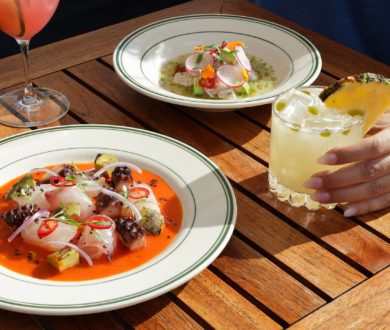
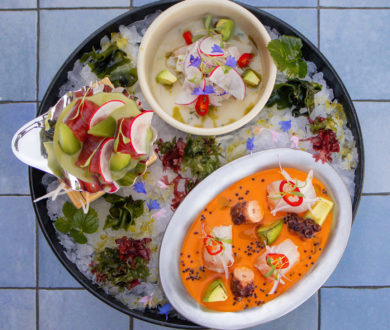
The dividends now sit on the table in Auckland, where the Umi Meshi, the Snapper and Octopus Tiradito and the Hiramasa Wasabi Ceviche all trace directly to the trip, and a six-week run of the Ceviche Trio, three styles served over ice, gave guests a survey course in the form. “You don’t have to copy something for it to be authentic,” Tabron says. “Rather than trying to recreate the dishes we ate, we’ve used them as inspiration and built them around the incredible seafood and produce we have here in New Zealand.”
Ten days as a customer, ordering unfamiliar dishes on the strength of strangers’ recommendations, also reminded her of the view from the other side of the table, and of the thousands of travellers who will form their impression of Auckland, and of New Zealand hospitality, at hers. “Great food will always bring people through the door,” she says. “But it’s how you make them feel that they’ll remember long after they’ve gone home.”