



At twenty-nine years of age, Dame Lydia Ko has lived several sporting lives. Her career has moved from Auckland’s North Shore to becoming World No. 1 at 17, breaking records as a teenager that almost made golf look indecently easy, to Olympic silver in Rio, bronze in Tokyo, and then gold in Paris, where she completed the full medal trifecta that no golfer had held before. Then came St Andrews, only weeks later, where her 2024 AIG Women’s Open victory delivered a third major title and gave the year a narrative symmetry that even sport rarely produces with such resounding glory, delivering a year of blockbuster, cinematic quality. Surely this only happens in movies? “To go from that to winning Olympic gold and the AIG Women’s Open at St Andrews within a year felt almost too good to be true,” she agrees.
Reflecting on this fairytale moment in time, Ko says: “One of the biggest things that I was most proud of at the Olympics was that I was able to overcome some of my own doubts. There was a moment in 2023 and 2024 where I really wasn’t sure if I was going to even break par and make cuts.”
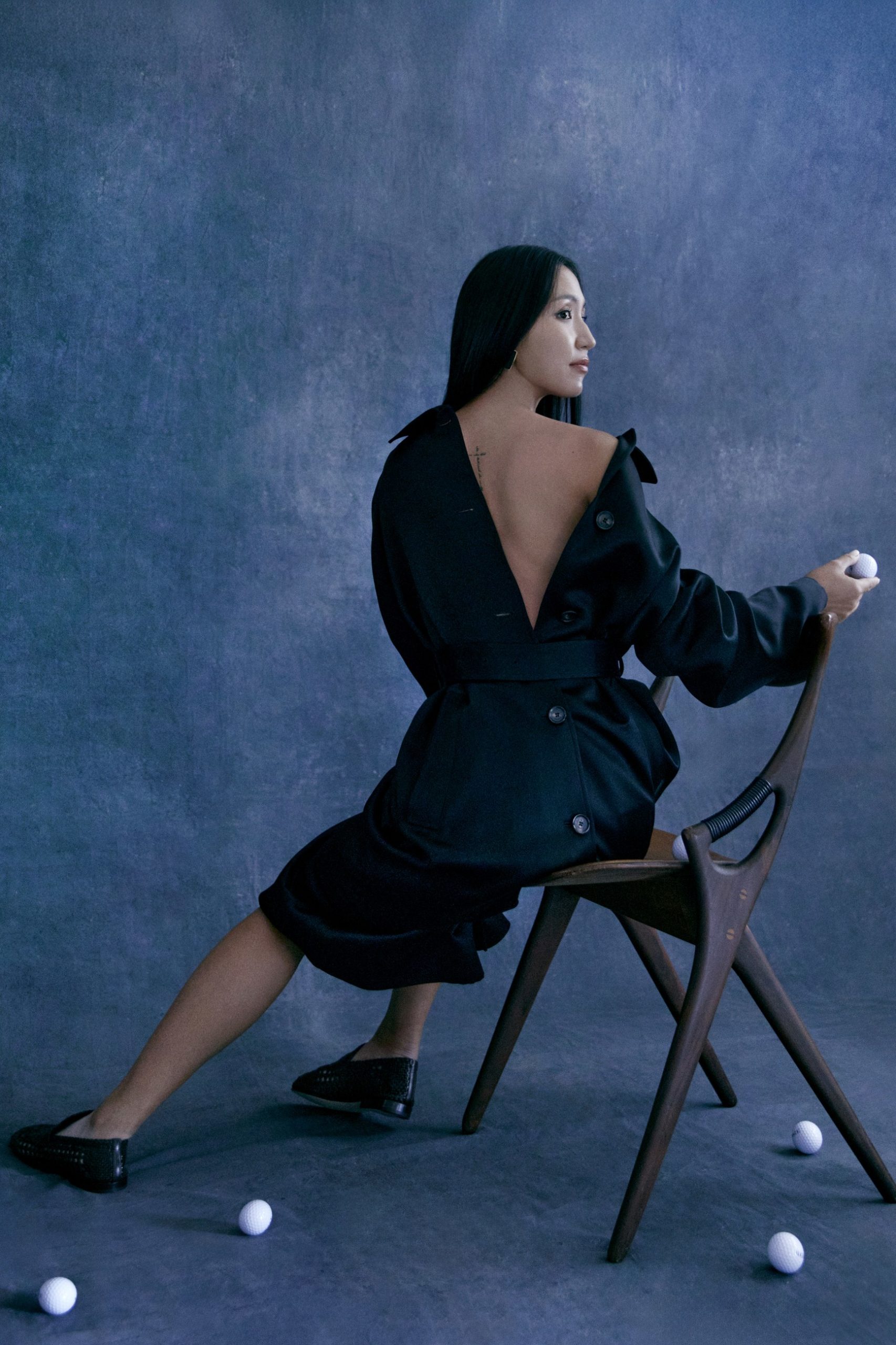
That same year, Ko was elevated to Dame Companion of the New Zealand Order of Merit, the youngest person ever appointed to the rank, an honour that only intensified the spotlight on a career clearly operating outside ordinary chronology. Ko has achieved more before 30 than most athletes would dare to map out across a lifetime, yet what makes her compelling now is not merely the scale of the achievements, but the sense that her future remains unresolved. Most athletes spend the first half of their careers trying to establish themselves and the second protecting what they have built; Ko became a phenomenon before adulthood, then had to grow into herself, while the world kept measuring her against the child who made history.
For New Zealanders, Ko’s ascent has always carried the warm unreality of a local miracle that went global before we could quite process it. Born in Seoul, raised in Auckland, and shaped through the early years at Pupuke Golf Club. Ko was propelled through the game with a fluency that, to outsiders, made it look easy. Yet Ko’s own account of those beginnings is less a polished myth than one defined by awkwardness and a child’s confrontation with a new language. “I’m very lucky to have grown up in a place like New Zealand; my formative years were there. But when I first arrived, I spoke no English,” she recalls, “I only knew four letters of the alphabet, and I knew it as ‘ABDC’, but I didn’t have them in the right order.” It is a charming admission, but beneath it sits the larger truth of an athlete whose beginnings were shaped by the necessity of having to fit in.
For New Zealanders, Ko’s ascent has carried the warm unreality of a local miracle that went global before we could process it.
It’s easy to conclude her life path was destiny, but Ko has never been interested in being anointed as a smiling prodigy. Her first phase of success was undoubtedly fast. Amateur dominance, professional records, major championships, World No. 1, and a playing technique so short and exacting, it seemed to belong less in sport and more in geometry. From the outside, it looked seamless, which is, of course, the cruellest illusion elite sport can produce. Golf, at the level Ko has played it, is repetition under pressure, patience under surveillance, and concentration stretched across hours in which a single careless moment can undo a week’s worth of discipline. In reflection, Ko says, “I learned a lot through my downfalls and through the times where I really wasn’t playing well, and I think that has made me the player I am today.”

Early greatness can often give an athlete everything and then quietly take it away, because once the world has seen a teenager perform with impossible composure, it becomes strangely reluctant to allow that young person to mature into someone more complicated. When the wins slowed, as they do for almost everyone, the scrutiny changed character. The girl who had been seen as a wonder became analysed, with questions gathering around her swing, her team, her confidence, and her place in a sport that had grown used to seeing her somewhere near the summit. For an athlete whose identity had been shaped by extraordinary youth, the difficulty was not simply losing form, but losing access to her earlier self that had made winning look natural.
Ko is unusually direct about the private thoughts behind the public persona. “When you look at my career, I’ve had some great years, some years where even I internally thought maybe I am unbeatable, where I felt like superwoman,” she says. “Then I’ve had years where I’m like, ‘Why am I playing? Do I deserve to be out here?’ I’ve personally felt embarrassed about how I played in previous seasons,” she says. Hearing her openly admit the ups and downs is an acknowledgement of the fantasy without diminishing the achievement. The gold medal in Paris was not a coronation staged for a champion who had never failed; it was won by a player who had questioned whether she still had it in her.
Hearing her openly admit the ups and downs is an acknowledgement of the fantasy without diminishing the achievement.
The golfer’s second act was not a triumphant return to her former innocence, because no adult athlete can return to being young of mind. It was instead a long-considered reconstruction, built through self-knowledge, technical refinement, emotional recalibration, and the slow restoration of trust in herself. By 2022, when Ko returned to World No. 1, won Player of the Year for a second time, and claimed her third Race to the CME Globe, the achievement mattered not because it replicated what had come before, but because it proved she could win as an adult. The player who returned was not the teenage phenomenon with a longer résumé, but a woman who had absorbed the losses, endured the speculation and still found a way to own the game. Then came 2024, Ko’s fairytale season, a culmination of events with phenomenal outcomes.

Yet Ko doesn’t refer to these enormous achievements as though a magic wand had suddenly insulated her from self-doubt; instead, she acknowledges the experience of living through it. Her most interesting comments during our interview are far removed from the glory of the trophy cabinet and more focused on the pressure, expectation and recovery, and the chasm that exists between the publicly perceived triumphs and private feelings of being alone. “I used to be deeply affected by my results, even as a teenager,” she says. “I remember coming home and having dinner, crying while eating these black bean noodles and thinking my life was over. It’s very dramatic, but at the time, it mattered to me. I wanted to play well. And at the time, I was like, well, quite frankly, I suck. And it was frustrating. I was so young. And I think all of those emotions combined, it affects you off the golf course too.”
It is an insightful detail that translates easily when thinking of an adolescent’s devastation. But when applied to an adult, it lands differently. She is trying to champion her younger self, but cannot call upon the child whose standards have outgrown her. It speaks volumes about the challenges and changes we all face, but rarely with the public scrutiny needed to recognise just how
much the mind develops as we grow into adults.
“I learned a lot through my downfalls and through the times where I really wasn’t playing
well, and I think that has made me the player I am today.”
For Ko, that emotional introspection has not disappeared; it is simply better understood. “Even now, a bad round doesn’t make dinner taste great,” she says, “but I recover much faster than I did 10 or 15 years ago.” Golfing outcomes still matter; they can still alter the flavour of a day, but they no longer own the whole house. For an athlete who has been measured since adolescence by numbers, rankings, cuts, medals, majors and milestones, that is a distinction that has been hard won. This is also where Ko’s maturity deserves its own award. Her refusal to let the scorecard become the only credible account of her life presents a level of mental evolution that very few child successes ever reach.
It is not the sort of thing sports mythology knows what to do with, because sport prefers devotion to arrive unsullied by complexity, all childhood dreams and grateful tears. Ko offers something less sentimental and more adult: the idea that a calling can be exacting, consuming, emotionally punitive and still be chosen with seriousness because the pursuit of mastery has its own gravity. She does not enjoy high-pressure situations simply because she has been in so many of them, and the pressure has never become comfortable in the way onlookers might imagine. What has changed is her capacity to understand the personal cost without being ruled by it. “The day it stops affecting me,” she says, “is probably the day I no longer care enough.”

The future, for a player still competing at this level, is not a simple matter of departure, nor does it read like a farewell waiting for the right moment. The U.S. Women’s Open and KPMG Women’s PGA Championship remain outside her major tally, and with them the possibility of a career grand slam, yet the way Ko speaks about golf now suggests she is a player less interested in proving devotion through endurance. “For a long time, saying ‘I love golf’ felt a bit false to me,” she says. “I’m not sure I love golf itself. What I really love is excelling at what I do.” It is a strikingly adult distinction, and one that great sports people rarely know how to accept.
Ko’s connection to New Zealand is both straightforward and layered, and when she speaks of it, she does so with a strong sense of national pride. Born in South Korea and raised in Auckland, she has often been seen here as both ours and global, a figure whose Korean heritage and New Zealand upbringing have never needed to compete for space in her identity. “My South Korean heritage and New Zealand upbringing are both crucial to who I am,” she says. “If you took either away, I’d be a different person, culturally and in how I think.” It is a statement for a life shaped by more than one geography.
The global sporting arena rewards spectacle, yet it is clear that Ko’s New Zealand upbringing has served as an anchor. “Growing up in a down-to-earth country where nothing felt flashy grounded me,” she says, recalling a local golf club where annual membership cost about $250, a figure she only understood differently after moving to the United States and seeing people pay four times as much for a single round. Golf was hardly the obvious choice in a country more devoted to rugby, cricket and netball, and Ko is acutely aware that, to some of her peers, a child choosing “an old person’s sport” played outside for hours may have seemed boring. Yet what came from that upbringing was not simply access to the game, but a temperament. “I do think that a lot of the way I think about things, especially on the course, is a lot of that young girl from New Zealand,” she explains, “growing up in that kind of environment, made me just a little more chill and calm and maybe in a way, naive to the rest of the world.”

For young athletes here, she also represents the possibility beyond our isolation, the useful kind of example: do the work, handle the attention, survive the dip, return with substance, and then give something back. She made excellence feel geographically possible from New Zealand, which is no small thing in a country that can still mistake distance for destiny. Ko says she would love to see more New Zealand players on the LPGA, and still hopes the New Zealand Open returns so she can “play at home again and show juniors that golf is cool.”
For now, Dame Lydia Ko’s story is incomplete, which is precisely why she is such a compelling figure. She is a champion living inside her own history rather than reflecting on it from a safe distance, still competing, still measuring herself against the game, still carrying both unresolved ambition and newly sharpened boundaries. She has given golf a childhood, an adolescence and a young adulthood of rare brilliance, and now she is negotiating what the sport will be allowed to take, and what she will keep for herself. If the teenage Ko taught New Zealand what precocity could look like, the woman she has become offers something more enduring: excellence not as a straight climb, but as a series of recalibrations, some public, some private, each demanding its own courage. She has mastered the timing of a swing, then the timing of a comeback, then the timing of a life large enough to contain golf without being consumed by it. That, finally, may be the most luxurious idea in the whole story: not winning everything, although she is extraordinarily close, but knowing the true value of the time and personal evolution of who she is today.